Lederhosen Country Trends: Austria
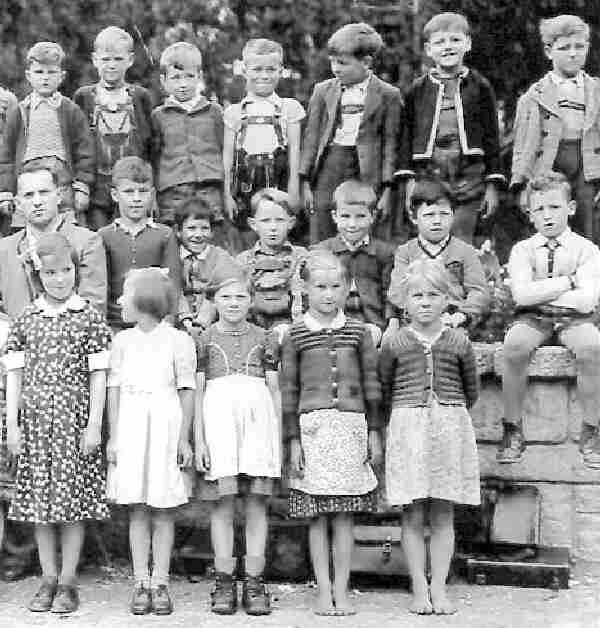
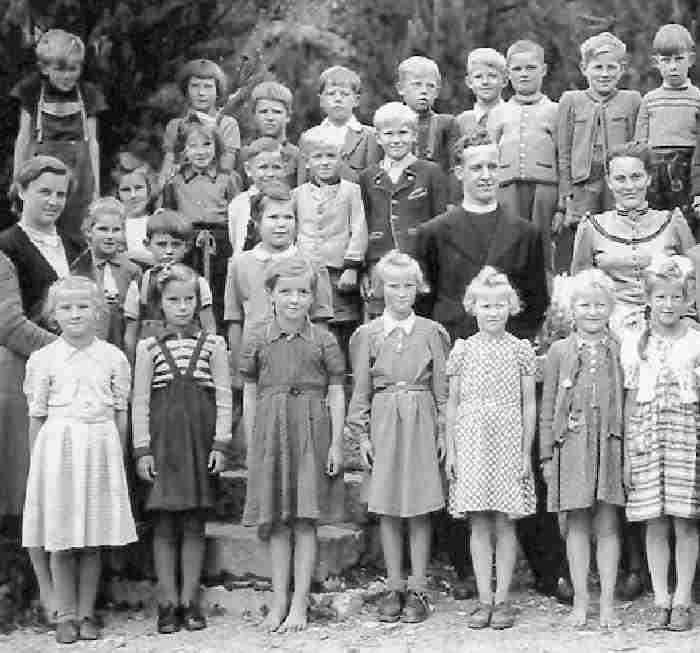
Figure 1.--Austrian boys commonly wore lederhosen to school. Many of the boys in this Austrian primary class during 1953 wear lederhosen. Several boys wear Tyrolean or other jacket so it is hard to tell if they are weaing lederhosen. To see the rest of the class, click on the image.
|
|
One popular local garment was lederhosen. Lederhosen were widely worn by Austrian boys. In fact the origins of lederhosen trace primarily from Austria and Bavaria in southern Germany bordering Austria. I have few details about lederhosen specifically in Austria yet, but the style was commonly worn in southern German (Bavaria), Austria, and Switzerland. Lederhosen in Austria were particularly popular in the inter-War years, Lederhosen were worn by Scouts and other youth groups, including the Hitler Youth, after the Anchluss in 1937. I believe they were mostly worn for outdoor activities, but also with a kind of folk jacket for dressier occasions. Boys would wear them to school with a jacket or sweater. They were worn for both dressing up, and because of their durability, for play. They continued to be widely worn in the 1940s and 50s. School photographs show many boys wearing lederhosen. They continued to be commonly worn through the 1950s. Lederhosen in Austria began declining in popularity in the 1960s as boys began wearing jeans.
Popularity
One popular local garment in Austria was Lederhosen. The popularity of Lederhosen have varied grealy over time, Lederhosen were widely worn by Austrian boys in the 19th and 20th centuries. In fact Lederhosen seem to have been more popular in Austria than any other country. They were essentially an Alpine garment which meant most of Austria, but only regions in southern Germany, mostly Bavaria. Much of our information on Lederhosen come from Germany, but this is because Germany is a much larger country with a far greater population than Austria. Actually outside of Bavaria and neighboring Alpine areas, Lederhosen were not very common in Germany. Lederhosen were also commn in the German-speaking areas of Switzerland. We have few details about lederhosen specifically in Austria yet, but hope our Austrian readers will contribute their insights. We note quite a number of boys wearing Ledehosen in Austria. The popularity of Lederhosen only began to decline in the 1960s.
Lederhosen are particularly associated with Alpine area (especially Austria and Bavaria) but also in other parts of Europe. There is a long tradition of wearing leather pants of varying styles dating back into the early Middle Ages. Some historians date leather pants back to the 6th century AD. It was in in the 16th and 17th Centuries in Bavaria and in the Alpine part of Austria that the modern lederhosen as we know it today emerged. One source suggests that the style of lederhosen evolved from French knee breeches (culottes) in the 18th Century. The French of course did not use leather, but a variety of materials, including silk and satin for the rich. It was the more practical Germans who began making long-wearing pants out of leather. The first lederhosen were kniebundlederhosen, knicker like knee breeches commonly worn in the 18th century. Lederhosen is a city in Thüringen. I'm not sure how the city got its name, but perhaps lederhosen were made there. Another factor is the developing interest in folk dress among royal courts in the Rococco period (18th centuty). This gave status to a fol style that may not have survived to the 18th century. We are not sure precisely when short pants lederhosen (kurze lederhosen) were first worn. We see portraits of Austrian royals in short pants Lederhosen in the late 19th century. We see them more after the turn of the Century. It was in the 1920s that large numbers of boys began to wear them. They were most common in Bavaria and neighboring Alpine areas, but boys in several neighboring countries also wore them.
The popularity and conventions concerning Lederhosen have varied greatly over time. And our archive of Austrian images is still quite limited. We do not yet have much information on the 19th century. We think that that at the time they were mostly worn in rural areas. Some wealthy families might have worn them as nostalgic folkwear. We note, for examole, Emperor Franz Josef and his son Rudolf wearing them for outings in the country. We gave more information on the 20th century. They seem to have still been ruralwear in the early 20th century. After World War I they seem to begin to become more popular in urban areas. Lederhosen in Austria seem particularly popular in the inter-War years. They continued to be widely worn in the 1940s and 50s. School photographs show many boys wearing lederhosen. They continued to be commonly worn through the 1950s. Lederhosen in Austria began declining in popularity in the 1960s as boys began wearing jeans. While we have quite a bit of information about German lederhosen, we have relatively information about lederhosen in Austria at this time. Clothing trends were similar in Germany and Austria. The difference concerning Lederhosen is that in Germn they were until after Wotld War II primarily a regional style, especially popular in Bavaria. In fact trends in Austria abd Bavaria were very similiar.
Age
We note quite a number of Austrian photographs with brothers wearing Lederhosen, often identical Lederhosen. Apparently the choice of Lederhosen as oposed to other kinds of pants was a family matter. Some parents appreciated them more than others. Presumably these were the more traditional families. Here age does not seem to have been a major factor. We see pre-school boys as well as teenagers wearing them. We see brothers of all ages wearing them. As far as we can tell, Lederhosen wre less common than drindels for girls. We do not always see boys dressed in Lederhosen with their sisters wearing drindels.
Lederhosen are a very flexible garment in that they were worn for an unusually wide range of activities from dressy formal occasions to casual play and even farm work. We also note many Austrian school boys wearing lederhosen. Lederhosen were worn by Scouts and other youth groups, including the Hitler Youth, after the Anchluss in 1937. I believe they were mostly worn for outdoor activities, but also with a kind of folk jacket for dressier occasions. Boys would wear them to school with a jacket or sweater. They were worn for both dressing up, and because of their durability, for play. Lederhosen conventions have varoed overtime. Into the 1950s we note boys wearing Lederhosen for farm work. Austrian boys today more commonly wear Lederhosen for dress-up occassions, often with green or other folk-styled jacket.
We see Austrian boys wearing Lederhosen with a variety of hosiery. Kneesocks seem common, but we also note ankle socks and long stockings. Rural children also went barefoot with Lederhosen. We also note the calf socks worn with folk outfits. This seems particularly common after World War II because of the poverty resulting from the economic dislocations caused by the War. We assume sme boys wear tights with Lederhosen, esecially the knickers-length Lederhosen. The type of hosiery worn with Lederhosen were affected both by chronological and social class factors as well as age. Demographic factors such as rural/urban areas were also important.
Personal Experiences
One Flenish boy visiting at the time reports that his Austrain cousins were all wearing lederhosen.
Reader Comments
A reader writes, "A real nice picture. It reminds me of my daughter wearing a dress like the ones the girls here are wearing. She was 5-6 years old. At the time it was still difficult to distinguish between Germany and Austria, but quite easy to destinguish differences between America, England, France, Italy, and other countries. But now children all seem to dress alike."
A reader writes, "Do we know anything about the origins of this interesting picture? You obviously know the date (1953). Does this mean that we also know the town in Austria? What age do you thinks the boys are? About 7? One thing that seems interesting is that one of the children is barefoot while another (the boy sitting on the wall at the right) wears a cardigan sweater, long
stockings, and hightop shoes. Is this a mixture of summer and cool weather
clothing in the same class? Or are the long stockings simply an indication of
conservatism and formality?" Unfortunately HBC has no further details about this school photograph. We try to list all avalable details in our captions. A photograph taken a few years earlier would have shown more of the children barefoot. This was largely a function of limited means. Austria like Germany was begining to make considerable economic progress by 1953, at least the western occupation zone, so most of the parents could afford shoes. We would guess that this photograph came from the Soviet occupation zone. A few years later after the Soviet withdrawl, school phhotographs show all the children wearing shoes.
HBC

Navigate the Boys' Historical Clothing Web Site casual pages:
[Return to the Main lederhosen country page]
[Return to the Main Austrian pants page]
[Return to the Main Austrian garment page]
[Camp shorts]
[Clam diggers]
[Cord shorts]
[Jeans]
[Jump suits]
[Koveralls]
[Pinafore]
[Shortalls]
[Smocks]
[Soccer shorts]
Navigate the Boys' Historical Clothing Web Site:
[Return to Main short pants page]
[Introduction]
[Activities]
[Biographies]
[Chronology]
[Clothing styles]
[Countries]
[Girls]
[Bibliographies]
[Contributions]
[FAQs]
[Glossary]
[Images]
[Links]
[Registration]
[Tools]
[Boys' Clothing Home]
Created: December 4, 2003
Last updated: 8:30 PM 6/3/2009