
|
HBC believes that in America, rompers were initially intended for boys, but came to be worn by both boys and girls. We still need to identify what the initial intentions were. We do believe, however, that it is clear that girls were wearing them in the 1910s. They appear to be the first non-skirted garments that girls commonly wore. (Amelia Bloomer had proposed bloomers in the mid-19th century, but they were for young women and never commonly worn by either girls or women.) Girls wearing rompers were especially true for the early rompers worn for play. I'm less sure about the dressier styled rompers. Probably a girl would be nore likely to wear a dress for formal occasions. HBC has, however, very little information on rompers, so this assessment is highly speculative at this stage. We hope to obtain more information from period catalogs. Much later romper suits appeared exclusively for girls. I'm not sure when this began, but I remember seeing these suits in the 1950s. It presumably occurred after romper-like bloomer suits became a standard type of girls' gym uniform. Eventually of course rompers became a style for infants, both boys and girls.
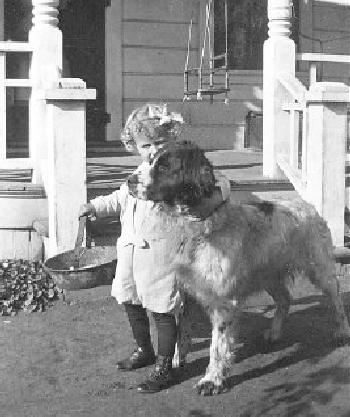
HBC believes that in America, rompers were initially intended for boys, but came to be worn by both boys and girls. We still need to identify what the initial intentions were. We do believe, however, that it is clear that girls were wearing them in the 1910s.
Assessing the gender of the children wearing rompers is often quite difficult. This is because the children that wore them were pre-school children. Thus the boys might have long hair and even hair bows--making gender identification problematic. Readers should not assume tht the children with long hair and even hair bows are girls. After World War I was more likekly the case, but before World War I it was not always the case. We see many photographs that are very difficult to assess. A good example is two unidentified children with waggons. A problem is that some of the rompers were probably hand-me-downs and there is no surity that mothers paid much attention to the intial gender when dressing the new occupant. Most useful here are catalogs and fashion magazines to establish gender styling elements used in rompers. One helpful source is the Best Spring-Summer 1912 catalog. Best was an important New York department store.
Rompers while primarily introduced for boys were the beginning of the revolution in girls clothing. Rompers appear to be the first non-skirted garments that girls commonly wore. (Amelia Bloomer had proposed bloomers in the mid-19th century, but they were for young women and never commonly worn by either girls or women.)
Girls wearing rompers wore them for play or in the case of older girls for strenuous activity. Almost all the images we have found of little girlswearing riompers are clearly plsy garments. We are less sure about the dressier styled rompers. We note some dressy rompers for boys, but we do not see this at all for girls. When girls dressed up they wore dresses. Girls wore dresses for formal occasions. Little girls wore rompers around the house for play. Older girls wore them for summer camp or gym. We do notice a few images of girls wearing rompers for outings to parks when they seem a little dressed up, but this was not very common and as far as we can tell, only for little girls. HBC has, however, very little information on rompers, so this assessment is highly speculative at this stage. We hope to obtain more information from period catalogs.
We note quite a number of younger children wearing rompers in the 1910s-20s. This may have begun in the late 1900s, but we do not have any dated images from the 1900s. As children at this age look so similar, it is very difficut to tell if the children are boys or girls. It looks to us as if boys and girls were wearing them in the 1910s, but this is very difficult to tell. If anything they seem more popular for boys than girls. Thus it is very difficult building a chronology of girls wearing rompers. One popular related style was the bloomer gymsuits for older highschool girls. These evolved into one-piece romper gym suits that were widely worn by American highschool girls for gym through the 1950s instead of the short pants gym suits that boys wore. We notice little girls wearing rompers in the early 1930s, but they appear to have been less common for boys. Rompers by the 1940s appeared to have evolved into a casual style for girls clothing. Even teenagers might wear them. Much later romper suits appeared exclusively for girls. I'm not sure when this began, but I remember seeing these suits in the 1950s. It presumably occurred after romper-like bloomer suits became a standard type of girls' gym uniform.
Rompers also became seen as an infant outfit. Both boy and girl infants were dressed in rompers. In this case both boys and girls wore them. After the infant stage, however, it was only girls that wore rompers.
By the 1910s a related outfit--bloomer pants usually with middy blouses had been adopted as a gym costume for girls in many American highschools. By the 1940s, bloomer outfits were still being used as a girls gym outfit in secondary schools. Girls' bloomer gym costumes had relatively long long legs until the 1940s. They were often worn with long black stockings. Schools did not generally consider shorts apropriate for girls until the 1940s. These bloomer costumes continued into the 1950s and 1960s with shorter legs. He styles changed from bloomers with middy blouses to one-piece romper suits. I can remember as a Virginia high school student in 1958 that the girls wore rompers rather than shorts for gym. These romper outfits were widely worn in American highschools. We do not at this time know to what extent these rompers were worn by girls as a gym outfit in other countries, if any.

Navigate the Historic Girls' Clothing Website:
[Return to the Main American girls' garment page]
[Return to the Main American rompers page]
[About Us]
[Activities]
[Biographies]
[Chronology]
[Color]
[Countries]
[Difficult images] >> combine w/ photo interprtation
[Fashion]
[Families]
[Garments]
[Gender conventions]
[Hair]
[Literature]
[Photo intrpretation]
[School]
[Sisters]
[Return to the Historical Girls Clothing Home Site]
Navigate the Historic Boys' Clothing Web chronological pages:
[The 1890s]
[The 1900s]
[The 1910s]
[The 1920s]
[The 1930s]
[The 1940s]
[The 1950s]
Navigate the Historic Boys' Clothing Web style pages:
[Return to the Main romper gender page]
[Dresses]
[Smocks]
[Bodice kilts]
[Kilts]
[Sailor suits]
[Sailor hats]
[Ring bearer/page costumes]
[Shortalls]