
Boys' Sport Uniforms: Country Trends--Germany
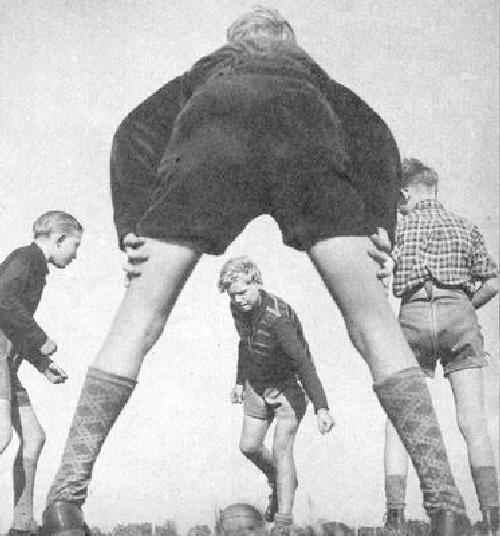
Figure 1.--We do not note boys playing sports as part of organized teams until after World War II. These boys in the 1950s are still playing pick up gmes in their reguklar clothes. Almost all sports images show German boys playing football (soccer). Notice the corduroy jacket and shorts the boy here is wearing. The outfit looks rather like the uniforms adopted at some British preparatory schools.
|
|
We have very little information on German sports until after World War II. We have no information on organized youth sports in Germany during the first half of the 20th century. We do not boys engaged in athletics, track and field. As far as we can tell this was not widely organized through the schools. German schools seem to have tsaken a very scademic approch with little emphasis on sports. We have no indication yet that there were inter-school or intra-mural sports competitions in Germany. We do believe that there were sports clubs. I'm not sure but I believe that before World War II this involved youths and not boys. Even in the 1950s, most photogrsaphs show German boys playing sports in their regular clothes rather than uniforms. In term of sports, we not many images of German boys playing football (soccer), but few playing other sports.
The history of sport in Germany is very interesting, in part because it touches upon a range of social and cultural trends as well as the major 20th century conflicts, World War II and the Cold War. Our information is still sketchy, hopefully German readers will provide more insight into German sports. German sport has been affected both by domestic and international trends. Friedrich Ludwig Jahn is considered to be the founder of gymnastics and other sports activities in Germany. He is widely known as "Turnvater Jahn". We have limited information on German sports clubs, but believe they played a najor role in German sports. German schools tended to give very limited attention to sports. Thus children and youth interested in sports joined clubs. Most of the clubs, especially before World War II wre male groups. Female sports clubs were very limited, if they existed at all. I'm not sure but I believe that before World War II this involved primarily youths and young men and not boys. Team sports as in other countries are mostly imported from Britain with of course football (soccer) becoming king. As best we can tell, however, major professional spectator sports did not develop in Germany as they did in Britain and even more so America. And opportunities for youth sports were very limited unless the famikly had the money so the child could participate in a spots club. The NAZI take over (1933) changed this somewhat because of the great emphasis on health and exercize. There were opportunities for sport, but for the most part the Hitler Youth movement emphasized other types of physical activity, but gifted children were encouraged to pursue sport. The NAZIs turned the Olympic Games into an international phenomenon as part of their effort to show case the nrew Germanhy (1936). After that Germany and Europe descended into war with little time for sport. After the War, German children for the first time had a real opportunity to enjoy sport and the German Economic Miracle. The East German Communists like the NAZIs put an enphasis on developing the capabilities of talebnted children. This included the use of drugs to enhance their performabce. The emphasis in West Germasny was to expanding sport opportunities for all children and not just the talented few.
We have very little information on German sports until after World War II. The photographic record suggests that sports were not all that important before World War II. We have no information on organized youth sports in Germany during the first half of the 20th century. Soccer was growing in importance in Europe during the early-20th century. The problem for boys (girls did not participatre in soccer at the time) is that there were few places to play in the cities. Germany had an an active youth movement, but sports seems a relatively minor part of the activity program. We do note boys engaged in athletics, track and field. After the War, sports becomes much more important. Like most European countries, that shift is concentrated in one sport--football (soccer). We note modern German boys are fixated on soccer, to the exclusion of virtually all other sports. And we note them playing soccer all year round. There are even indoor facilitues for the winter. There are other sports, but noting approching the popularity of soccer.
Schools
As far as we can tell this was not widely organized through the schools. German schools seem to have tsaken a very scademic approch with little emphasis on sports. We have no indication yet that there were inter-school or intra-mural sports competitions in Germany. A German reader tells us, "I don't know when sport activities were introduced in school curriculae. In winter,
there is traditional gymnastics in halls and swimming, in summer openair sport at fields and stadien. During the Nazi regime they were very much supported by the government, "Wehrertüchtigung" (pre-military training). In all schools and for children of all ages there were at least 2 hours of sport per week."
We have limited information on German sports clubs, but believe they played a najor role in German sports. German schools tended to give very limited attention to sports. Thus children and youth interested in sports joined clubs. Most of the clubs, especially before World War II wre male groups. Female sports clubs were very limited, if they existed at all. I'm not sure but I believe that before World War II this involved primarily youths and young men and not boys. Even in the 1950s, most photogrsaphs show German boys playing sports in their regular clothes rather than uniforms. Sports clubs seem to have have played a very important role in athlectics and sports. We have, however, very little informstion at this time. As far as we can tell it is Friedrich Ludwig Jahn who played a major role in popularizing gymnastics in Germany and it was his followers who founded the first athletic sports clubs. The importance of sports clubs seemed to have declined during the NAZI era, first because the Hitler Youth became the focus of youth activities and then because of the Wa.
Prsonal Experiences
A German reader who tells us that he was not especially sports munded, provides us some of his experiences, "In primary school, 1941-45 we had some gymnastics, running, and games. After World War II, as I entered the gymnasium (secondary school), we had first only very little sports activities, In winter there were no halls available because they were destroyed by the Allied bombing during the War or it was not possible to heat them. I can remember that in winter 1947/48 we had sport in a partially prepared hall of another school far away, two or three classes in parallel. The Turnhalle of my school was destroyed. In summer it was organised to go to a sports field doing openair activities. Then, I think it was in winter 1949/50 every second week, we went for swimming in a heated swimming hall, "Hallenschwimmbad" not too far away. Only in 1952 the Turnhalle of my school was usable again. I didn't like to do sports in school."
Sources
Jahn, Friedrich Ludwig. A Treatise on Gymnastics (1828).
HBC

Navigate the Boys' Historical Clothing Web Site:
[Return to the Main country sports page]
[Return to the Main German activity page]
[Introduction]
[Activities]
[Biographies]
[Chronology]
[Clothing styles]
[Countries]
[Bibliographies]
[Contributions]
[FAQs]
[Glossaries]
[Images]
[Links]
[Registration]
[Tools]
[Boys' Clothing Home]
Created: 10:19 PM 7/25/2004
Last updated: 6:48 PM 8/9/2011