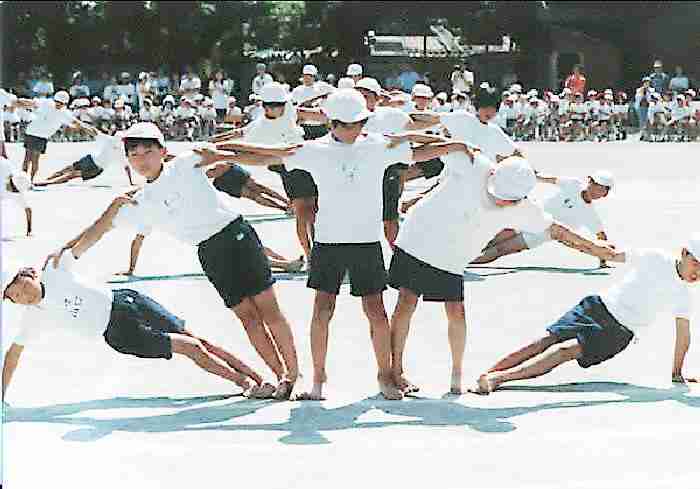
Figure 1.--These Japanese boys are participating in a school sports day with a gymnastics exhibition. |

|
Many of the Western sports are played in Japan. Sports outfits are virtually identical, primarily because the sports themselves have been imported from the West. Sports are popular in Japan. Baseball is especially popular. Japan seems to be one of the few countries where soccer is not the most popular sport. The very rigorous academic program means that Japanese children have less time for sport than Western children. They may play games in gym class, but do not have a lot of free time to actively pursue sports. And the schools do not emphasize sports like mny American schools. The primary exception to the Western sports tradition is of course sumo wrestling which is somewhere between a Western sport and a Japanese cultural ritual. There are also the martial arts, but unlike sumo, martial arts have become popular in the West. Japan of course has played a key roll in the development of the martial arts. We notice Japanese boys in a variety of athletic uniforms, but we are not always sure just what sport is involved. Hopefully our Japanese readers will povide us some insights on sports in Japan.
The Japnese do not seem as sports minded as many other countries. Surely the national sport is summo which is not etensively practiced outside of New York. Sumo is a form of we=restling. There most Japanese of all sports is of course sumo, often considered to be the national sport. There is a cultural tie in with Shinto. As in all countries a number of team sports are also popular. Perhaps the most populsar sport is baseball--an import from the United States. The game is played a little differently and Japanese fans are more sedate than American fans. Soccer is also very popular, although nothing along the lines of Europe and Latin America. We think sports like basketball and volly ball are played in schools.
Most Japanese schools rather they have regular uniforms or not seem to have gum uniforms. We see gym uniforms at both primary abd secondary schools. We think most promary schools had gym uniforms, but se are not entirely sure about this. We know little about gym in the early-20th century. We norice Japanese children doing drill in their regular school clothes. We do not have any informatin on gym and gym uniforms at this time. We are not sure if drill was considered gym or if there wre also gym clothes. After World war II we no longer see drill and we begin to see Japanese children doing gym and wearing gym uniforms.
A major event in Japan is Undo Kai or Sports Day. Many parents come to watch their children on Sports Day. It is perhaps the most intesively photographed school event in Japan. It is not a single day, but rather varies from school to school. Some schgools have more than one Undo Kat each year. The kids are of course the center if attention, but it is actually more of a community event than school event because so many parents and even neighborhood residents witghout kids attend. The school essentially closes down for the day. An effort is made to involve as many of the children as possible, The activities for the younger children focus on participation. Competition becomes more important for the older children.

Navigate the Boys' Historical Clothing Web Site:
[Return to the Main country sports uniform page]
[Return to the Main Japanese activity page]
[Introduction]
[Activities]
[Biographies]
[Chronology]
[Clothing styles]
[Countries]
[Bibliographies]
[Contributions]
[FAQs]
[Glossaries]
[Images]
[Registration]
[Tools]
[Boys' Clothing Home]