|
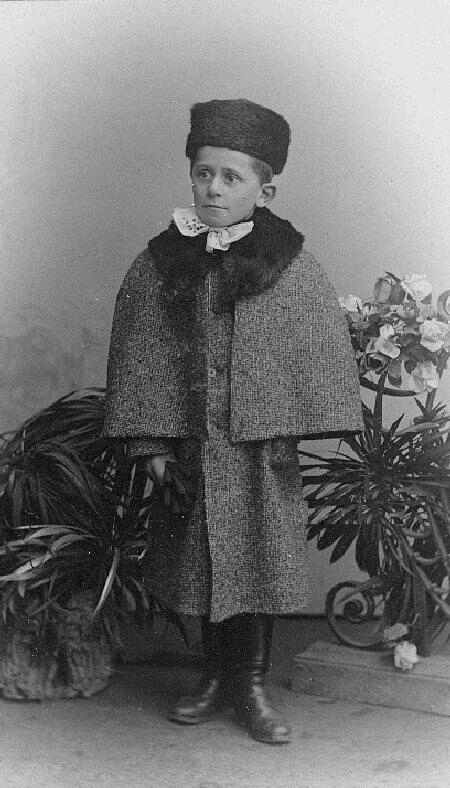
Capes were worn by adults as well as children in the 19th century. We also note them in the 20th century, but less commonly. It is a garment on which we have not yet collected much information. HBC has not yet been able to address this topic. They seem to have been in the 20th century primarily a school style. It is known that capes were also worn by French school children as late as the 1950s. We note capes offered in French catalogs. We at first thought they were a boys' garment, but they were worn by both boys and girls.
The French term for cape is "une cape" (a female word). The German term is ein Umhang (a male word). Interesting the variation in gender among different languages. This also appears to have varied from country to country. The term in Switzerland was "Pelerinen".
There are several different types of capes.
Capes were worn by children as part of dress outfits in the 19th century. HBC has been unable, however, to investigate this topic yet. We believe that it was a garment worn by children from affluent families. We have noted capes worn by both boys and girls.
We believe that in the 20th cenury that the cap became primarily a school garment for children. French children until relatively recently have worn school capes. HBC believes that they were primarily worn by children attending private boarding schools.
A few choirs also include capes as part of their choir costume. The cape is, however, is more associated with French school uniforms. HBC
knows of some Britush choirs which war capes. There probably have
some French choirs which also wear capes, but HBC can not identify
them at this time.
In addition to actual capes, we notice cape overcoats. This was a popular style for men in the late 19th century. Perhaps the most well known cape overcoat is the one worn by Sherlock Holmes. Many illustrators picture Holmes in a cape overcoat, although I am not sure if the garment was actually mentioined in the Doiyle books. Cape overcoats werecalso made for children, both boys and girls. We are not sure just how popular these cape overcoats were. We had thouht they were primarilly an upper-class style, but Sears marketed to the mass market and was very important in rural areas. We note two styles for boys advertized in the American Sears 1902 catalog. Another example is the Swiss Jelmoli 1938 catalog.
Our information as the the national trends associated with capes are fairly limited. We believe that in the 19th century that capes were worn by children in many European countries and North America, although not as common in America and England as on the Comntient. We have some details on America, but here we see mostly Sherlock Holmes type caped overcoats, not stand-alobe capes. Here there were probably social-class factors. The cape was probably a garment mostly worn by children from well-to-do countries. Capes appear to have become less common in the 20th century, especially after World War I (1914-18). We notice them only in a few countries. They were probably most common in France, primarily we think as a school garment at least by the 20th century. They seem to have also been worn by neighboring countries with a strong French fashion influence, primarily Belgium amd Switzerland. We also see them in Germany, but do not have mych information. One example is an unidentified German boy. They seem to have been more of a dress garment in Germany. We have not noted them in America during the post-World War I era. Nor have we noticed them in Britain, except in isolated circumstnces such as formal weddings or boy choirs.
We at first thought they were a boys' garment, but they were worn by both boys and girls. Here there may have been stylistic differences. Some caps were styled so they could be worn by both boys and girls.

Navigate related Boys' Historical Clothing Web Site cold weather pages pages:
[Return to the Main cold weather garment page]
[Coats]
[Knits]
[Leggings]
[Sweaters]
[Underwear]
[Long stockings]
[Other cold-weather wear]
Navigate the Boys' Historical Clothing Web Site:
[Return to the Main inclement wearher garment page]
[About Us]
[Introduction]
[Activities]
[Biographies]
[Chronology]
[Clothing styles]
[Countries]
[Theatricals]
[Topics]
[Bibliographies]
[Contributions]
[FAQs]
[Glossaries]
[Images]
[Links]
[Registration]
[Tools]
[Boys' Clothing Home]