
Native American Tribes: The Sioux
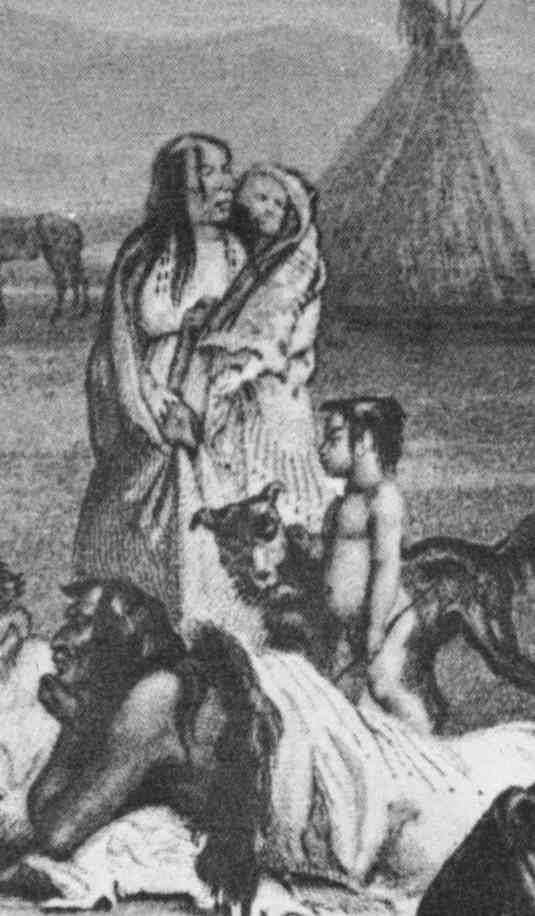
Figure 1.--Here is a detail from a a work by the the Swiss artist Karl Bodmer (1809-93) showing a Sioux camp (about 1834). Bodmer traveled in the American West and painted many Native American subjects. We can see a mother with a baby on their shoulder and another young child.
|
|
The Sioux, also called the Dakotas, were the most powerful tribe of the northern plains extending over large areas og the United Sates and Canada. Actually the Dakota were only a subtribe along with the Lakota and Nakota. There were also many bands. Sioux life came to center on the bufalo after they were able to capture and tame wild horses. The Sioux followed the migrations of the bufalo. They lived in bufalo hide teepees which were highly portable, an important atribute on the Great Plains and people whoses lives were centered in following the bufalo herds. The tepees could be easily put up and taken down. The poles needed for tepes could be pulled by the Sioux horses.
Location
The Sioux dominated the northern Plains, including the modern American states of North and South Dakota, northern Nebraska, eastern Wyoming, and southeastern Montana. This was an area bounded in the south by the Arkansas River, in the north by the western tributary of Lake Winnipeg, and in the west by the rising slopes of the Rocky Mountsins.
Origins
The Sioux were made up of four different groups linked by cultural and linguistic similarities. There was not political organization.
Winnebagoes: The Winnebagoes were found in the area between between Lake Michigan amd the Mississippi. This was the same area inhabited by the Algonquians.
Assiniboines: The Assiniboines or often referred to as the Sioux proper which is the most northerly of the Sioux tribes.
Minnetaree : The Minnetaree group was found in Minnesota.
Southern Sioux: The Southern Sioux inhabited the land between the Arkansas and Platte rivers and who hunted as far west as the Rocky Mountains.
There are subtribes of the Great Sioux Nation scattered across the Great Planes of the United States and Canada. We see different lists of these divisions, complicated by the various bands which sometimes want to be considered a subtribe. The most commonly list of subtribes include: the Dakota, Lakota, and Nakota.
The Dakota are also known as the Santee. There are four bands: Mdeakantonwon, Wahpeton, Wahpekute, and Sisseton.
The Lakota are sometimes referred to as Teon meaning prarie dwellers. There are seven bands. Oglala – They Scatter Their Own or Dust Scatters, Sicangu – or Brule: Burnt Thighs, Hunkpapa – End of the Circle, Miniconjous – Planters Beside the Stream, Sihasapa or Blackfeet (not to be confused with the Blackfoot Tribe), Itazipacola – or Sans Arcs: Without Bows; also known as Oohenupa/Two Boilings or Two Kettles.
The Nakota are sometimes reffered to as the Yankton with three bands, including the Yankton, Lower Yankton, and Upper Yankton.
Language
There are three native Sioux dialects: Dakota, Lakota, and Nakota, reflecting the important substribes.
Culture
Sioux life came to center on the bufalo after they were able to capture and tame wild horses. The Sioux followed the migrations of the bufolo. They lived in bufalo hide tepes whjich could be easily put up and taken down. The poles needed for tepes could be pulled by the Sioux horses.
History
Horse culture
The Sioux located in the interior vastness of the norther Plains were at first only indirectly affected by the comong of Europeans to the Americas. The major impact was the heards of wild horses which developed from esacped Spanish horses. They prolifferated on grasslands of the Great Planes and transformed the lives of the Plains tribes like the Sioux.
The French
The first encounter with Europeans was with French fur traders around the headwaters of the Mississippi River (1640). The Algonquiens, a neighboring tribe used the term Nadowessioux leading to the French adopting the term Sioux.
The French established a military presence in Sioux Territory (1679). Jean Duluth, a French military officer, camped near Lake St. Peter. The following year he rescued explorer Father Hennepin who the Sioux had captured. The French moved to sestanlish a degree of political control (1685). A series of wars with the French and other tribes allied with the French pushed the Sioux south. The Sioux in turn displaced other tribes that had inhabited the territory. Some sioux remjained in the north around St. Peter. Others moved into wht is now western Missouri and there joined the Southern Sioux. The tribes displaced by the Sioux did not have European allies and thus sources of modern weapons. The French and French allied tribes with French supplied weapons were a formidable military challenge, but French settlers did not follow in the wake of fur trappers and priests.
The Spanish
France transferred the Louisana Territory to the Spanish as a result of the French and Indian War in which the French also lost Canada to Britain. The northern regions of the Territory included the lands inhabited by the Sioux. The Spanish had little real control over the Terruitory other than taking possession of New Orleans. As a result of the Napoleonic Wars in Europe, the French regained control of the Territory.
The Americans
While the French and Spanish did not settle the Great Plains in any number this was to change with the Americans. The Americans with the American Revolution (1776-83) displaced the British from North America, except for Canada. The new American Republic purchased the Louisana Territory from the French (1803). The War of 1812 like the Revolutionary War divided Native American peoples. The Sioux sided with the British realizing that the Americans were a greater danger. Gradually Americans entered the area, at first trappers and prospectors, but settlers soon followed, especially in Sioux lands east of the Mississippi. These encounters lead to conflicts. The Sioux in their first treaty with the Americans ceded all land east of the Mississippi (1837). The Sioux then ceeded 35 million acres west of the Mississippi for $3 million (1851). The Sioux were marvelous horsemen and a formidable light calvalry. The development of repeating pistols and rifles doomed the Plains tribes. The Sioux were frustated by the failure of the Americans to honor the terms of these treaties. Sioux warriors strick out at some settlers. A military forced commanded by General Harney supressed the hostiles and another treaty was signed (1855). Again the Americans failed to comply with the terms of the Treaty and prospectors and settlers entered the shrinking teritory of the Sioux. The Upper Sioux tribes joined by some of the Southern Sioux launched a general rising during the Civil War (1862). As many as 1,000 settlers were killed. A military expedition subdued the hostiles tribes. About 1,000 wattiors were arrested. Eventually 39 warriors were hanged. After the Civil War, the Americans built the Trans-Continental Railroad. The once inexhaustible heards of bufalos on which Siox culture and livlihood was based were depleted by bufalo hunters to feed the railway gangs and to fill the Eastern demand for hides. The conflict revitalized the Ghost Dance, a ceremony calling back the buffalo and driving away white settlers and soldiers.
Economy
The Sioux economy became based on the bufalo for food, shelter, and clothing. Other animals like deer and fur bearing animals were also valuable. This became possible adter the Sioux acquired horses so the bufalo could be hunted on the vastness of the Great Plains.
The Bufalo carcases were used for meat. Items line bone, horn, and intestines had various uses. . Bufalo hide or leather was used for shelter (teepees) and for making clothing. After the bufalo was skinned, the hide had to be treated. First the hide had to be cleaned. Here methods variesd. The fresh hides were either staked to the ground or secured on a frame. Streached out, the leather could be prepared. The remaining flesh and fat was scraped off the inside. The fur was also scraped off the outside. This left the basic leather, but the inside had to be treated. For this the Sioux used a mixture also provided by the bufalo (fat, liver, and brains). This mixture was reeateldy rubbed into the interior side of the leather. This had to be done near water as the leather was washed in a stream.
The next step was to soften the leather which was very stiff. This was done by pulling it back and forth. This was done through a loop of rope.
Sioux clothing was primarily made from bufalo and deer leather. Furs were useful for winter wear. They had to trade for cloth fabric. Sioux clothing was varied. wore a variety of different kinds of clothing. Men and women dressed differently. The men wore shirts, leggings, breechcloths, and moccasins. The shirts and leggings were commonly made of deerskin which was more pliable than bufalo leather. Clothing was highly seasonal. The warriors when hunting byfalo during the summer commonly wore only a leather breechcloth (simple strip of leather) and moccasins. Accessories might include a knife sheath and a small bag for items like facepaint was held on from a leather belt. Women wore long leather dresses and leggings. The clothing worn for every day was very plain and utilitarian. There were clothes worn for special occassions. The Sioux had highly decorated clothing for special occasions. Decorations included beads, porcupine quills, and feathers. Styling was very ditinctive and tribes and sub-groubs could be identified by the clothing. The decorative clothing was worn fofr both war and ceremonies. The Sioux made dyes from local plants. These were used for painting designs on clothing. THese decorations might tell tribal tales. The chiefs had feather headdress, but only wore them for special occassions. Eagle feathers were the most prised. They were tipped with horsehair and fastened to a long strips of leather that trailed behinf. Women were more modest headwear. They commonly braided strips of leather into their hair. There was no destinctive clothing for children. They essentially wore the same clothing as their parents, only suitavkt scaked down. scaled down. The children until about 7 years of age went naked most of the time, especially during the warm summer seaon. This might also be the case during the Winter when they were in the teepees. Older boys wore breechcloths. In cool weather they wore shirts, leggings, and moccasins. Girls wore dresses, leggings, and moccasins. An old Sioux Woman reported that the younger children tended to view clothing as something disturbing. [Hassrick] The principal cold weather winter item was the buffalo robe. Men, women, and children wore them.
Sources
Hassrick, Royal B. The Sioux. Life and Customs of a Warrior Society (University of Oklahoma Press. 1964).
HBC

Navigate the Boys' Historical Clothing Web Site:
[About Us]
[Introduction]
[Activities]
[Art]
[Biographies]
[Chronology]
[Clothing styles]
[Countries]
[Bibliographies]
[Contributions]
[FAQs]
[Glossaries]
[Images]
[Links]
[Registration]
[Tools]
[Boys' Clothing Home]
Navigate the Boys' Historical Clothing ethnic pages:
[Return to the Main North American Native American cultural area page]
[Return to the Main North American Native American ethnic page]
[Return to the Main ethnic page]
[German]
[Greek]
[Irish]
[Scottish]
Navigate the Boys' Historical Clothing Native American pages:
[Ethnic]
[Dance]
Created: 11:19 PM 8/26/2006
Last updated: 10:16 PM 12/19/2016