
Long Stockings: Colors--Shades
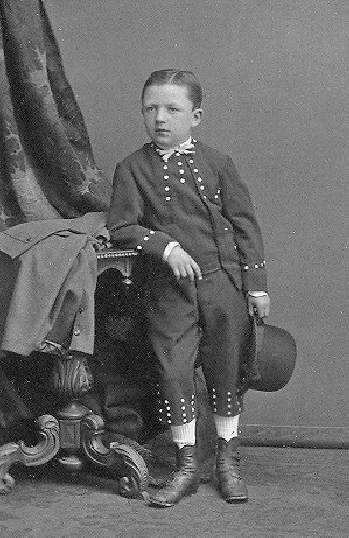
Figure 1.--Here we see a Brussles boy, probanly in the late 1860s or early 70s. Note the white or light-coloted ribbed stockings. Early knee pants tended to be longer lengths like this. Also notice the bowler (derby) hat. Click on the image for a fuller discussion.
|
|
We see many boys wearing white or light, natural colored stockings in the 18th century. White stickings were common in the early 19th century, although we are not sure about the length. We note many boys wearing white stockings when knee pants began to become popular in the mid-19th century. Gradually dark stockings became more popular. We also see stripped stockings. Most long stockings were black or dark colors in the late 19th century. We note both muted and bright colors. Children still wearing dresses before breeching might wear white stockings, but once they switched to kilt suits, they began wearing dark stockings. White stockings became more common after the turn of the century for both girls and younger boys. Dark stockings dominated for older boys. A variety of neurtral tan tones (with all sorts of names) appeared in the 1920s and became very common in the 1930s.
White stockings were common in th mid-19th century. Many portraits from the 1860s show boys wearing white or light-colored long stockings. The great majority of portraits taken during the late 19th century show boys wearing black and other darl colored long stockings. The black and white photography of the day make it difficult to destinguish between black and dark shades and to determine just what color of stockings were being worn. Thus HBC can thus not determine just how common black stockings as opposed to dark colors were. Many boys it seems to us were wearing dark shades that matched their suits rather thsan black long stockings. We note boys in the 1870s and 80s wearing dark colored long stockings that seem to match their suits. A good example is an American boy about 1890. We note in the 1890s that more boys are wearing obviously black stockings. Three are many examples archived on HBC. A good American example is the Sanborn boy about 1890. We note in the 1890s children began wearing black stockings with sharply contrasting white outfits. A factor here is that black stockings weee so common. Some mothers may have seen the ckntrast an attractive fashion. A good exampple is the Balfour boy in Canada during 1898. The Russel children. We can see the stockings worn by the boy's sister, but we would guess thjat they are also black. We have a few color imaghes that show some of the dark stockings were colored. A good example is a Austrian-German boy with blue stockings in 1911. The lighter tan tones worn after the 1920s were not worn in the late-19th century.
Older boys and men wore white stockings with knee breeches during the 18th century. Boys and girls commonly wore white stockings in the early 19th century, although I am not sure about the length. This was in part because long trousers were commonly worn by men and boys. In addition, dresses were long and long stockings of any color were not needed. Also boys and girls wore pantalettes making long stocking unnecessary. We note many boys wearing white stockings in the mid-19th century as knee pants began to become popular. Long stockings became common in the late 19th century as boys increasingly wore knee pants. Boys at the time mostly wore dark stockings, even with dressy Faintleroy suits. While long stockings were only worn by boys for a brief period begining at about the turn of the century until the early 1920s. After that period, in American they became entirely a girl's style, but have been replaced by white tights.
HBC believes that brightly colored lock stockings were not common. Some boys did wear red stockings. It is difficult, however to determine just how common these bright shades were because of the black and white photography of the 19th and early 20th centuries. Unfortunately the black and white photography of the era offers few clues. There are a variety of printed illustrations, but it is difficult to know the accuracy of the depictions. There are, however, other sources, especially catalogs. Catalog information is limited until the 1890s when the mailo order companies became important, but there are other sources of information. There are a variety of printed sources. Ms. Burnett mentions that Cedric early in Little Lord Fauntleroy wears red stockings. The Tennysons appear to have dressed their boys in tunics and, on sundays, red stockings. Mrs. Burnett in Little Lord Fauntleroy describes Cedris as wearing red stockings. I am not sure how common this was. Nor or we sure about other colors. And even the catalogs do not describe the hues involved.
Gray
HBC is a extensively photography vased site. Our assessment of fashion relies heavily, but not extirely on photography. Given the black and white photography that predominated when long stockings were worn, it is very difficult identifying grey shades. A reader writes, "Tan was so standard that it is pretty safe to assume beige or tan. In Germany, a few boys wore grey, but grey was definitely a minority color. We have a few color pictures that show tan, whereas grey seems to be uncommon. Grey, by the way, was not an option in the Sears and Wards catalogues of the 1920s, 30s, and 40s." Our information is still limited. The vintage long stockings we have found are these neutral tan/beige shades. We think our reader is ccorrect, at least as far as America and Canada are concerned. We are less sure about Germany and Eastern Europe. We have seen some color images of grey long stockings in Germany and Russia. Neutral tan/beige stockings may have been common on the Contimnent, but we can not yet confirm that with other information like catalogs, color photography, vintage clothing, etc.
We see children in the mid-19th century wearing white stickings. Boys rarely wore anything but dark colored long stockings in the late 19th century. It was not until after the mid-1920s that lighter colored long stockings became common. A variety of neutralcolors like light tan, brown, brownstone, ect. These are notably colors that approximate or at least are closer to flesh tones than the black or dark colors worn earlier. We are not sure why these colors became so popular so quickly after World War I. Notably these tones appear at the same time that boys began wearing short pants with long stockings. We think that earlier that flesh tine stockings would have been seen as inmodest. White and black colored stockings were also available in the 1930s, 40s, and 50s, but it was the neutral, tan, and light browm shades that wre the most popular. And they seem to have appeared in many different countries at about the same time, although they persisted to different dates. The tan stockings were the ones commonly worn for every day activities, such as school or for play on a cool day. Dark and white stockings became seen as dressy wear. The neutral shades might be wiorn with suits, but for really formal events, mothers usually chose either black or brown. Some mothers might hve chosen these neutral shades to go with brown outfits, but as they were essentially flesh tomes, they could be worn with outfits of any color.
Assessing the colors of long stockings is very difficult. Our HBC website depends heavily on photography. We have a varietyb of sources, but photography is by far the most important. For America we have extensive catalog information available in such detail for other countries. The reliance on photography means that almost all the photographic record is composed of black and white images because color photograph did not become common until after long stockings had gone out of style. We can of course discern light and dark stockings. The dark stockings during the late-19th and early-20th century were commonly black. There were arange of other dark colors such as blue shades, brown shades, burgandy, red, and other that show up as dark. It is impossible to determine the precide shade. There were also light shades. White is often deiscernable, but we cannot determine what the color was from the photiograph. Other sources suggest that these light shades were various light browns such as tan and beige. Other American sources such as catalogs, illustrations, limited color photography, and vintage clothing suggest that the light-brown shades were the most common. A Russian reader informs us that the same was the case in Russia during the Soviet era. We are less sure about Germany. Our initial impression is that the light shades were mostly neutral, light-brown shades. We know, however, there were also grey shades. One reader tells us thst the grey stockings were mostly darker shades, but we can not yet conform that. We note Russian children wearing lonf stockings done in light grey shades.
Vintage Tan Long Stoclings
Long stockings were worn before color ohotography was available or very common because when it first appeared about the time of World war II, it was first very expensive. Thus the photogrraphic record is almost entirely black-and-white. Thus vintage clothing are useful way of seeing the actual shades in which long stockings were made.
HBC

Related Pages:
[Return to the Main long stocking page]
[Knee socks]
[White knee socks]
[Striped socks]
[White stockings]
[Tights]
Navigate the Historic Boys' Clothing Web Site:
[Introduction]
[Activities]
[Biographies]
[Chronology]
[Clothing styles]
[Countries]
[Bibliographies]
[Contributions]
[FAQs]
[Glossaries]
[Images]
[Registration]
[Tools]
[Boys' Clothing Home]
Created: 8:48 PM 12/11/2006
Last updated: 12:53 AM 10/14/2010