|
The beret was commonly perceived as a French fashion and thus not widely worn by English boys. While the beret was not widely popular in England, some wealthy families thought it fashionable to adopt stylish French fashions. These families were likely to adopt French
childrens clothing, including berets and smocks. One such family was the Llewllyn-Davies family of Peter Pan fame. Few English boys, however, would wear berets after leaving for boarding school, usually at age 8 years. The English appear to have begun the military fashion of wearing berets. The beret gained considerable fame during World War II, especially after Monty adopted it. The English Boy Scouts adopted it as part of their uniform in 1969.
The beret was commonly perceived as a French fashion and thus not widely worn by English boys. While the beret was not widely popular in England, some wealthy families thought it fashionable to adopt stylish French fashions. These families were likely to adopt French childrens clothing, including berets and smocks. One such family was the Llewllyn-Davies family of Peter Pan fame. Actually we see more American and German noys than English boys wearing berets.
As far as we can tell, the beret was not prevalent among English boys. Our English archive i not massive, but it is large enough to conclude that berets were not very common in Enfland, at least for boys. The one exception was the couts beginning in the 1960s. Few English boys, however, would wear berets after leaving for boarding school, usually at age 8 years.
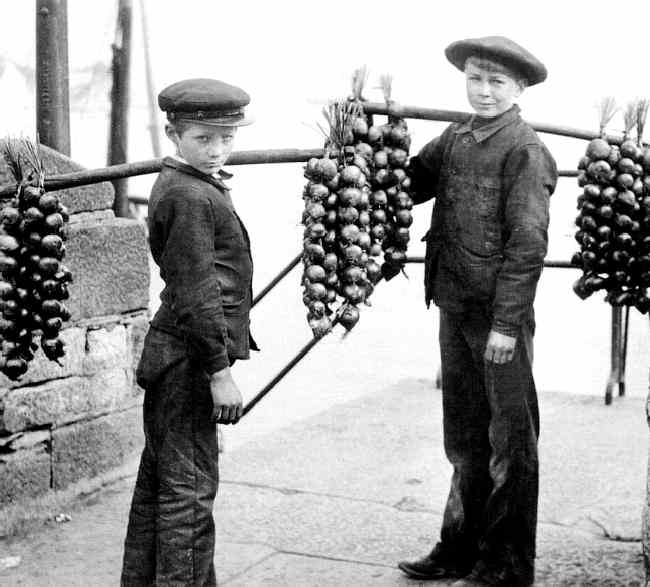
We have found so few images of English boys wearing berets that we are unable to construct a meaningful chronology. We note the Llewllyn-Davies boys wearing berets in the 1890s. This is the first example we have found far. But this may be n exception more related to the mother's artistic tastes. And here we see an onion seller wearing a beret in Devon during the 1900s. He may have Breton connections. We note one unidentified boy we think in the 1930s. We think he is Ebglish, although cab not be sure. The snapshot was found in Lancshore with many many English photigraphs. Just why he is wearing a beret we are not sure. And then there are the Scouts who adopted the beret as part of the unifirm in the 1960s. This is the only large number of English boys we have found wearing berets.
The English appear to have begun the military fashion of wearing berets. The British Tank Corps adopted the black basque beret in, I
believe, the 1930s. They appear to have been the first non-French unit to wear the beret. The reason was entirely pragmatic: they were looking for a cap that would help to keep grease out of the hair. Later, Montgomery popularised their black beret and other forces such as the early SAS, the partatroopers ("paras") and the commandoes adopted it in their own colours. Ironically, Dorman-Smith, Auchinlek's brilliant staff officer, was the one credited with coming up with the idea. Dorman-Smith and Auchinlek were sent on their way when Montgromery and Alexander came in at the behest of Churchill. Smith's career was over. The irony is that there would have been no 2nd Alamein or Viscount Montgomery of Alamein had not Smith and
Auchinlek stopped the German advance at 1st Alamein. And Montgomery's 'brilliant' plan for Alamein looks suspiciously like Smith's drawn up before he and the Auk were sent on their way. Montly of course appeared it also sorts of military headwear. It is the beret, however, that he is most associated with. The beret as a rsesult gained considerable fame during World War II.
The English Boy Scouts adopted the beret part of their uniform in 1969. The English were one of many natiional Scout associations that adooted the beret after World War II. Some military formtions wirevbereys and therefore had a popular look. Before the War, HBC has only note French Scouts wearing berets.
While we have found very few images of English boys wearing berets. We see many Engkish girls wearing bertets during the inter-War era (1920s-30s). Hair bows often quite large dominated girl's dress in the the 1910s, but this changed in the 1920s and we begin to see large numbers of berets. This is the same period when berets wre very popular in America and as in England, mostly by the girls. American girls called them 'tams'--derived from tam o'shanter. That if course was a British term, so this may have also been used in Britain. They were so popular with gurls that some schools adopted them as past of the school uniform. We see far fewer after World War II in the 1940s and 50s. The Beret wreakind of every day wear. When girls dressed up they were more likely to wear hats. We see girls of all ages wearing berets, kncluding teenagers. We are not sure about colors, athough we do note a number of white berets. There are various ways of wearing berets. We mostkly see girls pukking thenm down toward the wears. That may be because they seem to have been seen as a cold wethrer garment to keep warm. We see them being less commonly worn durung the summer.
HBC has never noted English boys wearing berets as part of their school uniforms. English schoo girls, however, have worn berets, HBC has noted girls at some schools wearing berets in the 1980s, the fashion, however, probably began earlier. We do not know just when. Perhaps our English reades will know more.
The photograph here shows two onion sellers in Plymouth, Deveon during 1907. The boy on the right appears to be aiming for a Breton look with a natty beret. I am not sure why he is wearing a beret, but there used to be a tradition of itinerant French onion sellers in Britain. Presumably this was most common along the southern Channel coast. Perhaps this was his or his parrent's idea of giving the onions a little international flavor--a little 1900s marketing. His little brother seems less interested in the Breton look.

Navigate the Boys' Historical Clothing Web Site:
[Return to the Main beret country page]
[Return to the Main English headwear page]
[Introduction]
[Activities]
[Biographies]
[Chronology]
[Clothing styles]
[Countries]
[Topics]
[Bibliographies]
[Contributions]
[FAQs]
[Glossaries]
[Images]
[Links]
[Registration]
[Tools]
[Boys' Clothing Home]