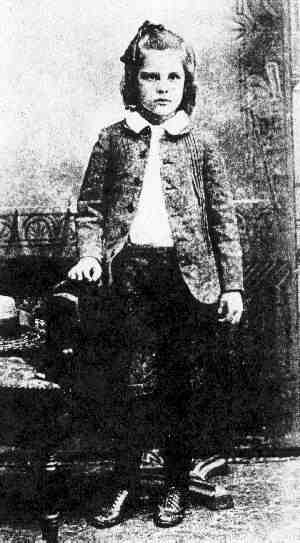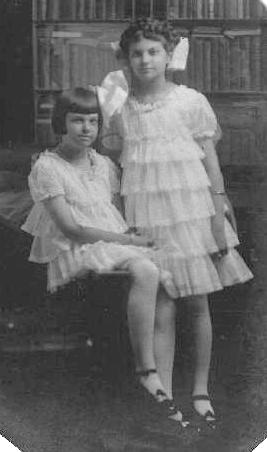
Figure 1.--Hair bows are of course associated with girls. They were particularly popular in the 1890s and reached enormous sizes. Hair bows were still very common in the 1910s. |

|
It is widely known that boys in the late 19th Century and early 20th Century wore long ringlet curls. Less commonly known is that some doting mothers added bows to their son's curls. Hair bows of course are usually considered adornments for girls. Curls were of great importance to a girl at the turn of the century, but so were the accompanying hair bows. The hair bow became an indespensable part of any girls' wardrobe in the late 19th and early 20th century. Hair bows were not common in the early 19th Century when long hair was not so common. By the 1870s as long hair became increasingly common, hairbows were worn more and more. By the 1890s girls of all ages were wearing them. Fashionable hair bows for girls by the 1890s had become large and floppy, but became somewhat smaller by the 1900s. Hairs bows for boys echoched these trends, although most mothers chose smaller, more modest bows for their son's hair styling.
The first hair bows worn by boys was in the 18th century. It wasn's a child's style, but an adult style. Latter when boys began to wear hair bows in the 19th century, it was a childs' style. Full chronolgical information is not yet available on the wearing of hair bows. We know that both boys and girls wore hair bows in the late-19th century and early 20th century. We have been able to find little information on this, but it is easily recognizable in the photographic record. Girls were particularly apt to wear hair bows, in some cases quite large ones. But boys also wore hair bows and not just infants. We also do not at his time have any information on the manufacture of ribbons and changes over time. I think silk and satin were the main materials, and at this time am unsure about chronological availability of these materials in ribbons. I don't think that they were commonly available until cloth was commerically manufactured. Another topic that needs to be pursued.
|
Hairs bows are today primarily associated with girls. In fact girls did very commonly wear hair bows, much more commonly than boys. And quite old girls wore hair boys. While boys wore hair bows less commonly, in fact we find many images of boys wearing hair bows. It was for girls that it was most important to keep up with the latest style for hair bows. The memoirs of many well known women touch upon the hair bows they wore as children. The famous 1920s film star Gloria Swanson, for example, commented on the hair bows she wore. Her mother and grand mother appear to have believed that young Gloria had large ears. Althogh noted at birth, the impact of her large ears was not felt until she was old enough to have her hair styled. Some boys have also had their hair done up in bows. The boys involved were the boys who wore dresses in the late 19th century. In all cases that I know of they were boys still in dresses that had not yet had their hair cut to short boyish length. I have only limited written information on this style. Much of what I know comes from paintings or photographic images.
The modern reader proably is somewhat taken back with the idea of a boy wearing long hair and bows. One observer cautions that it is probably wrong to make to big a thing out of boys wearing hair bows. Such matters are culturally based. What might be entirely common and accepted might be thought of as rediculous or even scandelous in another country or in a different time. American boys growing up during the 1950s-60s in "T"shirts, jeans, and Keds would have been aghast if they moved to England and had to wear school caps, blazers, short pants, kneesocks, and sandals. Of course English parents and school masters would have been agast at the American outfits. Likewise, long hair and bows seems to have been quite accepted by French boys and their parents. Jean Renoir mentions his long hair several times in his biography of his father, but never once mentions hair bows, which we know he worn as a boy. Obviously, this was the fashion. I think the problem with curls is that they were associated, as were dresses, with being a baby. In Simone Behavior book (sp.. and I don't remember the title) she remarks (about French boys) that they often cried when they had to wear pants and have their curls cut, because they would now be expected to act like boys and no longer receive the attention and adoration of little children and girls. Girls and babies were sheltered. Young boys of 5 - 7 were thrown out into the cold cruel world of men.
|
There were many types of hair bows. We see bows tied in different styles. The bows used by girls were generally were the standard bow with a tight center and wings that expand out. There were variations, but we see this style in most portraits. The size was especially varied. Boys hair bows were less varied and more modest. There were no rules about such matters. I was essentially up to the individual mother. They were generally much smaller than the ones worn by girls. And thus it is difficult to see precisely how the bow was tied in many available portraits. They do not seem for the most part to be tied like the girls' bow. They seem to be just amall little bir of ribbon tied in a simple loop.
The color of hair bows is very difficult to determine. We can see white bows which were popular. Biu even white-looking bows could be pale colors like light-blue. Other than that, the colors are very difficult to assess in the black-and-white photography of the day.
Hairbows were widely worn in Europe and America. They were especially popular during the late-19th century and early 20th century in these countries. Most of our information about hair bows comes from the United States. We think that hair bows were especially popular in America, but the prevalence is magnified in the phoographic record by the huge American photographic record. The American photographic industry was larger than that of all of Europe. And this is further magnified by the fact that HNC is an American site and we thus have primary access to American sources. Thus while we have primrily found american images, we also note hair bows in European countries. We think that they were especially common in England and France, but this is just our preliminary assessment. An important issue to remeber is that there may be gender differences as regards the relative prevalence of hair bows in different countries..
HBC had assumed that hair bows were primarily a formal style, added to a boy's hair on special occasions such a portrait or event like a wedding or party. HBC believes this may well have been the general pattern. It is clear, however, that this was not always the case. Such conventions appear to have varied from familt to family. There are instances of boys wearing hairbows in play clothes rather than the child's best suits. Such images are not as common as thevdressier images--but they do exist and suggest that boys may have worn hairbows every day.
Some of the hairbow images are very difficult to interpret. The hairbows and long hair make the children look much like girl to us. Often the
clothing or props are anbiguous. Have a look at these difficult images and let me know if you have any insights.
Nadar, Nigel Gosling, Alfred A Knope, New York, 1976.
Renoir, Harry M. Abrams, Inc, P ublishers, New York, 1985.
Renoir, Elizabeth Elias Kaufman, Ottenheimer Publishers, Inc, USA, 1980.
Dag Hammarskjold, Nicholas Gillett, Heron Books, 1970.

Navigate related Boys' Historical Clothing Web Site pages:
[Return to the Main bow page]
[Return to the Main hair page]
[Return to the Main hair implement and decoration page]
[Collar bows]
[Dresses]
[Kilt suits]
[Kilts]
[Fauntleroy suits]
[Fauntleroy dresses]
[Sailor dresses]
[Pinafores]
[Smocks]
Navigate the Boys' Historical Clothing Web Site:
[Introduction]
[Activities]
[Biographies]
[Chronology]
[Clothing styles]
[Countries]
[Topics]
[Bibliographies]
[Contributions]
[FAQs]
[Glossaries]
[Images]
[Links]
[Registration]
[Tools]
[Boys' Clothing Home]