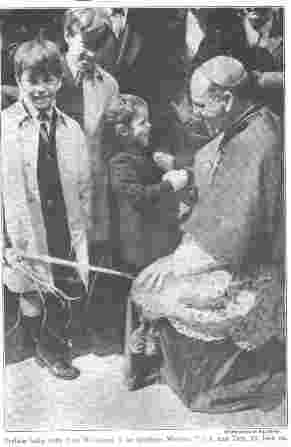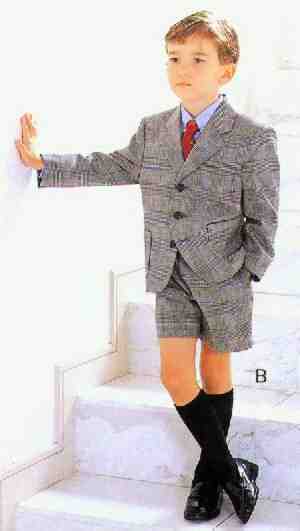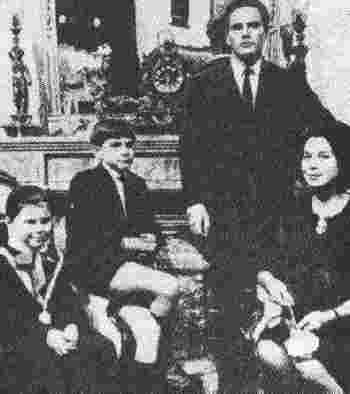
Figure 1.--American boys from affluent families in the 1950s might wear conservative black or navy blue short pants suits with matching dark knee socks. The 50s was the last decade in which short pants suits were very common. |

|
Most other kinds of pants evolved at a time when they were commonly worn as part of suits. Short pants were also worn with suits, but at the time they developed boys did not wear suits as commonly as earlier. Thus short pants often were not worn as suit pants. The fashion of short pants spread to the United States in the 1910s. Slowly the already existing knee pants evolved into short pants. Along with knickers, the new style by the 1920s had generally replaced the knee pants which had dominated boys' fashions since the 1870s. The dominant fashion was knicker suits. Short pnts and short panrs suits were never as popula in America as in Europe. Even BoyvScouts did not commonly wear shorts. Short pants might be worn by younger boys, There was also a social-class factor. Boys from affluent families were also more likely to wear short pants and short pants suits. Many well to do Americans had always looked to England, at least for men and boys'fashions much to the chagrin of American boys. Despite the English trends, however, knicker suits were more common in America--especially for older boys. After knickers went out if style in the early-40s, we only see long pants and short pants suits. Long pants began to become more common in the 1930s. And this trend continued in the era after World War II (1939-45) when short pants began to be seen as a casual clothing garment. Short pants suits were common before the War but became much less common after the war, especially by the 1960s. Long pants suits were by far the most common trousers with suits after World War II. nd gradually the short pants suits began going out of style. Except for very young boys, we only see short pants suits being worn into the 1960s.
Short pants first appeared in America during the 1900s along with the new Boy Scout movement. They did not become nearly as popular as in Europe. American boys fashions generally shifted from kneepants suits to knicker suits durng the 1900s. We see some boys wearing kjnickers with knee socks in ther 1910s, but we do not notice short pasnts suits. Some boys wore short panrs suits in the 1920s, although they were generally worn by younger boys or boys from more affluent families, often with English or European connections. They become more populsar in the 1930s, but not as popular as knicker suits. Knicker suits disappeared in the 1940s. Short pants suits were worn by American boys through the 1960s, but they were never as popular as knicker or latter long pants suits.
American boys after the First World war did not wear short pants suits as commonly as European boys. For some reason, many American mothers did not seem to think it was healthy to dress boys in short pants leaving their knees bare during the winter. This did not seem to phase British and European mothers. Boys there, especially in Britain, through the 1960s commonly wore shorts even during the cold winter months. Climate does seem to have been a factor in America and Canada, perhaps explaining why knickers wre so much more opular in America than Britain and other European countries. Certainly the winters were more severe in America than was the case in Western Europe.
|
HBC has only limited information on regional differences at this time. We do believe that short pants suits in America were also more common in the South with its warmer climate. Short pants suits may have been less regionally influenced. Age and social-class factors seem more important. This is, however, more complicated than it may seem. Short pants suits seem most common with affluent families, especially those with a European, especially British outlook. And well-to-do Americans with a British outlook were in the mid-20th century concentrated in the Northeast, especially in the urban areas running from Washibngton, D.C. through New York to Boston. Many of the country's best known private schools are also located in this area. We also see boys from well-to-do families in other areas wearing short pants suits, but not as commonly. Mothers seem to have generally preferred the shorts while the boys by the time they were 7 or 8 years old wanted longs, escpecially by the mid-1950s. This gradually age became an increasingly important factor. Long discussions ensued between moms and their sons on the subject. Boys did not wear short pants suits to school. We can see that in school portraits. There was even a Beaver episode illustrating this. Boys at private schools, however, might wear short pants suits, amd many of these schools were located in the northeast. This appears to have occurred irrespective of region and climate. The American media may have been a factor here. Beginning in the 1930s, Hollywood began to often costume brats, who were often scripted in wealthy families, as they appeared in movies in short pants suits.
Generally well to do American families, many with English family or social conections, however, did often opt for short pants suits. This English influence continued into the 1960s. Knicker suits were more common in America. They were usually worn with knee length socks pulled up under the knicker pants. Apparently American mothers felt knickers suitable for both summer and winter. Short pants suits were more common among upper middle class and wealthy families. American boys from wealthier families generally wore short pants suits longer. This was due to several reasons. One they went to private schools which might have short pants uniforms. Two they went to parties and other social events where their friends might also still be in shorts. Three many established families had ties to England and were strongly influenced by English fashions which still dictated short pants for boys. Custom varied widely in America. The upper-class look was a solid colored suit, often black or dark blue. Younger boys might wear such short opants suits with British looking peaked caps. Such suits were becomin less common by the 1950s, although younger boys still wore them in the early 1960s.
In some areas boys wore shorts for play. This became much more common in the 1960s, especially among older boys. In other areas boys wanted long pants, especially jeans, even for play. One common thread, however, was the desire of boys for long pants suits for dress occasions.
|
One new style which appeared in America during the late 1920s was Eton suits for younger boys. Norfolk suits were popular in the 1920s. Some boys wore double breasted suits, but shorts were less common with this style. Many of the short pants suit worn in the 1950s were black or navy suits. I am not sure why these dark suits became so popular. Interestingly while grey was a popular color for boys' suits in England, English boys rarely wore black suits. I am not sure why this difference developed.
it is striking how patterned different pieces of the boys' apparel are in the 1920s. Kneesocks, coats, short trousers, ties all had a pattern, or design, no matter how subtle. Most short pants suits in America during the 1920s were patterned suits. Patterned short pants suits were still quite common in the 1940s. Beginning in the 1950s solid colored suits become much more common. In America boys commonly wore navy blue or black suits while grey was more common in Britain.
American boys commonly wore short pants suits with knee socks in the 1920s and early-30s, but short socks began to become more populkar in the late-30s. We see the sne trends with knickers as well. Short socks seem dominant by the the 1940s and 50s. During this period, knee socks became increasingly identified as girl's socks as fewer and fewer boys wore them. Almost the only times they were wore were with suits and even with suits short socks were more common. Short pants suits declined in popularity in the 1960s, but for some reason, some of the boys that did wear them began doing so with them with knee socks. This was especially the case with well-to-do famlies. American boys generally wore short pants suits with black or brown lace up shoes. Younger boys might wear saddle shoes, but mosly with sports jackers and shorts, not suits.
Shortpants suits were not as popular in America as in Europe. Some American parents, however, believed like European parents that boys should wear short pants, especially for dress occassions. Some parents liked to dress all of the boys in identical suits. Sometimes the older brother might be allowed to war long pants. But parents had many different ideas about the age at which the older brother could wear long pants. Boys in the southern states might wear short pants longer than boys in the north or west. Some parents in the 1920s and 30s insisted on boys up to 13 or 14cwearing shorts. Other parents allowed the older brother to switch to long pants at an incfreasingly tyoung age, especially by the 1960s.
Shrt pants suits were never very popular with American boys. They were mostly worn by younger boys. They appear to have been most common in larger cities, like New York or Boston, definitely East Coast. They appear to have been somewhat more common in the South. They also appear to have reflected an affluent family's choice of clothes. The boys involved by the 1950s mightvwear jeans for play, but still have a short pants suit for every day wear, only special occasions. These shorts in the 1950s and 60s were addressed in television and other media which stressed how much American boys disliked wearing them.
New style: The 1920s
Boyhood memories: The 1930s
Affluent boy: Late 1940s/early 50s
The Party The 1950s
Tristain: Late 1950s-early 60s
America and Europe: The 1960s
School and home: The 1960s
Traveling in Europe: The 1960s
The beautiful people: The 1960s
British debate: The 1960s

Navigate the Boys' Historical Clothing Web Site:
[Return to the Main short pants page suit]
[Return to the Main national short pants page suit]
[Introduction]
[Activities]
[Bibliographies]
[Biographies]
[Chronology]
[Clothing styles]
[Countries]
[Essay]
[Contributions]
[FAQs]
[Glossaries]
[Images]
[Links]
[Registration]
[Boys' Clothing Home]