|
Boys throught Europe, Britain, and America in the 19th century wore dresses when young. In most cases these were pre-school ages boys. In other instances we note school-age boys still wearing dresses. Presumably these were boys being schooled at home. There were various differences from country to country. Not only did dress styles vary, but the fasdhion of outfitting boys in dresses varied from country to country over time. We notice differences in the pervasiness of this convetion, the style of dresses, the age of the boys, and various other factors. Details on these differences are not yet available, but HBC has begun to assess this question.
The United States dominates the North American market, but Canada is of some interest. While we have only limited information on the early-19th century, the advent of photography at mid-century meant that there is an enormous photographic record for the late-19th century. This makes it possible to follow clothing/fashion trends in some detail. And the trend we detect is fewer boys wearing dresses in America. We do not have a large enough Canadian archive to make any definative statement on Canada, but the same trend seems to be the case there as well. Canadian trends were influebced by American trends, but not totally determined. One complication here is that many boys even not wearing dresses were not breeched. For centuries there was only one garment for women and younger boys--the dress or to a lesser extentb skirts. Then a new garment appeared after mid-19th century, driven by the Beritsh Royal Family introducung the kilt as a boy's garment. American boys of course did not begin weraring Scottish kilts, but many boys began wearing kilt suits. Another development was the appearance of Fauntleroy suits (1885). Many fashion-concious mothers decided to breech their sons earlier because they so they coul sport Fauntleroy suits. Many mothers were enamored with the Fauntleroy Craze which swept the nation. As a result, the centuries old convention of younger boys wearing dresses by the turn-of-the 20th century was going out of style even with fashion-concious mothers.
Asia is comlicated because Western fashion had little impact on Asia until the 20th century, by whuch time the cinvention of younger boys wearing dresses had largely passed. Thus Asian fashion do not really matter in this particular topic.
HBC has virtually no information on Chinese boys' clothes. We do note a 1999 report that parents in one Chinese village dresses many boys like girls. While we have noted some similar accounts from other countries, this is the only current example of this that we know bout. The report indicates, "The apparent number of girls receiving an education in Caohai exceeds the actual count. Among the little girls I
thought were attending the local primary school there turned out to be, to my not inconsiderable surprise, a sizable corps of little boys dressed as girls. I soon learned that some boys, even to the age of six or seven, are "disguised" as girls, with pigtails and pink ribbons, because male children are thought to be more prone to illness and death than are female children. Dressing a boy as a girl may fool the bearers of disease and death. My new rule of thumb is that the more girlish a child's attire, the more likely that under the skirts will be a boy. [Melinda Herrold, The cranes of Caohai and other incidents of fieldwork in southwestern China, Geographical Review, July 1, 1999]
The topic here is the fashion convention of younger biys wearing dresses. This is a comvention that primasry developed in Area anbd was widely observed for centuries. Different countries had varied trends, but it was eidely observed throughout the region.
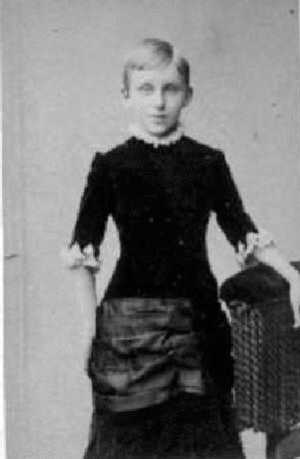
Younger Austrian boys like other European boys wore dresses. We so not yet have much information on this convention in Austria or the styles boys wore over time. Our Austrian archive is still very limited at this time. The boy here is apparently Pejn H. from Graz in 1891. He wears a pleated dress. Note that he wears knee pants with the dress. This was more common with tunic suits.
We note younger Croatian boys wearing dresses in the 19th century. This was a commonn practice in Europe. We do not know how common it was Croatia or how it may have compared to other countries. We suspect that in the major cities the fashion was similar to that in other provincial cities in the Austro-Hungarian Empire. We do not have a sufficient archive of ikjages to make real assessment at this time.
At this time HBC has little information on England beyond information about the Brotish royal family. A few available images does show that some boys continued to wear dresses beyond the normal breeching age of 4 to 6 years of age. It is likely that fewer older boys wore dresses than in the rest of Europe. This is because it was very common in the 19th century, especially by the late 19th century, for British boys from affluent families to be sent to boarding school, often beginning at about 8 years of age. Thus there breeching would have to take place a least by this age. While younger boys of all social and economic classes wore dresses in the 19th century, it was primarily the boys from affluent families that wore them beyond the normal age of breeching.
Some limited information suggests that it was more common for French boys to wear dresses than boys in many European countries. French boys also seemed to have worn dresses to an older age than boys elsewhere in Europe. As in other European countries, social class and wealth appears to have been a factor here. I am unsure if the more common use of smocks in France was a factor affecting breeching and dresses. HBC has acquired a variety of images, but very little written information to help interpre the images.
Young German boys like boys in other European countries wore dresses. In the early and mid-19th century, these dresses were just like the ones their sister's wore. HBC has only limited information pn this fashion in Germay. We do not yet have enough information for a full page. The link here takes you to a 1838 portrait where a brother and sister wear the same dress style. HBC has also noted the future Kaiser Wilhelm II about 1860 wearing a dress.
Irish boys in some rural areas of Ireland Irish boys were commonly outfitted in dresses until they were 12 or 13 years old. This practice was most common in rural areas, but it was not unknown in towns. Folk lore warned mothers to hide their boys from the "faries," so they were dressed as girls, usually in long flannel dresses. I have little information on these flannel dresses. Much of the information described below is derived solely from an examination of the available photographic images. Please let me know if you have any additional information or note anything in the
photographs.
Young Italian boys like other European boys throughout the 19th century seem to have worn dresses, but we have little information on this. Our 19th centuy Italian archive is very limited. As a result, we have few specific details on this practice in Italy, such as dress styles and ages at which boys wore dresses. Nor do we have details on conventiions. We are left with the same basic questions that we have for this practice in other countries. Did Italian boys breeched all at one time or did they continue wearing dresses for a while after their first pants were purchased. The few exmples we have found seem basically the same as the styles we see in other European countries at the time. An issue here is socio-economic. Italy was a relatively poor country compared to many other Western European countries. And the practice of dressing younger boys in dressess seems tohve been in part a practice followed by more affluent families.
We have no information about the dresses Dutch boys wore before breeching. The only information we have noted about the Netherlands is the fact the boys on Marken Island use to wear dresses.
While the kilt is the skirted grment most associated with Scotland, it was certainly not the only one. Younger Scottish boys like other European boys wore dresses in the 19th century. This continued into the eaely-20th century. We do not know how common this was and any infgormation about the Higlands (where kilts were worn) and the Lowlands. We suspect that social-class factors were involved. We have virtually no specific information about Scottish dresses at this time and very few images. This means that can make no stylish assessment at this time. We sbelieve, however, that styles were basiclly the sane as in England. Photographic images are our principal source of information. We think this may suggest prevalence, but our Scottish archive is rather limited. One Scot reports, "In rural Scotland this fashion continued well into the 1930s. Before my first haircut (February 1938, aged 4�) in my frocks and smocks, I looked like a Shirley Temple clone." [Ronald Fraser, The Times, (London) November 29, 2002.]
Dresses of course are rhe primary skirted garments. We believe that younger Welsh boys in the 19th century wore dresses just as English boys did. This was the general pattern throughout Europe, including Britain. We nelieve that the styles and conventions were comparable to England. Social class factors could have affeted Welsh trends, it was a rather poor area of Britain. We suspect, however, that trends were very similar among people of similar class and station. Our Welsh archive, however, is very limited and thus we have far fewer image of Wales than England. We have acquired a few images. And we see no dresses with specifically Welsh styles or differences in conventions. This would follow the same pattern we have seen with other gament. There were Welsh folk styles, but standard styles were the same as in England.
Thank you for your interest in our site. If using any of our material, partially or in full, we ask that you always provide an active hyperlink to the pages that you have consulted.

Navigate the Historic Boys' Clothing Web dress pages:
[Return to the Main dress page]
[Pinafores]
[Ringlet curls]
[Smocks]
[Bodice kilts]
[Kilts]
[Fauntleroy dresses]
[Sailor dresses]
[Fancy dresses]
[Dresses: 16th-18th centuries]
[Dresses: Early-Mid-19th century]
[Dresses: Late-19th century]
[Dresses: Early 20th century]
[Difficult images]
[Movie dresses]
Navigate the Boys' Historical Clothing Web Site:
[Introduction]
[Activities]
[Biographies]
[Chronology]
[Clothing styles]
[Countries]
[Bibliographies]
[Contributions]
[Essays]
[FAQs]
[Glossaries]
[Images]
[Links]
[Registration]
[Tools]
[Boys' Clothing Home]