|
English boys, as did boys in other European countries and America, wore dresses when they were little until breched. The age of breaching varied from family to family and over time. The dresses for boys through much of the 19th century were indestinguisable from those worn by the boys' sisters. The styles were basically the same as those worn by English girls at the time. This did not change until the late 19th century when boy dresses became plainer than those worn by girls. Plaid was a popular fabric for boys' dresses, in part because it related to a boy's garment--the kilt. We do not know of any specifically English styles here. We do not know if the English pattern differed in any way with the general European pattern. At this time HBC has little information on England beyond information about the British royal family. A few available images does show that some boys continued to wear dresses beyond the normal breeching age of 4 to 6 years of age. It is likely that fewer older boys wore dresses than in the rest of Europe--especially across the Channel in France. This may in part be because it was very common in the 19th century, especially by the late 19th century, for British boys from affluent families to be sent to boarding school, often beginning at about 8 years of age. Thus there breeching would have to take place a least by this age. While younger boys of all social and economic classes wore dresses in the 19th century, it was primarily the boys from affluent families that wore them beyond the normal age of breeching. Such boys might still be educated at home with governesses and tutors.
Many English boys, as in other European countries, wore dresses from the middle ages into the 19th and early-20th century. Boys wore dreses before modrn pants involvd. After pants appeared,, youngr boys vontinued wearing dresss which became a symbol of early childhood. Boys wore dresses until they were breeched. Breeching became a milestone in childhood. The age of breeching varied from family to family. but was generally done before the boy began school. It might be done a little later for the children who did not attemnd school and were tutored at home. A few available images does show that some boys continued to wear dresses beyond the normal breeching age of 4 to 6 years of age. HBC is attempting to assess this custom in different countries, but to date has been unable to identify specific English trends. While there were some destinctive English boys styles, this seems less true of girls' dresses. This was in part bcause France was so important in setting women's fadhions--even in England. And girls into the 19th century basically wore small versions of their mothers' dresses. But one notable factor influincing England was that it was the wealhiestt country in Europe. The Industrial Revolution created great wealth and substantially expanded the middlle class. And because well-to-do families were more likely to delay breeching, this practic at least in the 19th century may have been more pronounced in England than other countries. This may have changed at about the age of 8 years, at least in the late-19th century. As in America, some boys had their hair cut before breaching, at breachingh, or after breaching. The apttern varied widely from family to family. This means that hair styles varied for the boys wearing dresses. Boarding school which was more common in England than in the continnt, this affcted both hair and clohing styles, but probably not dresses a so many boys were breeched by about 8nyars of age when boys began boardinf school in the scond half of the 19th century.
HBC has not yet been able to identify chronological trends associated with dresses in England. We have very little chronological information at this time, but we hve begun to collect some information. Younger English boys wore dresses and other skirted garments throughout the 19th century, although this practice varied widely from country to country. Both boys and girls appear to have worn the same style dresses in the early 19th century. Later in the 19th century boys began wearing more dectintly styled oy dresses. This was increasingly common by the1880s, but again many mothers had their own very personal idea about what was suitable for boys. While some mothers continued to prefer fncy dresses, other mothers like sailor or plaid dresses. We do have an image from the 1880s with a boy wearing a sailor dress with wide-brimmed hat. Plaid was also a popular pattern for boys, presumbly because it appeared somehat like a kilt, which was a male garment. Likewisekilts and kiltsuits were also worn by boys.
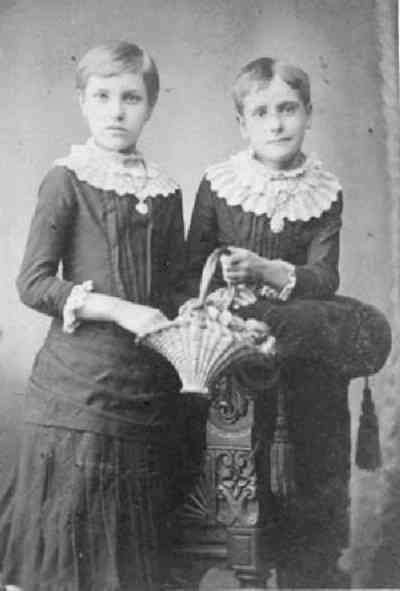
The dresses for boys through much of the 19th century were indestinguisable from those worn by the boys' sisters. The styles were basically the same as those worn by English girls at the time. This did not change until the late 19th century when boy dresses became plainer than those worn by girls. Plaid was a popular fabric for boys' dresses, in part because it related to a boy's garment--the kilt. We do not know of any specifically English styles here. We do not know if the English pattern differed in any way with the general European pattern. HBC has not yet been able to identify chronological trends associated with dresses in England. The boys pictured here appear much older than was common for English boys to wear dresses. In addition, their matching dresses do not appear to have any of the boyish stylistic details which developed in America. HBC assumes that these boy styled dresses also appeared in England, but can not at this time confirm this. Unfortunately, HBC has no details about the boys pictured in the photograph (figure 1). We have noted portraits of English boys wearing sailor dresses. Some look rather like middly blouses worn with skirts while others are clearly one-piece dresses.
There are many elements that go into the contruction of a dress. The collar is a very important element on some dresses while other dresses are worn without any collar and are open at the neck. Other impoortant elements include the sleeves, boddice, waistline, and hem as well as other parts of the dress such as lining. The back and front are usually quite quite different. Generally dresses button at the back, although we note some boy dresses in the late 19ty century that buttoned at the front. A dress might also have a back tieing bow.
At this time HBC has little information on England beyond information about the British royal family. The numbers of available photographic images of boys in dresses drop sharply after age 5-6 years. This is an assessment based on the available photograpic images. The English princes appear to have been breeched at about 5 years of age. HBC has, however, no details on how breeching was handled in the royal family. This was probably the norm, at least among upper and middle class Britons. Working class boys were probably breached earlier.
We have only limited informsation on the colors used for boy dresses in Englsnd. A major source is paintings. We note some bright colors being used in the early-19th century for a group of unidentified children. We also notice a dark green velvet being used for an unidentified boy, probably als in the early-19th century. We have much more informarion on dresses beginning in the 1840s from photographs, but of course they were nlack anbd white and thus provide little color information. Anf bythe time color photogrsphy is developmed, boys no longer wore dresses.
Many images of English boys wearing dresses look to be garments that just as easily could have been worn by girls with the same neck lines and styling. Boys wore the same dress styles that were fashionable at the time for girls. The boy here wears a dress withba low neck line just as his sister may have worn (figure 1). Later in the 19th century some more plain styles for boys developed. Not all mothers, howrver, used the plainer, less ornate styles. English boys, as did boys in other European countries and America, wore dresses when they were little until breched. The age of breaching varied from family to family and over time. The dresses for boys through much of the 19th century were indestinguisable from those worn by the boys' sisters. The styles were basically the same as those worn by English girls at the time. This did not change until the late 19th century when boy dresses became plainer than those worn by girls. Plaid was a popular fabric for boys' dresses, in part because it related to a boy's garment--the kilt. We do not know of any specifically English styles here. We do not know if the English pattern differed in any way with the general European pattern.
Dresses covered the child from neck to knee and lower for olfer girls. Thus there are only limited accompamnying clothing to be worn with dresses. We have not found a lot of English images with children headwear with their dresses. We are not sure why. Our English archive is growing but still not large. So we do not yet have a real sampling of dress images with headwear. Because of the age factor, boys and girls wore many of the same basic styles. Boys did not, however, wear the flowery decorated hats that some girls did. We believe the most common headwear was rounded crown hats with various width brims. In the 19th century wide brimmed hats with wide and medium brims were common. After the early-20th century we no longer see noys wearing dresses, but we continue to see girls wearing these hats. Often the portraits do not shoe the top of thee hats, but some haf only slightly rounded crowns, Another hat was boaters, but they were not as common as rounded-crown hats. We rarely see caps being worn with dresses. We do not know much about petticoats. The prtticoats are usually all covered up by the dresses. We can see sometimes the hem of the petticaits peeking out at the hem of the dress. Women wore long dresses in the 19th century, but younger children might wear shorter dresses. Still most of the petticoat is normally covered. All that we can tell from the photographic record is just a touch of the hem of the petticoat. Pantalettes were worn by English children for about a century. Pantalettes were extensively worn by English children, both boys and girls in the 19th century. The pattern described for America above appears to have been similar in England. Quite a few available images show English children, including boys wearing pantalettes. They were worn with both dresses, tunics, and skeleton suits. Pantalettes appear to have been more common in England as American travelers to England have commented on the fashion for boys to wear them. Apparently older boys wore them in England than in America. Many English children wearing dresses wore them with socks rther than long stockings which were much more common in America. English trends seem more similar to French trends. This was especially true of younger boys and girls. We do not think there was any difference among the younger children on a gender basis. We are not sure about the early 19th century yet, but by the mid-19th cntury, socks, often white socks, were very common with dresses. We note both ankle socks and three0-quater socks. Knee socks were not very common, although they were worn with kilts. We also see long stockings which were more common with older children. Children wore shoes with dresses. We see different styles in he 19th century. This included strap shoes, low-cut shoes, and high-top shoes. This is a little different than America where high-topmshoes were the dominant footwear. We see some strap shoes in America, but after mid--century. low cut shoes were unusual.
We note several individual English boys wearing dresses. In several cases these are not boys that we can identify, but we have been able to obtain some information about them. We can usually approximately identify the country and date of the image. In other instances we know a good bit about them.
We have found some images of children wearing dress that look like boysvin the photographic record. As the images are not identified, we can only speculate as to gender. Youngr boys from a wide range of backgrounds commonly wore dresses. As it was so common, many of the children in the available photographs are often not identified. Thus figuring out gender is often a difficult exercize. Conventions concerning outfitting boys in dresses and breeching varied wideky from family to family. Some older boys wore dresses. Most of these boys were from well-to-do families. There are gender indictiors that cn be used. They are ghelpful, but often not definitive. Just as boys sometimes wore dresses, many girls had short hair. Readers are welcome to offer any assessments they might have about these images.
One problem we have when dealing with dresses is that we can not always identify the gender oif the children involved. Younger boys commonly wore dresses in the 19th century. Complicating this is thecfact that younger children do not have the same destinct genger features that older children and youth have. We invite readers to comment if they have any insights to offer about the children pictured in these images.

Navigate the Historic Boys' Clothing Web dress pages:
[Return to the Main national dress page]
[Pinafores]
[Ringlet curls]
[Smocks]
[Bodice kilts]
[Kilts]
[Fauntleroy dresses]
[Sailor dresses]
[Fancy dresses]
[Dresses: 16th-18th centuries]
[Dresses: Early-Mid-19th century]
[Dresses: Late-19th century]
[Dresses: Early 20th century]
[Difficult images]
[Movie dresses]
Navigate the Boys' Historical Clothing Web Site:
[Return to the Main English garment page]
[Introduction]
[Activities]
[Biographies]
[Chronology]
[Clothing styles]
[Countries]
[Bibliographies]
[Contributions]
[FAQs]
[Glossaries]
[Images]
[Links]
[Registration]
[Tools]
[Boys' Clothing Home]