|
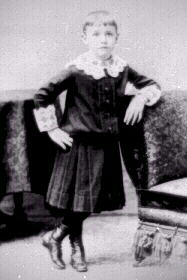
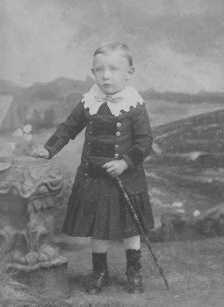
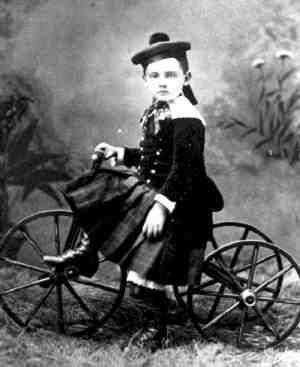
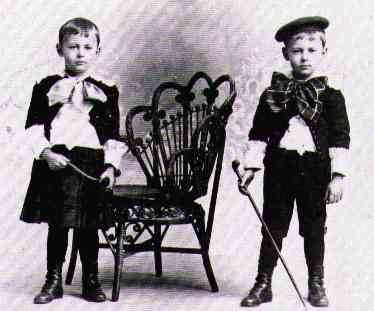
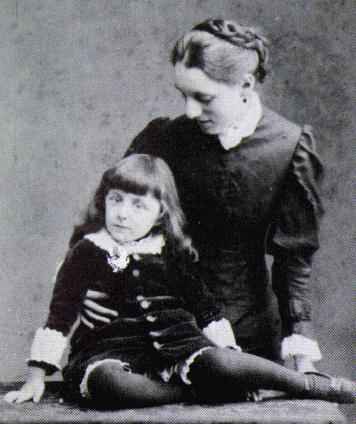
The classic Little Lord Fauntkeroy suit was made to be worn with knee pants or blommer knickers. American boys mostly wore knee pants, but we see both knee pants and bloomer knickers in Europe. Many mothers with younger boys still in dresses and not yet ready for boyish pants, were so entralled with the Fauntleroy style that they began dressing their sons in various styles of Fauntleroy dresses. Latter they may have chosen Fauntleroy fresses or Fauntleroy suits with skirts or kilts rather than knee pants. Normally a Fauntleroy dress or Fauntleroy kilt suit would have been worn by younger boys and a Fauntleroy suit with knee pants by a somewhat older boys. There were no firm conventions, hoiwever, and this varied substantially from family to family. A Fauntleroy suit with a kilt rather than knee pants could be worn by even school age boys. The Faultleroy kilt suit or plain kilt outfit was quite common in the late 1880s and 1890s. We also see quite a few Fauntkeroy dresses. Attitudes toward skirted Fauntleroy garments are not altogether clear. One HBC contributor had some thoughts on the matter. He doesn't think Little Lord Fauntleroy dresses or kilts fit into the breeching paradigm. It seems to him that boys didn't wear dresses Boys outfitted in Fauntleroy suits were often, but not always, kept in curls rather than boyish short hair. Interestingly, some mothers had their son's hair cut before he was breeched so that they might wear dresses with short hair for several years. Other boys were breeched at an early age and wore keepants for several years with long, often curled hair.
|
The classic Fauntleroy suit was a black or dark blue velvet suit with knee-length velvet trousers. Some mothers in the 1880s and the 1890s were enchanted with the Mrs. Benetts' Fauntleroy suit, but did not believe their boys, who were still wearing dresses, were quite ready to be breached. As a result, Fauntleroy suits appeared as one-piece dresses and interchangeable suits with blouses and jackets that could be worn with skirts or kilts rather than the knee-length pants that most boys saw as the only redeeming feature of the otherwise rather unpopular garb--at least with the wearer as mothers adored them. We have slowly been acquiring information in this topic. In doing so, we have found it necessary to be very precise about terminology and the different skirted garments.
Fauntleroy dresses were made any any materials besides the velvet of the classic Fauntleroy suit. Velvet was a populat, but not the omly choice. Deparment store catalogs of the 1880s and 1890s list flannel, cassimere, or even linnen. Abnd of course with the Fauntleroy kily suit, the kilt skirt was often dine in woolen plaid.
The Faultleroy kilt suit or plain kilt outfit was quite common in the late 1880s and 1890s. We also see quite a few Fauntkeroy dresses. Some information is available on how Mrs. Benett dressed her son Vivian, but I do not know at what age he was breched and began wearing proper Faintleroy suits. The boys were quite close to their mother and dutifully wore what she so carefully chose for them. I do not know if either boy raised the subject of their attire with mother. Knowing how she loved to outfit them and presumably the amount of money she was making on marketing Little Lord Fauntleroy the issue may have postponed. Boys continued to wear Fauntleroy suits through the turn of the century and into the 1900s. After World War I, however, it became uncommon to keep little boys in dresses and the fashion disapperared.
|
Boys outfitted in Fauntleroy suits were often, but not always, kept in curls rather than boyish short hair. Interestingly, some mothers had their son's hair cut before he was breeched so that they might wear dresses with short hair for several years. Other boys were breeched at an early age and wore keepants for several years with long, often curled hair.
|
Fauntleroy dresses and kilrs were generally worn by boys from about 2 1/2 to 6. A good example is Ralph Cope in 1888. He looks to be 3-4 years old. Here the issue of Fauntleroy styling is complicated. This boy's lce collar is not unlike lace collrs worn before the publication of Little Lor Fauntleroy. There was, however, no set age. Store catalogs generally show the dresses through size 6 years. A Fauntleroy dress/kilt suit brough for a boy at 6, might well be worn at 7 or sometimes even 8 years of age. As noted in the dress pages, a particularly doting mother might keep her son in dresses several years beyond 5-6 years of age when most boys were breeched. It was all up to the individual mother and some sought to keep their sons in pretty clothes as long as possible. The age of 7-8 was about the age range range for the Fauntleroy suit worn with kneepants. Most of the older boys, of course, would wear the kneepants rather than the skirted version. And while most boys passed out of Fauntleroy suits by 8 or 9, many with particularly fashion conscious mothers wore Fauntleroy suits for several additional years.
Many mothers chose Fauntleroy dresses with the idea that their son could be breeched and contunue wearing the jacket, blouse, and hat for several years. The breeching process would only require replacing the skirt that came with the dress with knee pants. The rest of the outfit remained just the same.
Attitudes toward skirted Fauntleroy garments are not altogether clear. When the Auntleroy suit appeared (1885), the convention of boys searing dresses was in decline. And the pouloarity of the Fauntleroy sdtyle was an enducement for mothers nreeching their sons. Butv ab ootion was sjirted Gauntkerioy garments. One HBC contributor had some thoughts on the matter. He doesn't think Little Lord Fauntleroy dresses or kilts fit into the breeching paradigm. It seems to him that boys didn't wear dresses after being put into Fauntleroy suits. Remember in the movie the Magnificent Ambersons that the boy is first shown wearing a Fauntleroy suit with pants and later a Fauntleroy suit with a pleated skirt or kilt. I don't think mothers considered these to be dresses, but just variations on the Fauntleroy suit. It interesting that the original Little Lord Fauntleroy is never shown wearing a dress or kilt. We think boys probably wore both and never went through a stage where they first wore kilted suits and later suit with knee pants. A reader remembers reading a mention in a biography of a woman who grew up about the 1890s of a Fauntleroy suit. She had several brothers and the contributor remembers the line in the book, "..tweaked Julian's long ringlets. Julian was 7 and wore a Fauntleroy suit and long curls." A family photograph in the book shows Julian in a skirted Fauntleroy suit. Obviously, his sister didn't consider this to be a dress.
|
I think one aspect to bear in mind is the difference between dresses, skirts, and kilts. Dresses were one piece garments. These were worn by the younger boys. One a boy was breeched he stopped wearing such one piece dresses. However, Fauntleroy jackets could be worn with skirts, kilts, or knee pants. Thus a boy might have worn skirts and even more kikely
kilts after he was breeched and stopped wearing dresses. I'm not sure about the skirts, but breeched boys might be dresses up in kilts for several years after they were breeched and commonly wore knee pants. Of course some mothers absorbed with the lore of the Higlands might have several different kilt outfits and dress her son in them after breeching.
The Fauntleroy craze affected America and much of Europe. It seems most common in America, but we see quite a few examples in Britain. We also see it in the Continent, but to a lesser extent. The same is also true of skirted Fauntleroy outfits. Some countries like Germanyn and the Netherlands seem less affected. Most of the examples we have found are American. We have country pages for the Fauntkeroy suit. We are just beginning to build country pages for skirted Fauntkrroy garments. .

Navigate the Boys' Historical Clothing Web Site:
[Return to the Main Fauntleroy page]
[Return to the Faunleroy velvet garments]
[Introduction]
[Activities]
[Biographies]
[Chronology]
[Cloth and textiles]
[Clothing styles]
[Countries]
[Topics]
[Bibliographies]
[Contributions]
[FAQs]
[Glossaries]
[Images]
[Links]
[Registration]
[Tools]
[Boys' Clothing Home]