|
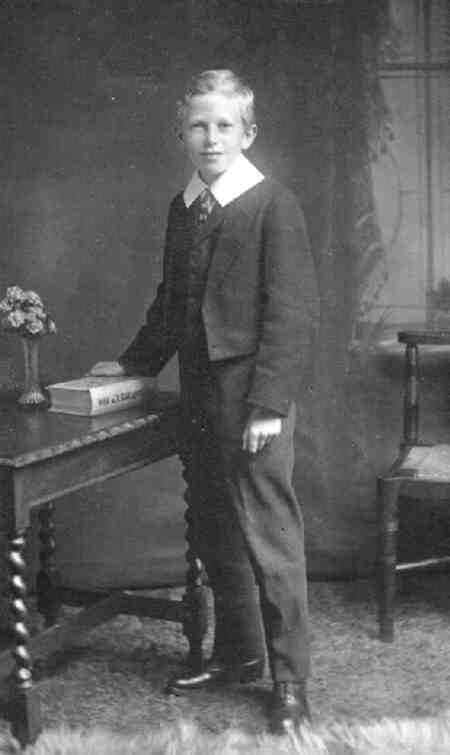
It was in England that the Eton suit was created in the late 19th century and it was in England that the Eton suit reached its greatest popularity. For two generations a well dressed English boy was expected to wear an Eton suit for formal occasions. Many boys also wore them as a school uniform. Many boys wore Eton collars with a range of suits. Only suits with the short jackets are true Eton suits. The characteristically short jackets are normally worn with long pants. We see boys wearing Eton collars with a variety of pants, but often they are not true Eton suits.
The historical development of the Eton suit began in England. It is of course associated with Eton School and other public schools that adopted similar uniforms. The development is described on the main Eton suit page.
Eton suits and collars were worn not only at exclusive public schools, but also at state schools which did not require uniforms--a reflection as to just how commonly worn Eton suits were in England at the turn of the century. The state schools did not require that boys wear Eton collars, it was just that they were such an common style of the day. Many preparatory and public (private) schools as well as the grammar schools did require the boys to wear Eton collars. Some boarding schools even had collar monitors! Boys at day schools of course were looked after by their mothers.
For two generations a well dressed English boy was expected to wear an Eton suit for formal occasions. A formal Eton suit had a class image to it. Wealthy boys would have actual Eton suits and would wear them for most formal occasions. Less affluent boys might not have a formal Eton suit, but they would often wear their suit with an Eton collar. These less affluent boys would not have a large wardrobe and would wear a suit for a wide range of activities that today would call for casual clothes.
English boys at the turn of the 20th century wore their Eton suits and collars, just about everywhere, even to picnics or even beach outings. It is even difficult to fathom in our modern, casual era wearing a stiff Eton collar to a picnic or the beach.
Until relatively recently, fashion was primarily set by the aristocracy or wealthy class. The average person, who often had little disposable imcome, tended to wear utilitaian clothing, often with limited attention to fashion. This changed radically in the 19th century when the new indutrial economy radically increased personal income and the size of the middle class. Many parents which before could give little attention to fashion sudenly found that they had the income to dress themselves and their children fasionably. The Eton suit and collar was one of the styles associated with this development. The Eton suit was initually the style worn by the boys at an exclusive English "public" school. Mothers all over England came to want to dress their sons in this initially posh style. As a result by the late 19th century virtually every English boy was wearing the Eton collar--no mater how humble his background. The full Eton suit complete with a top hat was an entirely different matter. While the detachable Eton collars were within the range of virtually evert family--a full Eton suit involved quite an expenditure. After World War II, class attitudes toward fashion begin to change. Biys from wealthy families continued to wear Eton collrs fir a while, but the average English boy soon changed to more comfortable soft collars.
Several different garments are assocoated with the Eton suit. A formal Eton suit might vary somewhat but had many common features. Hats were much more common in the 19th century and early 20thth century than would be the case today. An English boy would have worn some kind of hat when going out. With a formal Eton suit, a wealthy English boy would have worn a top hat. This was actually part of the uniform at Eton and Harrow, The jacket for an Eton suit was modeled on the short black jacket worn by Eton schoolboys. The jacket ended just at the waist, much shorter than the jackets worn with oyher suit styles. Some Eton suits may have had grey jackets rather than the black jackets worn at Eton school. But by far the dominate style was black jackets. Although not part of the suit itself. The wide, stiff, detachable Eton collar was a key feature associated with the Eton suit. This was a part of the uniform at Eton and many other English schools. The Eton collar was worn, however, with many different types of suits. It was such a popular collar style for such a long period that it was worn with a wide range of suits. Most boys black pants with Eton suits. Eton schoolboys wore stripped pants. Boys at other schools or as a regular suit wore solid colored pants. Most of the Eton suits I have seen had black trousers to match the black jacket, but I beleve that grey pants were also worn with black jackets. Eton suits were primarily worn with long pants a worn at Etomn school. HBC has not Eton suits with knee pants, but less commonly knickers. [HBC note: The British refer to kneepants and later short pants as knickers, so some care needs to be given in assessing contemporary sources.] HMC is not yet sure how the different styles of pants were. This assessment is further complicated by changing fashions over time. HBC is making a preliminary assessment, but invites reader comments.
We have not found many examples of English boys wearing the junior Eton suits that are so popular for yonger American boys. Because we have a fairly substanyial English archive, we think that our failure to find many exampples is a fairly accurate indicator of prevalence. We are not sure why the style never caught on in England. Boys seem more likely to wear regular suits or school uniform styles. Given that the Eton suit amd collar originated in England, ome might have assumed that the junior Eton suits would be a popuolar style in England. But we just do not see many in the photiographic record. Even in wedding and other formal wedding portarits, we do not seee many examples. England is not unique, we do not see many of these suits in other countries as well.

Navigate the Boys' Historical Clothing Eton pages:
[Return to the Main English suit type page]
[Return to the Main Eton national page]
[Eton School uniform]
[Classic Eton suits]
[Fashion article]
[Eton collars]
[Eton kilts]
[American Eton suits]
Navigate the Boys' Historical Clothing Web Site:
[Introduction]
[Activities]
[Biographies]
[Chronology]
[Clothing styles]
[Countries]
[Bibliographies]
[Contributions]
[FAQs]
[Glossaries]
[Images]
[Links]
[Registration]
[Tools]
[Boys' Clothing Home]