|
Nowhere was the Fauntleroy suit more popular than in America. Quite a number of boys wore formal velvet Fauntleroy suits, but many more boys wore less expensive suits with large lace or ruffled collars.
American boys generally wore Fauntleroy suits with wide-brimmed sailor hats. Other head gear was worn, but was not nearly as popular as in Europe. Someboys wore their Fauntleroy suits with long ringlet curls. Most of the American boys with long hair wore ringlets. I was not common for boys to have long uncurled hair. One of the most destinctive elements of the American Fauntleroy suit was that it was worn with large, carefully tied bows. Most boys wore large bows to match the large collars. Almost all Fauntleroy suits, except for kilt suits, were worn with knee pants. Unlike England. knicker Fauntleroy suits were rare. The American Fauntleroy suit was often worn with heavy high-top shoes that looked like boots. The patent leather pumps and buckle shoes worn in England were much less common in America. Here we have not extensively developed this page on American Fauntleroy suits. This is primarily because the main HBC Fauntleroy page has primarily been developed with information and images about Fauntkeroy suits in the United States.
No where was the Fauntleroy suit more popular than in America. We see boys in other countries wearing them. The photographic record, however. suggests that really large numbers of American boys wore Fauntleroy suits or suits with Fauntleroy styling. It is difficult to assess just how popular the Fauntleroy suit was. Probably the best indicator is school photographs. The public school by the late 19th century, especially by the 1880s had become regularized throughout the country. The vast majority of younger children were by that time attending school. Thus school portraits provide a goof cross section of America. Thus these images suggest just how popular the Fauntleroy suit was. When interpreting these portraits it should be remembered that theyh do not show two groups. First the abjectly poor, especially blacls in the Deep South. And the really affluent who could aford tutors and private schools. The really poor were less likely to wear Fauntleroy suits and the really well to do were more likely to wear them. One clear observation is that some younger biys did wear Fauntleroy suits to school, but this wasa a realtively small minority of the boys. A much larger proportion wore outfits with some elements of Fauntleroy styling, but not a full Faunrleroy suit.
Fancy suits looking like Fauntleroy appeared in the 1870s, but were not very common. They were basically following European fashions at the time. The Fauntleroy craze began when Mrs. Burnett published Little Lord Fauntleroy (1885). This inspired the Fauntelroy craze of the 1880s and 90s which became a very much American phenomenon. Many boys were dressed in the fancy velvet suits and much larger numbers in less expensive imitations or suits with some Fauntleroy styling. We see quite a range of styles during this period. Boys not only wore velvet suits, but destinctive Fauntleroy blouses with large lace and ruffled collars. Many boys had regular suits rather than velvet suits, but mothers hadded Fauntleroy trim. There are many portraits of American boys archived on HBC. Unfortunately many are not dated, complicating any chronology. We will eventually link the dated ones here. One such portrait is Charles H. Pool, Jr. photographed in 1896. We still see Fauntleroy suits after the turn of the 20th century in the 1900s, but by the 1910s they are rapidly going out of style.
Little Lord Fauntleroy suits are generaly associated with plush velvet. In fact the suits were made in a wide variety of fabrics. Velvet was most popular for the classic suits, but velvet was an expesive material and thus cost-conscious mothers used many other less expensive and more durable fabrics. This developed as middle-class mothers copied the fashions of the privlidged classes.
Velvet was also a relatively heavy fabric. Thus lighter weight materials were adopoted for warm summer weather. A boy might wear just his blouse in hot weather. But there were jackets done in light-weight fabrics as well. Othther materials were used depending on the type of Fauntleroy outfit. Boys wearing Fauntleroy kilts, for exmple. might wear a velvet jacket with a wool tartan kilt. Fauntleroy dresses might be made in velvet, but a range of other fabrics were also used. I am not entirely sure about the fabrics for the accompsnying garments like the fancy blouses. Of course lace was sometimes employed for the collar. Boys wearing dresses might wer a Broderie Anglaise petticoat and drawers underneath.
Our extensive archive of American boys wearing Fauntleroy suits is almost all black-and-white studio portraits. This provides agreat deal of information about the garments and styles, but very little color information. Most of the suits are dark and look to be black in the portraits. There are other sources of information. We know that many mother bought patterns and thus could select the material to be used. This was often, but not always blacl velvet. There are also colorized portraits as well as painted over portraits in addition to actual paintings. None of these are as relaible as a color photograpph in terns of depicting precise shades. They they do show, however, that other colors were used. And we have some atual vintage suits which clearly show somne of the colors. We think royal blue, burgundy, and forrest green suits were worn. All of these colors would have shown up as black.
Suits with parrens were very common in the 19th century. Fauntleroy suits are often depicted as solid colored suits. This often was the case, especially with the velvet suits. Other dark colored suits also often seem to be solid colors without patterns. Perhaps some of the dark muted patterns did not show in portraits, but we think that most were solid colors. Light-colored suits were different. We are not sure why that was. The light-colored suits were also mostly light-weight fabrics for summer wear. A good example is B. Curtis Sunderland about 1900.
Quite a number of American boys wore formal velvet Fauntleroy suits with lace collars, Both velvet and lace were expensive material. The Fauntleroy suit was aelatively expensive way of dressing a little boy, especially when all the finery is added to the basic suit. Besides the popularity of the Fauntleroy style the very expense of the Fauntleroy style probably added to its popularity. The United States in the 1880s was undergoing a period of raod economic growth and industrialization. The result was an enormous creation of wealth. Many families of very humble, rural origin found themselves enjoying considerable economic success. There was an enormous expasion of the urban middle class. And these successful families wanted to show their success. Here we are not just talking abourt the rich, but prosperous middle-class families as well. And clothing was one ways to do this. This include not only the parents, but the children at well. Thus dressing their boys in fancy and expensive Fauntleroy suits was a way of showing off their affluence. It is difficult to know how commonly this was done on purose or without fully thinking it through. At the time, even in democratic America, fashions were largely set by the wealthy and well-to-do. Thus the not so affluent mothers also wanted to dress up their boys in fashionable Fauntleroy suits. We thus see mothers scrimping to buy these suits. Some outfits were sewed at home, reducing the cost. And less expensive materials could be used. Some were even regular suits, but worn with large collars or Fauntleroy blouses which could be purchased in expensive materials. Often these suits used in expensive lace or ruffled collars. It is very difficult to assess the mind set of the mothers who chose Fauntleroy suits. It is possible to follow the democratization of the Fauntleroy style with low cost outfits is iobservable in the photographic record.
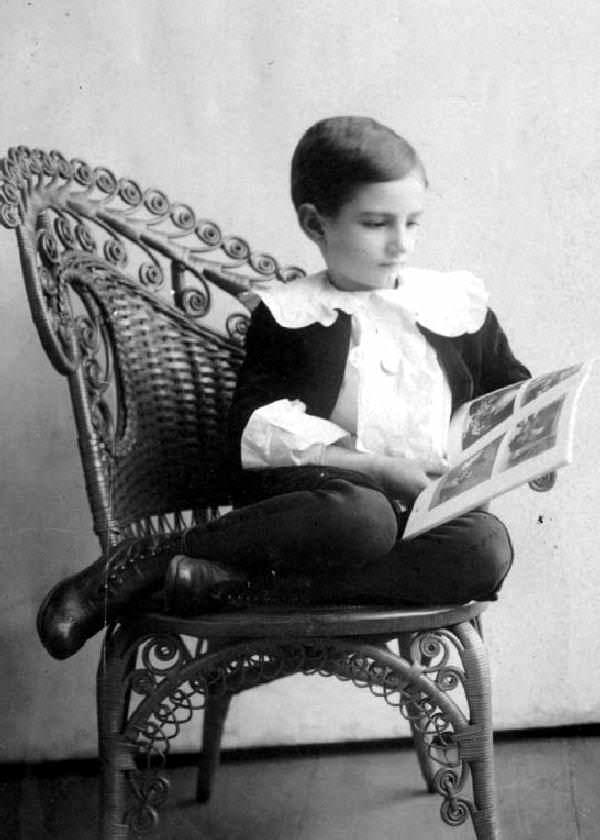
A Fauntleroy suit was essentily a jacket, especially a cut away, jacket worn with a fancy blouse and kneepants. Several other garments, however were associated with Fauntleroy outfits. American boys wore Fauntleroy suits with a variety of headwear. The most common was the wide-brimmed sailor hat. Other head gear was worn, but was not nearly as popular as in Europe. The classic Fauntleroy suit of the mid-1880s was worn with a lace collar. After the turn of the 20th century, ruffled collars became more common. The large collar the boy here wears is a good example of this (figure 1). Some boys wore pin on lace collars rather than a fancy blouse. The classic Fauntleroy jacket was a cut-away velvet jacket, but there were other styles. One of the most destinctive elements of the American Fauntleroy suit was that it was worn with large, carefully tied bows. Most boys wore large bows to match the large collars. Almost all Fauntleroy suits, except for kilt suits, were worn with kneepants. Unlike England. knicker Fauntleroy suits were rare. American boys normally wore Fauntleroy suits with long black stockings. There were some exceptions here as not all Fauntleroy suits were black. There were also chronological changes especially after the turn of the 20 century. The boy here, gor example does mot look to be wearing black stockings, but it is difficilt to tell for sure (figure 1). Also note that they look to be expensive stockings--the material fits tightly and has a kind of sheen. They may even be silk. The American Fauntleroy suit was often worn with heavy high top shoes that looked like boots. The patent leather pumps and buckle shoes worn in England were much less common in America.
Many Fauntleroy suits were decorated with embroidered designs. Almost alwats these were the classic Fauntleroy suits with cit-away jackets. In this regard they are similar to Zouave suits. Often the embroidery does not show in the available photographs. This is because the embroidery was often done in muted tones. We commonly see black or very dark embroidery on black suits. Often the same colr was used on other dark suits such as bugandy, deep blue, and frest green. The embroidery is often very elaborate so it seems rather strange that mothers would want it done in the same color because it was not very prominant. Very rarely do we find the dark velvet suits with contrasting-colored embroidery. We know more about the embroidery from the lighter-colored summer suits. These suits did sometimes have embroidery done in cntrasting colors. The most elaborate embroidery was usually on the jacket, but the pants often had matching embroidery. The embroidery styles was often rather like the fancy embroidery on 19th century military uniforms. The embroidery stles may have had names, but we have not yet been able to find information explaining the different styles.
One interesting apepect is how the Fauntleroy suit fits into the overall family clothing picture. We note a range of family portraits. Families tended to be larger in the 19th century. So families which several children were fairly common. Normally it is the youngest boy or two that wears a Fauntleroy suit. Given the age spread of the children in a normal family, there were usually only about two boys the right age for Fauntleroy suits. We have noted three boys in Fauntleroy suits. I've never seen a family with four boys wearing Faunteroy suits, but I wouldn't say that there ws no such families. This depended on part as to whether their were girls in family as well. Another factor was to what age the boys wore their Fauntleroy suits, this varied somewhat from family to family. We notice the other children in the family waring all kinds of outfits, it part depending on their age. This of course is best viewed in family photographs.
American boys wore Fauntleroy suits ith many different hair styles. We note boys with various hair lengths. Many boys wore a range of short hair styles. By the 1880s when Fauntleroy suits became popular, it was no longer common for boys to wear their hair doen to or over their ears as was common at mid-century. So we see most boys with short hair cuts similar to those of older boys. Some boys, however, wore their Fauntleroy suits with long hair. These longer styles were longer than common at mid-century, in some cases worn to shouldr length. American boys with long hair generally had in done in ringlet curls. This was much less common in Europe. Many boys had their curls cut when they were breeched. Some boys such as some of the boys wearing Fauntleroy suits had their curls cut later. It was not common for American boys to have long uncurled hair. We notice a range of other styles such as top curls.
Boys wore Fauntleroy suits at a range of ages. They were most common for younger boys. We have commonly noted boys from abour 3 to 8 years of age. A good example is 3 years old Charles H. Pool, Jr.. The boy pictured here looks to be avout 6-7 years old (figure 1). Boys younger than 3 years did not commonly wear Fauntleroy suits, in part because they were not yet breeched. Some of these younger boys might wear Fauntlroy dresses. We have also noted a small number of older boys wearing them as well. Less common are older boys, especially boys older than about 10 years of age. We do not, however a few bous of 11-12 years wears them, even 13 year ols--nut this is much less common. We will link more of the pages here to show the different ages at which American boys wore Fauntleroy suits. Unfortunately many of the availabkle images are unidentified and we can only guess at the boys' ages.
We do not fully uderstand the usage of the Fsuntleroy suit. This is in part because most available images are forml portraits rather than family snapshots. Fauntleroy suits would have been wore for special occasions and formal events such as church. People dressed more formally at the time. Thus occassions that today are casual events such as parties, peole in the late 19th and early 20th century would have dressed formally. We see boys in Fauntleroy suits in outdoor events such as garden partirs or even picnics. Certainly parties would have been such events. Another event would have been formal studio ohotographic portraits. Here peole did not always dress up, but it was quite common. Cerainly evebts such as weddings would have requied formal dress. Interestingly we do not see a lot of boys in Fauntleroy suits doing First Communion. We are not sure, but we believe that at the time Fauntleroy suits were popular that modern First Communion celebrations were not yet developed. The same is true of conformations, but here boys tend to be older and most were no longer wearing Fauntleroy suits.
One clothing historian believes that the Fauntleroy suit was an important factor in ending the centuries old convention of dressing younger boys in dresses. She speculates that mothers were so anxious in the lare 1880s and 90s to dress their sons in Fauntleroy outfits that they breeched them earlier than they might have. Of course there were skirted options such as a Fauntleroy dress of a Fauntleroy kilt suit. Even so, the standard Faunteroy suit as decribed and depicted in the book was a knee pants suit. And that was what most mothers wanted for their sons. We do not have any written evidence supporting this thesis from the late-19th century. We do, however, have a very lsrge archive of historical images. The problem is thst most of them do not identify the individuals making it difficult to assess gender. Not only do we have individual and small group portraits, but we also have whole family images. Even with out names, it seems that once boys were dressed in knee oants Fauntleroy suits that they no longer wore dresses. Thus it does seem that Fauntleroy suits accelerated the age of breeching. To what extent this influenced the decline of the convention of boys wearing dresses and other skirted garments, we are not ebntirely sure.
At the time of the Fauntleroy Craze, the United States was still alargely rural nation. Indusyrializatgion was well underway and remaking the country, but the majority of Americans wtill lived in the country. Even by 1890, some 65 percent of American still lived in rural araea. Even so, we see boys wearing Fauntleroy suits throughout the country, even in many states where the rural population was over 90 percent rural. Even in these states we see boys wearing Fauntleroy suits. It was not just a style appearing in the fashionable Northeastern cities. A factor where was the mailorder catalogs like Sears and Ward catalogs which offered Fauntleroy suits to mothers across the countries as soon as the style appeared. Thanks to the studio infotmation on cabinet cards, we know where most of the portits were taken. We are able to see just where the thousand of image we have archived were taken. A good example is a porttait from a relatively small town in South Dakoata. The Hepperlenoys dressed are dressed like just like boy in the most fashionable New York family.
The photographic record does not tell us a lot about the demographics of Fautleroy outfits. During the Fautleroy era (1885-1905), Anmerica was still a majority rural country. Mist mericans lived on rarms or at least in rural asreas. The country was rapidly industralizinjg which meran jrbsnizatuin, but woukld not criss the 50 percent threahiold until the 1920s. While period photohrasphy involved studio portraits that identified the city or town where the oportrait was taken, it dies not indicate where gthey lived. And farm families woul dress up and come into towen to have their portraits taken. Thus there is no way of determining if they were farm or town families. We know that the mailorder catalogs by the time of the Fauntleroy Craze had brought big city fashion within easy reach of the most remotely located farmer in the country. We have found a few images showing that farm boys did not entirely escape the Fauntleroy Craze. Esopecuallhy prosperous farm families. A good example is an Iowa family about 1895. We are unable to quanify the relative imoprtance at this time. We believev that Fasuntleroy suits were most common in fashionable big cities, but wasc notable throughout the country, including rural areas. It shiuld be noted thatv there were not only proper Fauntleroy suits, but regular suits for which Fauntleroy trim or a Fauntleroy blouse was added.
Social claass essentially converted to money, especially in America. And Fzuntleriy suits and otyher items like blouses were expensive. This virtually by definition determined who would war these outfits -- boys from fanikies at least in comfortable circumstances. As the Fauntleroy Craze developed, we note outfits offered at relastively low prices. This coukld be done by reducing the amount of luxurious materias (velvet and silk). It should be remnered that American workers were the best paid wirkers in the world. So some working-class fanilies could aford to dable in fashion, especislly the lower priced Fauntleroy items. Again the photographic record is difficult to assess in social class terns because almost everyone dressed up in their best clothes for a studio portrairt.
We note some boys who are wearing Fauntleroy costumes that are so perfect that they seem to be costumes rather than actual suits. In the case of Funtleroy suits, the concept of a costume and a boy's best suit may actually merge. It is difficult to tell in many instances as for so many portraits rhere is no provinance. Some of these costumes images may actually be boys involved in stage plays. "Lottle Lord Fauntleroy" was presented as a play throughout America and Europe. We have images of several American boys who played the part. In some cases these are identigied, in other cases they are not. Fauntleroy costumes are a little more complicated than most other costumes as long hair and often ringlet curls are a part of the complete outfit.
HBC has not persued information on clothing manufacturers, although it is a topic of interest. A reader asks us if we have any information on the clothing manufacturers in New York City during the early 1900s. She reports that her great granfather Morris Teitelbaum and his brother or cousin Meyer Teitelbaum, both owned clothing manufacturing companies which manufactured children's clothing, including Little Lord Fauntleroy suits. The 1910 and 1920 census indicated that he was a clothing manufacturer. Our reader reports, "I was also told he owned several clothing stores in upstate New York, but I do not have a name. And that my grandmother would make my father wear knickers and he couldn't stand." While we have no additional information at this time, we are interested in adding information on clothing manufacturers.
Here we have not extensively developed this page on American Fauntleroy suits. This is primarily because the main HBC Fauntleroy page has primarily been developed wiyh information and images about Fauntleroy suits in the United States.
We have archieved numerous images of individual American boys wearing Fauntleroy suits. Most of these boys are unidentified. We are also collecting accounts about American boys wearing Fauntleroy suits. A number of biographies include boyhood accounts. We have collected some brief accounts from various countrites. Of course he most famous account is Vivian Burnett, the son of the author of Little Lord Fauntleroy.

Navigate the Boys' Historical Clothing Fauntleroy related pages:
[Return to the Main national Fauntleroy page]
[Return to the Classic Fauntleroy page]
[Fauntleroy dresses]
[Lace collars]
[Vivian Burnett]
[Fauntleroy patterns]
[Classic materials]
[Classic hair styles]
[Individual classic suits]
[Fauntleroy style]
Navigate the Boys' Historical Clothing other related pages:
[Dresses]
[Breeching]
[Kilts]
[Smocks]
[Pinafores]
[Sailor Hats]
[Blouses]
[Ring Bearers]
[Long hair]
[Ringlet curls]
[Hair bows]
[Bangs]
[Collars]
[Bows]
Navigate the Boys' Historical Clothing Web Site:
[Introduction]
[Activities]
[Biographies]
[Chronology]
[Clothing styles]
[Countries]
[Bibliographies]
[Contributions]
[FAQs]
[Glossaries]
[Images]
[Links]
[Registration]
[Tools]
[Boys' Clothing Home]