|
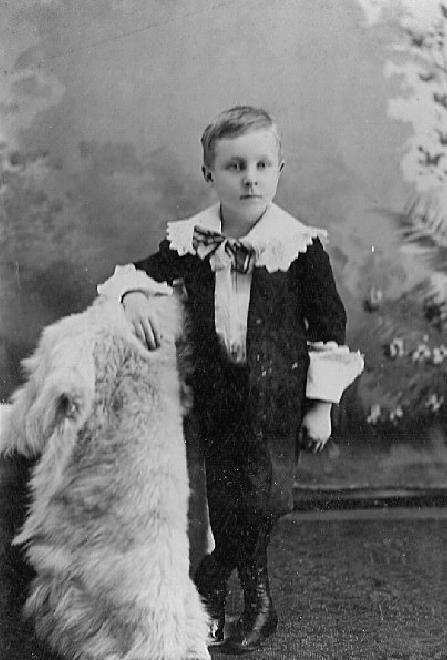
The classic Fauntleroy suit of the mid-1880s was worn with blouses that had lace or more importantly ruffled collars. The collar and blouse were a very important part of the Fauntleroy style. We see fewer lace coolars by the late 1890s. The Fauntleroy blouse that the boy here wears is an example of this (figure 1). In this case you can see most of the jacket. Some Fauntleroy jackets were much smakler. Some boys wore pin-on lace collars rather than a fancy blouse. Often there wee matching sleece cuffs. This was often the case for actual lace collars. Real lace was quite expensives. Thus it was oftten no used as blouse collars. Or if it was used, it was only as trim. It is not always easy to tell if the collar and cuffs are actually part of the blouse or not. Fauntleroy blouses or trim items like collars and cuffs were not always worn with actual Fauntleroy suits. Rather they might be worn with regular sack suits, giving the impression of a Fauntleroy suit. Because the Fauntleroy suit was especially popular in America, the Fauntleroy blouse was also an especially popular American style. We also see boys wearing Fauntleroy blouses without a jacket. This was especially common during the summer.
There are two types of Fauntleroy collars: attachd and detachable as well as pin-on collars. The detachable collars were rarelused as Fauntleroy collars. The detacable collars were nostltly Eton collars, although not all were shaped like standard Eton collars. There wee also Peter Pan collars and all kinds of inter-mediate shapes. Unlike the attached collarscamme already attachd to the blouses that children wore, these collars were as the term indicates, detachable. This was very utilitarian because the collar was what gets the dirtiest quickest. And at a time when laundry was real drugery, all the boy has to do was to change his collar. Attached collars represented the vast majority of Fauntleroy collars that boys wore. Abd unlike the common perception, they were not lace collars, they were lmost all ruffled collars often done in linen. Some were very plain others were extrodinarily large, ruffled and scalloped, perhaps with a little lace trim. Often theu had a back flap like a sailor collar. There were lace collars, but these were pin-on collars. They were much less coomon, primarily because lace was expesive which could be quite costly because mothers wanted Fauntleroy collars to be large.
A range of collars were worn with Fauntleroy suits. Some of the most important were Eton, lace, Peter Pan, ruffled, and scalloped collars. Fauntleroy suits are probably most associated with lace collars. This is, however a misnomer. They were not the most common collar worn with the classic cut-away jacket Fauntleroy suits. This is because mothers not only wanted a fancy collar, but a fancy frint as well. As a result, mothers commonly brought fauntleroy blouses which were more commnly done with ruffled rather than lace collars. Actual lace collars did not come with matching fronts. The rulled collars were almost always apart of a blouse which were done with fancy plackets (fronts). The lace collars that we do see are mostly pin on collars worn with collar buttoning suits. We see some Eton collars, but they were more popular in England. The Fauntleroy blouses often had scalloped rather than ruffled collars. In sone cases lace was mixed in, usually eyelet lace around the edgess. Peter Pan collars were not common, but began to become more common after the Fauntleroy craze declined.

Navigate the Boys' Historical Clothing Fauntleroy related pages:
[Return to the Main U.S. Fauntleroy garment page]
[Return to the Classic Fauntleroy page]
[Return to the Main Fauntleroy blouse page]
[Fauntleroy dresses]
[Lace collars]
[Vivian Burnett]
[Fauntleroy patterns]
[Classic materials]
[Classic hair styles]
[Individual classic suits]
Navigate the Boys' Historical Clothing other related pages:
[Dresses]
[Breeching]
[Kilts]
[Smocks]
[Pinafores]
[Sailor Hats]
[Blouses]
[Ring Bearers]
[Long hair]
[Ringlet curls]
[Bangs
[Main bow page]
[Sashes]
[Hair bows]
[Lace collars]
[Ruffled collars]
Navigate the Boys' Historical Clothing Web Site:
[Introduction]
[Activities]
[Biographies]
[Chronology]
[Clothing styles]
[Countries]
[Bibliographies]
[Contributions]
[FAQs]
[Glossaries]
[Images]
[Links]
[Registration]
[Tools]
[Boys' Clothing Home]