
German Sailor Suits: Conventions--Specific Uses
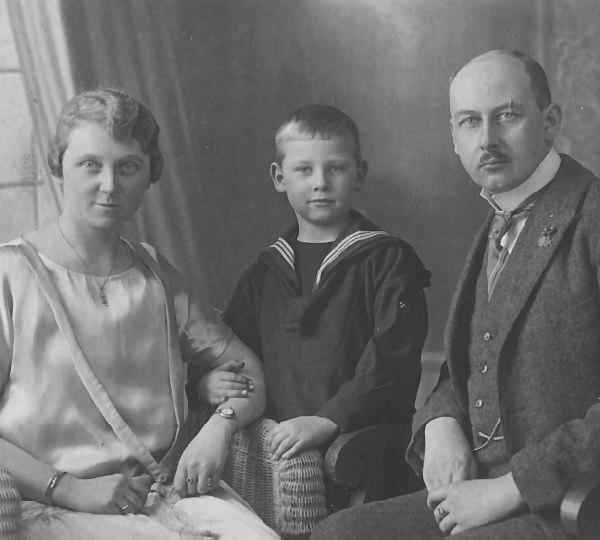
Figure 1.--This German boy probably wears his best suit--a sailor suit--for this intimate family portrait. The boy's sailor suit is difficult to date as it is a very traditional style. La Couturière Parisienne indicates thahis mother's dress definitely looks like 1920s. It's hard to be more specific because only part of the dress is visible. It does not appear to be earlier than 1920. The time of plain bodices and short hair is from about 1923 on.
|
|
Some information is available on the different conventions for wearing sailor suits in Germany. The sailor suit was a an extrodinarily versatile garment. Our German archive offered numerous insights on where and when boys wore sailor suits at least during the 20th century when family snapshots become available. We seen it being worn in all kinds of diverse circumstances. It could be an informal play garment or a boy's best suit. Many younger boys did not have a dress suit and instead wear sailor suits. Other boys played in them. They were also widely worn to school, especillly in Germany although this declined in the 1930s with advent of the NAZIs . They could also be formal wear to occasions like weddings. Few garments could be worn for such widely different circumstances. The styling could be quite similar for these different occassions. The material was also similar, although materials could vary by season. HBC knows of no other boys' garment that was so versatile. Here are some of the varied conventions for wearing sailor suits. In other instances a boy might have different suits, often a new suit was reserved for good and the older suit for play. Unlike other outfits, the styling could be quite similar for both best and play. In other instances there were plainer suits for play.
Destinctive Nature
The sailor suit was an extrodinarily versatile garment. Few garments could be worn for such widely different circumstances. The styling could be quite similar for these different occassions. The material was also similar, although materials could vary by season. HBC knows of no other boys' garment that was so versatile. The tunic was similar in some respects, but not nearly as versitile as the sailor suit. We see boys wearing simarly styled sailor suit for play, church, school, parties, and other occassions.
Some information is available on the different conventions for wearing sailor suits in Germany. The sailor suit was a tremendously flexible garment. Our German archive offered numerous insights on where and when biys wore sailor suits at least during the 29\0th century when family snapshots become available. . We seen it being worn in all kinds of diverse circumstances. Here are some of the varied conventions for wearing sailor suits. In many cases the sane suit could be worn for different events abd circumstances. In other instances a boy might have different suits, often a new suit was reserved for good and the older suit for play. Unlike other outfits, the styling could be quite similar for both best and play. In other instances there were plainer suits for play.
HBC

Navigate the Boys' Historical Clothing Web Site:
Sailor Suit Country Related Pages:
[Returnt to the Main country sailor suit pages]
[American]
[Denmark]
[English]
[French]
[German]
[Italian]
Other Related Pages:
[Sailor suits]
[Kilts]
[Smocks]
[Pinafores]
[Sailor Hats]
[Blouses]
[Ring Bearers]
[Long hair]
[Ringlet curls]
[Hair bows]
[Bangs]
[Collars]
[Bows]
Navigate the Boys' Historical Clothing Web Site:
[Return to clothing styles]
[Introduction]
[Activities]
[Biographies]
[Chronology]
[Cloth and textiles]
[Garments]
[Countries]
[Topics]
[Bibliographies]
[Contributions]
[FAQs]
[Glossaries]
[Images]
[Links]
[Registration]
[Tools]
[Boys' Clothing Home]
Navigate the Historic Boys' Clothing Web German pages:
[German choirs]
[German country page]
[German sailor suits]
[German school wear]
[Lederhosen]
[German youth groups]
[German royal family]
Created: August 16, 2001
Last updated: 2:08 AM 3/26/2011