|
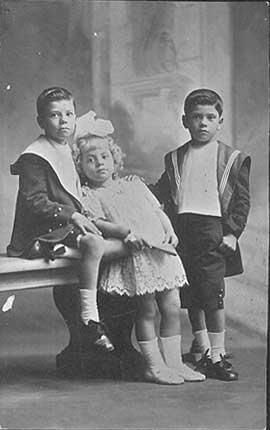
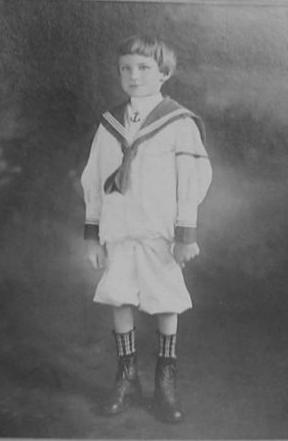
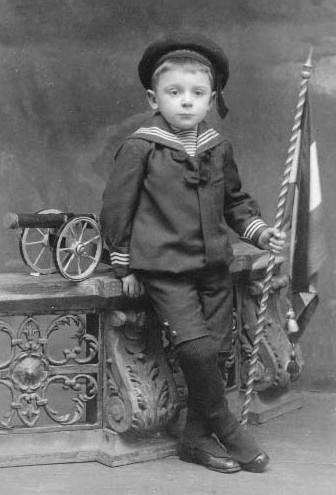
The sailor suit as boys' wear znd subsequentlky girls'wear as well was a Brutish creation. And the style was especially popular throuhout Europe, but it was not limited to Europe. We also notice many American boys wearing sailor suits as well as boys in the British Dominions. Sailor suit fashions and conventions for wearing them varied greatly from year to year. Many of the differences are based on the uniform differeces of the various national navies. Even so there are a great many similarities with the sailor suits worn by boys in dufferent countries. The reason for this of course is that both boys' sailor suits and sailor uniforms were often based on Royal Navy uniforms. The Royal Navy was a dominaznt force in the 18th century, bit after Trafalgur (1805), the Royal Navy was not even challenged by another navy for over 100 years. Thus it was the Royal Navy uniforms that became such an influential standard.
Sailor suits were not common in Africa. At the time they were most popular in Europe and America, the Scaranle gor Africa had just been completed. Most African children to the extent that they wore clothes, nostly wore traditional styles. Some European children living in Africa wore sailor suits, but few African children. By the time that that Western clothes began to be worn in Africa, the sailor suit was a declining style. There are a few exceptions. As with other Western-style clothing, we see sailor suits being worn by children in a few wealthy families. We note the children the Lozi royal family in Barotseland of modern Zambia during the early-20th century.
Latin America is the region pf the westen world that we see the fewest sailor sits. This is primarily because it was the poorest region of the Western world. As a result there was a small middle class with ealth concetrated in a narrow ruling elite. Fashion in Latin America was primarily imported from Europe. Thus we do see some sailor suits. We do see middle- and upper-class boys in the region wearing sailor suits, but because the well tomdo was a relatively small portion of the populatiom was so small, the number of photographic taken was relativly small compared to North America and Europe. Thus our Latin Americam archive is limited. The major exception was Argentina because of the country's dynamic growth (late-19th and early-20th century) and resulting expanion of the middle-class. Argentina came very close to make the transition from a developing to a developed economy. Left wing populaist politicians prevented this from happening. Argentina's economic expansion occurred precise at the time that the sailor suit was most popular. We also have some information on Brazil, essentially half of South America. Brazil experienced a seriesof booms (sugar, rubber, coffee) which created graet wealth. This there were people who adopted European fashions. Brazil was not close to the level of development of Argentina at the time of World War I, but beginning in World War II began to develop a modern ecomnomy. By this time the popularity of the sailor suit had passed. We suspect that the same genral pattern in true for other Latin American countries, but our archive for those countries is very limited and we this have very few exmples.
|
North America is dominated by Canada and the United States. We know sailor suits were worn by Canadian boys, but the style does not seem to be as popular as in Britain and the United States. Here we are still assessing Canadian trends. Our Canadian archive is not as large as our Ameruican archive. We thus more about the United States. Sailor suits were worn relatively little through the 1870s. This changed dramatically in the 1880s. By the 1890s they were the single most popular outfit for boys and, unlike the Fauntleroy suits also wornh in the late 19th Century, boys actually liked them. The sailor suit became popular in America as the country emerged as a major naval power. The styles seemed to follow British styles modified to reflect U.S. naval uniforms. Even boys still wearing dresses were outfitted in sailor suits with skirts. Sailor suits in the 1860s and 70s were made in a variety od styles and only gradually did the traditionlly styled suits emerge as a standard. As the sailor suit became popular in the 1870s, pants styles for boys shifted to knee pants worn with long stockings. Sailor suits with knee pants continued to be a popular style for boys through the 1910s. As boys pants styles shifted to knickrs in the 1920s, sailor suits began to go out of style. Some small boys wore them, but with short pants rather than knickers. While most of North America is the United States and Canada. There are a few other jurisdictions. Mexico is located in Morth america, but we have rchived it in the Latin American section.
The sailor suit while enormously popular in Amerca and Europe was not widely worn in Asia. This was primarily because traditional styles still prevailed in most of Asia and perhaps Asian coyntries did not have navies, although Japan began vuilding one in the late-19th cenbtury. The one exception to boys wearing sailor suits was Japan. And of course Japan was the only Asian country which had begun to industrialize and possesed a navy of any importance. Interstingly, the sailor suit became primarily associated with girls in Japan because schools adopted sailor styles for girls' school unifoms. This also influened Korea as it was seized as a colony in the Japanese Empire (1909). Other than Japan and Korea we see on occasional examples of Asian boys wearung sailor suits.
Sailor suits while popular n the West, never seem to caught on for boys in Japan--despite the emense prestige of the Imperial Navy. We have limited information about sailor suits in Japan, but the imaes we have found of boys wearing sailor suits are commonly very young boys, often pre-school boys. A good example here is a 1912 postcard. School boys after elementary school have worn uniforms with an army look. School girls, however, have worn sailor suits. European clothing styles for children were popular in Japan. HBC had assumed that the fact school girls wore sailor suits probably made the style unpopular with the boys least they be thought of as dressing like the girls. A HBC reader, however, tells us, "Sailor suits are rather popular in Japan in the 2000s, mostly as school uniforms but also as a basic style. A lot of little boys wear them, but more girls do, up through highschool and even adult women wear them." HBC at this time has not details on the extent to which boys wear sailor suits in Japan or other details such as ages, styles, conventions, and the chronology.
We Korean school children wearing sailor suit outfits, although we are not sure how common this was. Nor do we know if girls wore sailor outfits as was common in Japan, especially girls at secondary schools. A reader has sent us a photograph from on school which we think is Korean. It may be a private school with coordinated uniforms. Boys and girls wear the same middy blouses, but the boys wear shorts and the girls pleated skirts. Both the boys and girls wear white tights, mostly with sneakers. The one boy who stands out (perhaps the bad boy of the group) seems to have on white knee socks which he has rolled down to look like anklets. He seems to be the only child with bare legs. There seems to be a curious mixture here of formality and informality. The red and white shorts look almost like modern American basketball shorts (worn very long), but the white tights are quite dressy. I've never seen school uniforms quite like this before. The children look to be about 8-9 years old, equivalent to the 3rd or 4th grade in American terms.
|
It was in Europe that the sailor suit was first introduced as a boys' outfit by Queen Victoria and Prince Albert. it was aconcious effort to popularize the monarchy which had fallen into some direpute with the wider Britih public. And the ideaa proved very sucessful, both in popularizing the monarchy and in launching a new fashion trend. They had no isea that they were launching a major fashion style for children, one that would last a century. The public not only was impressed, but wanted to dress their sons and evenually daughters in sailor suits. And the popularity quickly spread to other countries. Royal families, in many vases with family connections to the British royal family, adopted the syle and the public in those countries soon followed suit. And it was not just the aristocracies that adopted the syle, but the middle-class as well. The middle-class through out Europe began dressing their children in sailor styles. The sailor suit became a fashion strongly associated both with royal familie as well as the middle class.
We see very few sailor suits in the Middle East and North Africa. Most boys wore traditional clothing until after World war II with some exceptions. We see some Western dress in the countries colonized, but mostly elite familie close to the Europeans. An exception was Egypt with a substantial European population, especially in Alexandria. We see very few Egyptian children wearing sailor suits. We see few Turkish childrn wearing sailor uits, but again mostly elite families.
HBC know little about Turkish boys wearing sailor suits. We have seen some images of Turkish boys wearing sailor suits, but do think it was very common. We do know that they were stronly influenced by the Germans politically, so perhaps some fashions were also affected. Kemal Attaturk seized power in the 1920s and began a westernization campaign which again may have affected boys fashions. The Ottoman Turks have operated powerful naval fleets, but by the early 20th century had only a small force when they entered World War I. It does not seem to have inspired public interest, and thus the popularity of the sailor suit, as was the case in many European countries.
We see salor suits in Oceania mostly in the two Dominions, Autralia and New Zealand. There fashions wre bsically tranplsnted English styles.
We know virtually nothing about sailor suits in Australia at this time. Our Australian imited. The English princes began wearing sailor suits (1840s). We are not sure when Australian boys began wearing sailor suits. As far as we know the styles and conventions in ustralia were the same as in Englnd. Of course the uniforms for the Royal Naby and the Royal Australian Navy when established were the same. Thus there were no dufferences in the national uniforms. And because Australian fashions were largely set in Britain, we do not yet know of any differences in sailor suits. Climate of course was a factor. This may hsve affected the fabric and the weight of the material. Hopefully as HBC expzands we will be able to address this topic in grerater detail.

Other Related HBC Pages:
[Sailor suits]
[Kilts]
[Smocks]
[Pinafores]
[Sailor Hats]
[Blouses]
[Ring Bearers]
[Long hair]
[Ringlet curls]
[Hair bows]
[Bangs]
[Collars]
[Bows]
Navigate the Boys' Historical Clothing Web Site:
[Return to the Main national sailor suit page]
[Introduction]
[Activities]
[Biographies]
[Chronology]
[Cloth and textiles]
[Clothing styles]
[Countries]
[Topics]
[Bibliographies]
[Contributions]
[FAQs]
[Glossaries]
[Images]
[Links]
[Registration]
[Tools]
[Boys' Clothing Home]