|
Belgium was one of the several European countries in which the sailor suit was a popular child's garment. Unlike some countries where sailor suits were popular, Belgium had no national navy of any consequence. HBC believes that Belgium fashions are basically a function of French fashions and sailor suits were enormously popular in France. Likewise they were extremely popular in Belgium. I'm not sure about the exact chronology, but at the turn of the century most Belgian boys had a sailor suit and commonly wore it. They were an extremely versitile garment They were often worn to school and for a variety of formal occasions.
HBC has little chrological information about Belgian sailor suits at this time. We believe the fashion time is similar to that in France. I'm not sure when they first became popular in Belgium, presumably about the same time that they became popular in France. We noye a lot of boys wearing sailor suits, but believe they were popular much before that. We know that the naval arms race began in ernest in the 1890s, but as Belgium was not a naval power, this may nothave been a factor influencing the popularity of the fashion. At the turn of the century most Belgian boys appear to have had a sailor suit and commonly wore it. They were still commonly worn to school by boys in the 1920s, but declined in popularity during the 1930s.
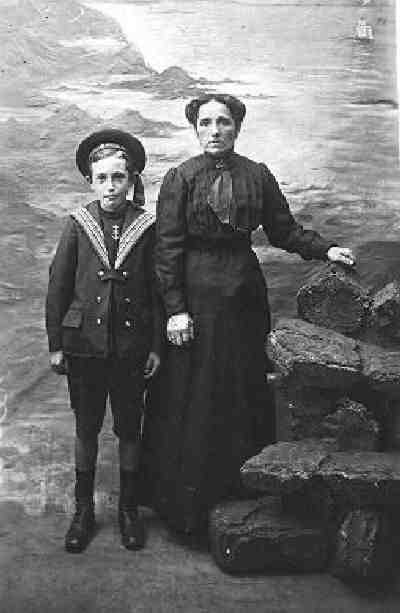
HBC believes that the styles for sailor suits in Belgium were similar for that in France. One exception may have been the suits, especially the caps with the red pom, styled on the uniforms for the French Navy. We do not see those in Belgium. We see quite a diverity of styles even into the waely-20th century. Many boys wore traditiinally styled suits, but they were by no means unversal. Thestandard style was the icomic V collar front and back flap, often detailed with stripes, like the boy here (figure 1). There were other styles, but none of them even approachd the populrity of the V collars. We see a few boys tht had blouses with pointed collars a various detailing. Thy were, howevr, only a small fraction of he sailor suits we habe found in the photigraphic record.
The detailing on Belgian sailor suits appears similar to those we have seen on French and Dutch sailor suits. We note nothing destinctive about the detailing on Belgian sailor suits. There seems less variety in the Belgan sailor suits than we have noticed in Germany. The Belgian saiklor suits seem to be basically rather traditionally styled. The use of the basic three stripe detailing seems less common than we have noticed in America and Britain.
HBC is not quite sure just what age groups wore sailor suits in Belgium. We believe that the age range was comparable to that in France. We have no information on the 19th century at this time. We note both young and older boys boys wearing them in in the early 20th century. We also note even younger teenagers wearing them through the 1920s, although this became less common in the 1930s. After the 30s they were mostly worn by younger boys.
The sailor suit gaments were the same as worn throughout Europe. We do not yet have enough Belgian images to know much specific styles and garments. As far as we know, Belgian styles were quite similar to those worn We do not know of any specific Belgian styles at this time. The sailor caps commonly worn to those worn elsewhere in Europe. Flat top caps with streamers were popular in the early 1900s. Most boys who wore sailor suits would have a matching hat or cap. Many boys wore their streamers to the side for photographs, but we do not think this is how they normally wore their caps. Smaller boys wore broad-brimmed hats with streamers. Older boys wore caps more like the ones wore by sailors. After World War I, boys in the 1920s were less likely to wear sailor caps with their suits. Many Belgian boys wore standard middy blouses. The boy here wears a jacket with double button rows, but held closed by a kind of tab on the top buttons (figure 1). The standard three white stripes were common in the detailing as was a nautical motif on the dicky. Most boys wore knee pants with their sailor suits in the early 20th century. Some boys wore bloomer knickers. After World War I (1914-18), short pants became more popular. We see long pants suits , often for formal occassions.
|
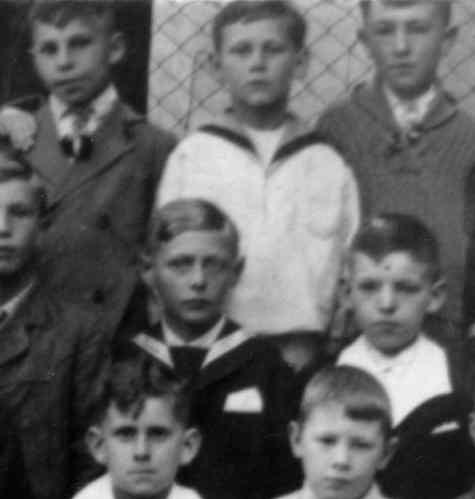
Belgian boys wearing sailor suits had a wide variety of hair styles. These of course changed over time. Some boys had very short almost shaved hair, especially in the late 19th and eraly 20th centuries. Most boys wore short medium-length hair. This was especially true by the late 1920s after World War I (figure 1). Social class factors may be involved here. We suspect that boys from working class families may have been most likely to have had closse-cropped hair. The boys most likely to have been photographed in smart sailor suits, were probably boys from middle-class and more affluent families which more commonly had the medium length hair cuts we see in most of the available photographs. A few boys had long hair styles. We have not yet noted boys with ringlet curls. but this may because we have a limited number of images.
Most Belgian schools did not require a uniform. Sailor suits were, very popular for school wear at the turn of the century. Even after World War I in the 1920s, many boys wore sailor suits to school, although they were no longer the majority. The styles could be quite varied. By the 1930s, sailor suits were less popular, but in many classes a few boys still wore them.
Sailor suits were especially popular in the early 20th century. Most were dark suits, but we note some white suits as well. Most boys wore sailor caps with these sailor suits. We do have one undated photograph of a Belgian boy taking First Communion in an elegant kneepants sailor suit. I am not sure if it is black or navy blue. We would guess that the portrait was taken in the 1910s, perhaps before World War I. The sailor suit pictured here is a rather elegant one. It is worn with a matching soft top black cap. There is a jacket which buttons rather than a middy blouse. It is worn with a plain white shirt with clored detailing at the collar, rather like a dicky. Also notice he is wearing a white button front vest under the middy jacket and over the white shirt or dickie. It is worn with matching dark kneepants and long black stockings. He has lace-up shoes. He has white gloves and even a hankerchief in his sailor jacket. HBC rarely noted hankerchiefs being worn in sailor jackets. This suit was a dark suit, but we note white suits being worn in France during the 1930s-50s and the same was probably true of Belgium.
Both boys and girls wore sailor suits in Belgium. Girls of course wore sailor sits with skirts rather than pants. This was the general pattern in Belgium. It was boys who first began wearing sailor suits. We do not yet fully understand the chronology of the sailor suit in Belgium. And we do not know when girls first began wearing sailor suits as well. We know that girls were wearing sailor suits at the turn of the 20th century. We note both styles worn by both boys and girls as well as some special more elaborate styles for girls. The common styles were the more tradituinal styles like actual uniforms. Some mothers dressed all the children in sailor suits, sometimes with identical styling. Other mother chose different styles for the boys and girls or just chose one gender for the sailor suits. Age was a another factorto be considered. Younger boys were more likely to wear the same sailor suits their big sister wore than older boys the same suits as their little sisters.

Sailor Suit Country Related Pages:
[Return to theMain country sailor suit page]
[American]
[]
[English]
[French]
[German]
[Italian]
Other Related Pages:
[Sailor suits]
[Kilts]
[Smocks]
[Pinafores]
[Sailor Hats]
[Blouses]
[Ring Bearers]
[Long hair]
[Ringlet curls]
[Hair bows]
[Bangs]
[Collars]
[Bows]
Navigate the Boys' Historical Clothing Web Site:
[About Us]
[Return to the Main Belgian garment page]
[Introduction]
[Activities]
[Biographies]
[Chronology]
[Countries]
[Essays]
[Garment index]
[Bibliographies]
[Contributions]
[FAQs]
[French glossary]
[Dutch glossary]
[Images]
[Links]
[Registration]
[Tools]
[Boys' Clothing Home]