|
Few garments are more associated with boyswear than the sailor suit. While no longer commonly worn, the sailor suit was worn by boys in Europe and America for a century. The origins of the boys' sailor suit or vague. Apparently it was in England during the first quarter of the 19th century when someone had the inspiration that boys should wear sailors' trousers. (Some sources suggest an even earlier appearance of the sailor suit as boys' atire, but as yet I cannot confirm that.) It is not known who first conceived of the idea. It is known with certainty, however, who popularized it--Queen Victoria. It was a clevely designed effort to associate the monarchy which had declined in popularity with the most popular institution in Britain--The Royal Navy. The result was a stunning success for the monarchy and a fashion that dominted boyswear like no other style for a century.
The origins of the boys' sailor suit or vague. Apparently it was in England during the first quarter of the 19th century when someone had the inspiration that boys should wear sailors' trousers. (Some sources suggest an even earlier appearance of the sailor suit as
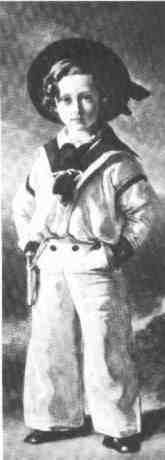
boys' atire, but as yet I cannot confirm that.) It is not known who first coceived of the idea. It is known with certainty, however, who popularized it. It was Queen Victoria who began to dress the young princes in sailor suits during the 1840s. The 5-year old Prince of Wales (the future Edward VII) was not the first English boy to wear a sailor suit. It was, however, when in 1846 the prince's portrait was painted onboard the royal yacht during the Queen's visit to Ireland that the sailor suit began to attract the interest of English mothers and eventually mothers around the world. The prince wore a scaled down version of a real Royal Navy uniform. The uniform was arefully chosen to be an enlisted man's sailor suit. This can not have been an acident. It was almost certainly a carefully chosen decision calculated to give a favorable impression of the monarchy to the British people. Unfortunately HBC does not yet have details on precisely how the uniform was selected. The sailor suit was not, however, an immediate success as a style for children. For several decades relativey few English boys wore sailor suits. It was
not until the 1860s that increasing numbers of BEnglish boys were wearing them. By the 1880s, the sailor suit was widely worn by children, both boys and girls. Few English boys grew up by this time without wearing a sailor suit. Some boys wore practically nothing but sailor suits.
The Royal Navy was founded by Henry VIII in the 16th century and four the next four centuries has played a central role in modern history. It is no exageration to say that Royal Navy was the critical force in the creation of the modern world. The Royal Navy is common seen as an instrument of British colonialism and the suppression of many Asian and african peoples. This is certainly true. It is also true that the Royal Navy helped establish the modern world trading system. It broke up the closed international system established by Spain and Portugal and replaced it with a much more open system. The Royal Navy impact on the modern world is extensive and pervasive. The Royal Navy chartered sea lanes around the world. There are few ports and sea coasts that have not been touched in some way by the Royal Navy. The Royal Navy played an important role in the Indistrial Revolution. It helped to defeat series of opponents for the most part countries goverened by authoritarian or dictatorial rulers (Philip II, Louis XIV, Napoleon, Kaiser Wilhelm II, and Hitler). Thus the Royal Navy played a key role in establishing parlimentary democracies in the modern world. It was the Royal Navy that ended the slave trade. Although the Royal Navy played a major role in the Revolutionary war, it is also true that for much of the early history, the Royal Navy provided a shield from European interference behind which the American Republic developed. The prestige of the Royal Navy by the 19th century was such that the uniform of the British enlisted sailor became a standard outfit not only for British boys, but also for boys throughout Europe and North America.
The sailor suit is essentially a Victorian style. Sailor suits as outfits for boys appeared first in the mid-19th century. Some reports suggest that boys may have worn sailor suits in the early 19th century. We can not yet confirm this. We do know who popularized the sailor suit. It was the British royal family. The Royal Family chose a copy of a Royal Navy uniform--astutely an enlisted uniform. Many other parents purchasing a sailor suit or their children chose much more imaginative designs. Gradually as the sailor suit grew in popularity the styling became more standadized on actual uniforms. This varied somewhat by country as did the age of the children wearing sailor suits. The sailor suit was a first only for boys. Girls gradually began wearing dresses with sailor styling and eventually sailor suits as well. The sailor suit persisted as a popular style for boys in Britain until after World War I.
The initial English sailor suits for boys had traditional styling meaning they were minature reproduction od the uniforms weorn by Royal Nasvy enlisted men. As the style began to become a popular style for boys a variety of more styilized creations appeared in the late 19th century. Many diverged significantly from traditionl styling, but for the most part were instantly recognizable as sailor suits. These more creative versions came in many different styles. Designers also played with the standard blue and white colors, but this is difficult to onserve in the black and white photography of te day. Some retained the "V" front and back flap, but some even played with these basic sailor features. Traditional styling never disappeared and gradually by the turn of the 20th century was the dominant style. Thus in the 20th century most English sailor suits were made with traditional styling.
We note mostly younger English boys wearing sailor suits. We do not see many boys wearing them older than about 10 years of age. Most boys stopped wearing sailor suits after about that age. Some older boys may hasve worn sailor suits, but we do not note teenagers, even younger teenagers wearing them. We see older boys wearing sailor suits on the Continent, especially in the 20th century. This was when well-to-do boys began preparatory school. This acted to set an age standard throughout Britasin. And the sailor suit was most popular with well-to-do families and middle-class families that were most likely to be able to aford private schools. We see some younger boys at prep schools wearing sailor suits in the later-half 19th century. This was, however, when prep schools were just beginning to become established. Many early prep schools did not have uniforms. Of course only a limited number of English boys went to private schools, but they had a major impact on boys' fashions during the 19th and early-20th century when sailor suits were most commonly worn. Age trends varied over time after the sailor suit first became a boys' style, introduced by the royal family (1840s).
|
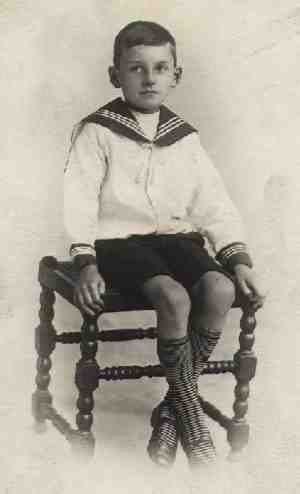
There are a range of sailor style elements used on a range of sailor garments. These are not garments, but elements used with sailor garments and styling. Sailor headwear had tallies like the shop tallies worn by Royal Navy sailors. Another element was the streamers on sailor caps and hats. These were not exclusive to sailor headwear, but were strongly associated with it. This gets a little confusing because wide brimmed-sailor hats became worn by boys and girls even when not wearing sailor outfits. We also notice the streamers on Scottish bonnets, but are unsure at this time as to any connection. Surely the most important element was the destinctive V-front sailor collars used on blouses and other garments. They were done in a wide range of styling and detailing. Another element was bows or scarves used with sailor collars. There was also the back flap added to the V-front collar. This is one way of didderentating English and German sailor suits. There were also coordinated sleeve cuffs like the boy here has (figure 3). Both the V-collar and cuffs could vary quite a bit. Another important element is the bellbottom feature on some long pants sailor suits.
Quite a range of garments were made with sailor styling. Some are a little difficult to classify. There were many different styles of sailor headwear. We note boys wearing sailor headwear with many diffeent outfits and not just sailor outfits. The two basic sailor suit garments were the middy blouse and trousers. Middy blouses were pull-over garments. We also note button-up tops. This inclides both blouses and jackets. The first trousers worn with the sailor suit were the bell-botton trousers worn by British sailors. Gradually as kneepants and knickers became common for boys to wear, many boys began wearing these sortened pants with middy blouses as well. There were many other sailor garments such as Jack Tar suits, reffer jackets, sailor tunics, and square cut blouses all of which were done in a wide range of styles. And there were dresses and skirts done with sailor styling for both younger boys and girls of all ages.
Sailor suits were made in a range of materials. This reflected the cost, purpose, and seasonality. The middy blouse and pants might be done in different fabrics. This was particulrly true of summer suits. Most summer suits were made in various cotton frabics as were play suits. One popular fabric was galatea, a strong twill-weave cotton fabric. It could be striped or plain. It was named after the Rotal Navy man-of-war HMS Galatea It was afabric paryticuilarly noted for use in sailor suits, I think both Royal Navy uniforms and children's sailor suits. A little more expensive sailor suit might be made in linen--especially the blouse. Winter suits were more likely to be made in wool fabrics like serge. More expensive dressy sailor suits might be made in velvet. It is difficult to assess the specific fabric from photographic images. An exception here is velvet.
The sailor suit may be the most popular style in the history of children's fashion.The question arises as to why the sailor suit was so popular and lasted for about a century as a popular style and has still not totally disappeared. We believe that a key reason is that both the parents and children liked them. Some fashions like the Fauntleroy suits were a favorite of mothers, but not the boys. The sailor suit was different. For decaded the sailor suit not only had the aura of royalty, important to fashion-concious mothers. And it had wide appeal accross class lines, both upper- and midle-class mothers liked it. It symbolized Britain's greatness through the association with the Royal Navy. We are less sure about the working class, but some woirking-class mothers also liked the look. Many mothers saw the sailor suit as a charming style for children. Fathers also liked the style. King George V insistd that the princes and princess wear sailor outfits. There were also practical considerations that helped popularize the sailor suit. The sailor sut was a versitile garment that boys could wear for both play and dressing up. It was a widrly worn outfit at Britain's popular seaside resorts. A good example here is the outfit worn Harry Shaw, probably about 1890. We not only see studio portraits, but sailor outfits being wotn by boys and girls for public occasiins. The Cambridge-Oxford Boat Race is a good example. Many sailor suits were for summer wear seaside holidays. The suits were designed to withstand the salt water and sunshine. We also see sailor outfits done in heavier fabric for winter wear. The reefer jacket became a standard coat type. Parents, especially middle-class parents, appreciuated the fact that sailor suits were both versatile and durable. Sailor suits were ideal for a variety of social situations, including both formal to the informal. This was important in an age when most boys did not have large wardrobes. The versatility can be seen in that girls as well as boys began to wear sailor suits. In fact, as girls began to attend school as commonly as boys, educators tirned to the sailor suit as a gym unifor,. We see white middy blouses worn with black bloomers, they allowed more freedom of movement than girls had experience before in their clothes. Sailor suits were durable because expensive, delicate fabrics that were not easy to care for were not commonly used.
The key to the popularity and longevity of the sailor suit is that not only did parents like the style, but the children also liked it--both boys and girls. The boys liked the aura of military style--especially an asociation with the prestegious Royal Navy. And in modern times it is no accident that iconic figures like Donald Duck and Popeye wore sailor suits.
The sailor suit was a popular boy;s outfit for neaely a century. Acrually it was more poopular uin ithers ciunriesm epdcuialy France abd Germabny, than Englabd. But it was very popular in England. The phiotiographic record suggests that there was a social class factor involved here. We believe that the sailor suit was primarily worn by upper-class and middle-class boys. We are not entirely sure why, but these groups were most likely to be infuenced by how royalty dressed the princes. Sailor suits were only used to a limited extent by Queen Victoria abd Prince Albert, but King Edward VII and King George V used them extensively probably in petr to please Victoria. Ideological iussyues nay aksi have been involved, but we are not sute how ideology had affectedc the working class in the late-19th and early-20th centuries. This is a little difficult to assess with any surity, but there are clues such as how sharply ay=th bioys are dressed abnd theuir griooming. In additiion some images include the parents. We can also assess school photography to see how boys were dressed for schiol. The schools woukd include many working-class boys.
It was Queen Victoria's sons who first wore sailor suits. The style was initially one for boys. Queen Victoria did not dress her daughters in sailor suits. We are not sure when the sailor suit first became a popular style for girls as well. We known that the Prince of Wales and Princess Alexandra dressed their daughters in dresses with sailor styling in the 1860s-70s. They may well have been some of the first girls to wear dresses with sailor stylinng. We begin to see girls more commonly wearing sailor dresses in the 1880s, including dresses with traditional sailor styling--not just elements of sailor styling in their dresses. By the 1890s we see whole families wearing sailor outfits, sometimes coordinated outfits. Many brothers and sisters wore identical middy blouses with the boys wearing pants and the girls skirts. Sometimes the headwear was also identical.
Most of the photographs we have found of British boys are individual portraits or family portraits with the younger boys wearing sailor suits. Some portraits show the entire family dressed in sailor suits, in some cases even the girls. What is very rare is any kind of non-family group portrait of boys wearing sailor suits. We do note some of the younger boys at schools wearing sailor suits, but these are not uniforms, just sailor suits there mothers have chosen. This is easily observable because the sailor suits the boys wear are all different. We have found a few images of boys wearing uniform ailor suits. We have not, however, been able to determine just what the group was. Similar ages show that they are not family groups. A school group is possible, but we have yet to find a verifiable school group with the boys dressed in sailor suits.
The sailor suit when introduced by Prince Albert and Queen Victoria was for Bertie and the other royal princes (1840s). The princesses did not wear sailor outfits. We are not sure just when girls in England began wearing sailor outfits. The first such image we have noted dates to the 1870s, but we believe that girls began wearing sailor outfits earlier. Just how much earlier we are not sure. It is a topic we are working on and hope to address
as HBC expands. We note many examples of both sailor dresses and sailor blouses and skirts furing the 1880s-1910s. We know that girls for gym wore bloomers, but weare not sure they wore sailor blouses with their bloomers as in America. We are not sure to what extent whole families were outfitted in sailor outfits. We see that with the royal family (both Edward VVi and George V). As to ordinary families we do not see a lot of examples. We think this was more common in Germany, but we do see some exmples. Sailor suits for boys declined in popularity after World War I. We are not sure about the trend for girls yet. Many American girls wore sailor blouses and dresses for school. A factor here is the fact that private schools had uniforms so sailor outfits were out for them. Of course they could be worn to the state schools which until after World War II did not have uniforms. So we are looking into this as well.
We have very little color information on English sailor suits. Virtually all the images we have or black and white. And we have very little information from English catalogs which ofen had color information. Of course blue and white would be the predominant colors. We note blue and white in America as well, although we note many more colors in America a well. We do not know how commonn these non traditional colors were in England. We suspect they were not as common, but we can't confirm that. We have found some illustrations, but we are not sure how reliable the color depictions are.
Color and seasonality were related. Boys generally wore while sailor suits for the warm summer weathrer and and navy blue suits for the colder winter monyhs. It was, however not quite that simple. The material could also chanhe. White summer blouses were usually done in a light cotton or pethaps linnen shirting material, often with blue detailing. Navy blue blouses and pants were commonly done in heavier suiting material. And while many boys had the white summer blouses. Often they wore the haevier blue pants in summer as well instead of changing to lighter-weight white pants. This all varied from family to family. For families with modest income, the choice of wearing the heavier blue oants during the ssummer was a viable option. The choice of long or shortened=length pants seems more of a family fashion convention than a seasonal matter. Although the choice of hosiery does seem to to have been a seasonal matter. Boys might wear long stockings during the winter and socks during the summer. This differed with America where long stockings were commomnly worn even suiting the summer during the late-19th and rarly-20th century. There was also a color change with the hosiery English boys wore with their sailor suits. The summer socks were often white and and the winter long stockings were mostly dark. The girls of course had the same optiins as to the same sead=sonal choivs of color and nmaterial fot their blouses, desses, skirts, and hosiery. There of course were no hard and fast written rules. Mothers could do what they wished, but these were the general patterns.
Here we will incluse personal accounts we find as well as individual pages we have loaded whether or not we have biographical information. These personal accounts are rather limited at this time, but we hope to add more as HBC develops.
The Shepards (The 1890s)
Unidentified violinist (1914)
A HBC contributor notes that the biography of a famous British dancer/choreographer Frederick Ashton should be consulted. Frederick and his brother wore sailor suits as a boy. While British he was born in Ecuador. I hope to find the book.

Sailor Suit Country Related Pages:
[Return to theMain country sailor suit page]
[American]
[]
[French]
[German]
[Italian]
[Polish]
Other Related HBC Pages:
[Main English garment page]
[Sailor suits]
[Kilts]
[Smocks]
[Pinafores]
[Sailor Hats]
[Blouses]
[Ring Bearers]
[Long hair]
[Ringlet curls]
[Hair bows]
[Bangs]
[Collars]
[Bows]
Navigate the Boys' Historical Clothing Web Site:
[Return to clothing styles]
[Introduction]
[Activities]
[Biographies]
[Chronology]
[Clothing styles]
[Countries]
[Bibliographies]
[Contributions]
[FAQs]
[Glossary]
[Images]
[Links]
[Registration]
[Tools]
[Boys' Clothing Home]