|
The French film industry has made some beautiful films about children, including both school films and coming of age films. Two wonderful classics are Auervoir les Infantes (France, 1990?) and Murmer of the Heart (France, 1971). Clothes and school uniforms worn during the 1940s are shown in Auervoir les Infantes (1990?). Clothes and school uniforms worn a decade later are depicted in Murmer of the Heart, including the white knee socks worn by schoolboys at Catholic colleges (private secondary-level day and boarding schools). Zero for Conduct (France, 19??) is another well known film. A film made by Americans, but shot in France is Happy Road.
Les Amités Particulières is a classic French film. It is a very romanasque novel. The title could be translated as "The Particular Friendships". Roger Peyrefitte's original book was translated into English as Special Friendships. That English translation is a bit misleading. The novel is about a platonic relationship between boys at a boarding school. I saw the film several years ago and do not remenber the details. The boys, as is the case at most French schools do not wear uniforms. They do commonly wear suits and many boys wear short pants suits with kneesocks.
Jean-Loup Hubertd made Après la guerre made in 1988. It describes vision of war through kids eyes, narrating adventures of two brothers aged about 7 and 9 years. It is set in the midst of World War II. The boys are waiting in a small village south of France for the arrival of Allied forces. They are confused an mistakingly assuje that retreating German tanks are the Ameruicans arriving. It was summer 1944. The older boy was dressed in the uniform of a village fanfare (band) that was to welcome the U.S. soldiers. The younger boy was wearing his grey school smock. The two boys run back to village shouting "They arrive". The whole village gathers for a big welcome with French and U.S. flags. When the German soldiers enter the village, they are not amused about such a demonstration and proceed to shoot the mayor. Afraid of their foolish mistake, the two boys slip away to rejoin some family in Lyon. One boy wears a girl's sun smock to desguise himself as a girl.
This wonderful, but tragic film is based on the prsonal experiences of Director Louis Malle's tragic Au Revoir. Au revoir les enfants would be loosely trans;ated, Goodbye Childhood. Malle is a gifted craftsman who directed another film illustrating French boyhood fashions, Murmer of the Heart. The conclusion of the movie is heart breaking. Until the end it was a rather ordinary film describing boyhood conflict and friendships at a French boarding school. The conclusion is shocking, especially as it actually occured and the director Louis Malle witnessed it.
|
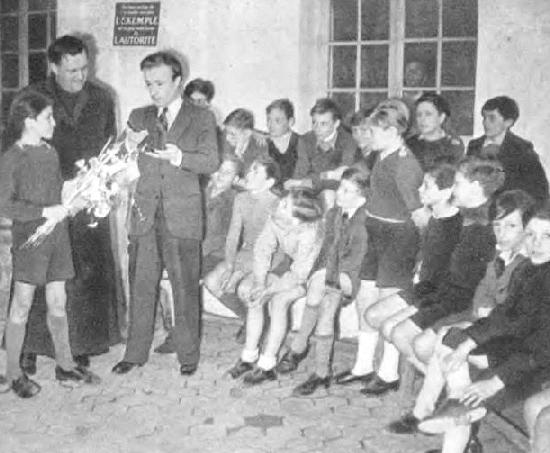
The French movie La cage aux rossignols ("The cage with the nightingales") used choristers from the French boys choir Les petits chanteurs a la croix de bois, the Little Singers of the Cross of Bois. The story line involves a young professor who is employed in a house for delinquent children. He is a musician and decides to create a choral group to develop the children who are mistreated in the home. The pictures on this page are the choir mememberrs meeting to practice. The movie has a contemprary setting, the
mid-1940s. The scene here shows the choristers in an informal momment. It shows casual clothes commonly worn by French boys during the mid-1940s. This is one of the few French films that we know of dealing with a boys' choir.
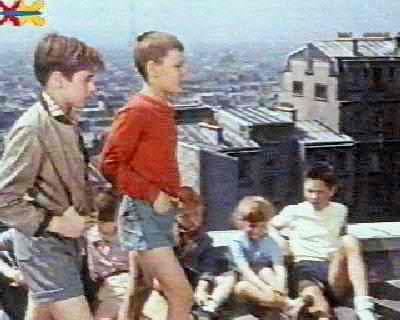
This interesting little French film is set in a run-down suburb of Paris. Regrettably, as they so often do, the TV channel cut the credits short before the date came up, but it looks to me late 50s or 60s. There are few cars on the road and the ones you do see are pretty
old-fashioned. It's about a group of bored children making mischief to fill the days (eg
sticking a cat up a tree and then calling the fire brigade so they can
watch them get it down!) One of them has a Chinese kite, with a message on a piece of paper in Chinese on it. His mates try to grab it to sell to an antique shop.
One night, one of the boys and his sister are visited by a mysterious Chinaman and are promptly floated off on their bed to China in their pyjamas.
The Chinaman clicks his fingers and they appear once again in their everyday
clothes, and have all sorts of adventures in China. As for clothes details; it's much clearer on the telly than in these grabs. Footwear: mostly plimsoles and various varieties of brown sandals. Trousers: mostly shorts....interestingly, many German-style leders,
sometimes rolled up at the bottom. One kid wears jeans, and as is so often
the case, age seems to have nothing to do with it; he's by no means the oldest.
Shirts: a variety of t-shirts and normal button-up shirts with collars. Headwear: only the Chinese kids seem to go in for that, and then not very
often.
The original French title of this film is Les Diaboliques. I think that would translate as The Devils. The film was released in 1954 and the clothes worn by the children are a good reflection of French boys' clothes at mid-decade. It is a very good thriller set in a seedy French boarding school. The tale involves the headmaster and his wife in a murder plot. A film guide discribes it as "A sadistic
headmaster's wife and mistress conspire to murder him; but his body disappears and evidence of his presence haunts them." The film appeared in a German version as Die Tauflischen.
HBC knows very little anout this important French film at this time. It was directed by French filmmaker Jean-Loup Hubert. The movie stars the director's own son Antoine Hubert. He beautifully lad plays a sickly 8-year-old who is sent off to visit country relatives while his mother has a baby. Close knit French families did often send children to live with relatives for a time. The film covers his country adventures which vary from enchanting to scaru. The film has a little of a European "coming of age" tone to it, although the boy is very young. Grand Chemin was released in the United States as Grand Highway. A French reader tells us, "'Le grand chemin' is a very important film which is realy a deep story about the French character. I love this film very much, but I'm not sure how it could be translated to English".
|
Happy Road is a film made by Americans, but shot in France. Happy Road was relaeased in 1957, but it has a somewhat earlier look. Two children escape from a French boarding school so that they can reunite with their parents. The boy thinks that making it to Paris will demonstrate that he can look out for himself. For film buffs, Happy Road is good fun and entertainment--a "Gee, they don't make 'em like they used to" film.
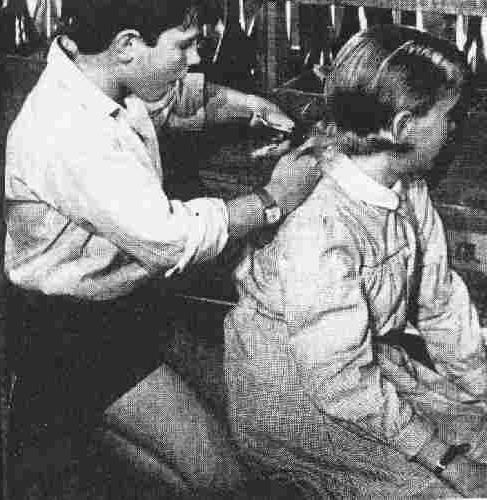
A French reader tells HBC that younger boys might wear their smocks after school. But this was less common on thursday and rarely on sunday wich were day to
wear the "L'habit du dimanche". He indicated that A French movie of 1953 explains this fashion. It is a classic French film and know to most French people--"Jeux interdits" with Brigitte Fosset and Jean Claude Poujouli.
Kirikou is the production of a European, primarily French team. The team inckides producers and animators in Belgium Luxembourg, and Latvia. An African boy is is the protagonist of a series of animation movies, set in a traditional African village. The first film was 'Kirikou and the Sorceress' (1998). It depicts how a newborn boy, Kirikou, saves his village from the evil witch Karaba. Kirakou was not a normal boy. Even as a new born he knows just what he wants. He already can speak and walk. His mother alerts him to an evil sorceress. She has has dried up the village water spring. She has devoured all village warriors except for one. Brave little Kirikou decides he will accompany the last warrior to confront the whicked sorceress. He proves to be the last hope of the beleagered village. It proved so sucessful that it generated a series. Next was 'Kirikou and wild beasts' (2005) and 'Kirikou and men and women' (2012). The Kirakou series is set in Africa before or at very beginning of the colonial rule. The women are shirtless and the children unclothed. Some complained about this when the films were released. One important part of the first film is that Kirikou, keeps asking, "Why is Karaba so mean and evil?" The answer is very thiought priovoking. There is also a wonderful sound track by Youssou N'Dour.
"Mare Nostrum" (Our Sea,i.e., the Mediterranean, but also the name of the male lead's boat) is an important French silent film. It was directed by Rex Ingram in 1926. Ulysses Ferragut (Antonio Moreno), the owner and captain of the boat, has an uncaring wife and a teenage son, Estaban (Mickey Brantford), whom he loves very much. An evil but sexy German spy Freye (Alice Terry) seduces Ulyssess and inveigles him into helping bring supplies to a German submarine. Ulysses agrees to do this only to have the submarine tragically blow up the ship that his beloved son Estaban is travelling on. Freya Talberg, the seductive spy (who was married incidentally to the film's director, Ingram) is executed by firing squad.
This is another of Louis Malle's films. Malle is also famed for Aurevoir les Enfantes. A French school boy is shown in ordinary life scenes at the beginning of the film. He is diagnosed with a heart murmer and has to go to a sanotarium/spa for treatment. Clothes and school uniforms worn in the 1950s are nicely illustrated in this classic French film. Of special interest is the boys school uniform. Most French boys did not wear school uniforms and in the 1950s smocks had begun to decline in popularity. The main character in this film went to a private French Catholic college(private secondary-level day and boarding schools). A common uniform at these schools was a white shirt, blue seater and short pants, and white knee socks.
|
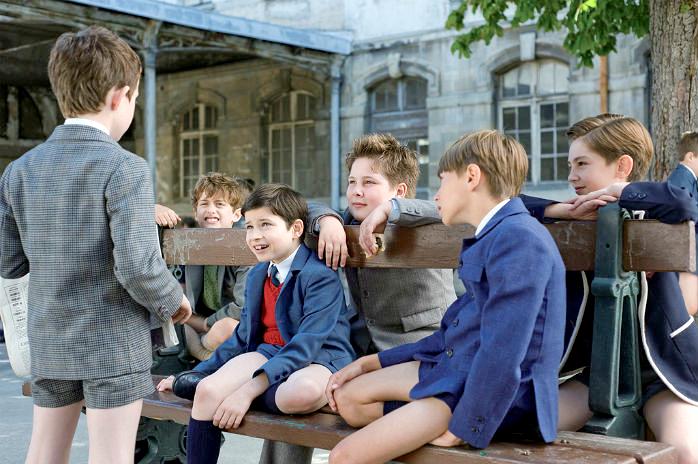
The movie 'Le Petit Nicolas' (Little Nicholas) was a captivating film about a French school boy and his mates. It was based on a series of French children's books authored by René Goscinny and illustrated by Jean-Jacques Sempé. It first appeared (1959). At the time it was set in the time period depicted. The film retains that 1950s setting. The charming books depict an idealized French childhood, a little like a trend began in America: Peck's Bad Boy and Perod followed in Britain by Our William and the Jennings series. Nicolas seemm a little more innocent and less mischivious, perhaps relcting betterbehvioir expected in France. The series began a little earlier as a comic strip in the Belgian magazine Le Moustique (1956 and 1958). It was the work of the illustrator Sempé and written by Goscinny. Goscinny began to write 'Le Petit Nicholas' as short storries illitrated by Sempé. An English edition with the title Young Nicolas was completed by Stella Rodway for Hutchinson & Co. (1961). The books were published in the United States (1962). The characters' names for the most part retain the French form. Part of the charm of the series is that they are told from the point of view of Nicolas, of course the main character in a way that micics how a boy would actually tell the story with a genrous dose of captivating schoolyard slang. And like the American and British books, many of the story lines are based on how Nicolas misunderstands adults. It was moving toward the now standard modern children's literature based on child's interpretation of the world which we do not see in the earlier classics. We do not see a French film version until (2009). It was directed by Grégoire Vigneron and Alain Chabat. Nicolas is nicely played by Maxime Godart. It was well received by critics and had an excellent box office. As in the books, the film is set in 1950s Paris. Nicolas and his school friends get into mischief, both intentional and unintentional. The film version centers on how Nicolas, an only child, gets the idea that his mother is going to have a baby. He is uncertain about the idea of having a baby brother. (For some reason he assumes it will be a boy.) At schhol, a friend who has a baby brother tells him how bad it is. Nicolas gets the idea that his parents no longer want him. He and his school mate devise a plot to raise 500 francs to hire a kidnapper and leave the baby in a far-away jungle. Strangely, the boys seem dressed more like English than French school boys. None of the boys wear smocks which were still very common in the 1950s. The blazers and suits seem rather British.
A French reader mentions " Un Petit Parisien ", a TV-film of Sébastien Grall from the the book of Dominique Janet. He reports, "Benji a huit ans lorsque son père Claude, prisonnier de guerre est libéré. La famille s'installe à Paris mais la mère meurt d'une longue maladie. Claude est pourtant nommé au lycée Montaigne, comme professeur de lettres. Depuis le décès de sa femme il commence à mener une vie mondaine, s'entoure de femmes et collabore avec les allemands." That means, "Benji is 8 years old when his father Claude, a prisoner of war is released. The family settles in Paris but the mother dies of a ligering disease. Claude obtains an appointment to Montaigne college, as professor of letters. Since the death of his wife, he starts to carry out a fashionable life, surrounded by women and collaborating with the Germans." The cast was: Enzo Bosseti: "Benji" Thibault de Montalembert: "Claude" EliseTielrooy: "Dora"
A made for TV movie which features French Italian boys wearing dark smocks and berets. "Rital" is a derogatory French term for Italian-French. HBC has no information on this film at this time except for the fact that the boys wear smocks and berets. Hopefully French or Italian readers will provide details.
The film stars Francis Lascombrade and Didier Haudepin. Hauntingly beautiful movie about a friendship between a younger (Alexandre) and older (George) boy at a strict Jesuit boarding school. The brothers sharply censure "impure" friendship and the movie has a predictably sad ending. The younger boy appears often in shorts and knee socks.
HBC knows nothing about this film other than it is a French film and seems to deal with a boarding school. The boys wear blazers and short pants with white ankle socks. They wear starnge little ties. It looks to be set in the 1940s.
Zero for Conduct is another well-known French film. This French black and white movie from Jean Vigo was released in 1933. It was a short film only 43 minutes. It depicts life in a French boys' college. There are boarders and day-pupils, I would say between 9 and 14 years old. It is not a religious college but I cannot say whether it is private or public, but the fact that it had boarders suggest that it was a private sdchool.. The
movie finishes with the revolt of four boys throwing things to the guests from the roofs during the college f�te. A precursor of the British public school movie If.

Navigate the Boys' Historical Clothing Web Site:
[Return to the Main French movie page]
[Return to the Main movie page]
[Return to the Main French page]
[About Us]
[Introduction]
[Activities]
[Biographies]
[Chronology]
[Clothing styles]
[Countries]
[Theatricals]
[Bibliographies]
[Contributions]
[FAQs]
[Countries]
[Glossaries]
[Images]
[Links]
[Registration]
[Tools]
[Boys' Clothing Home]