
Shane (United States, 1953)
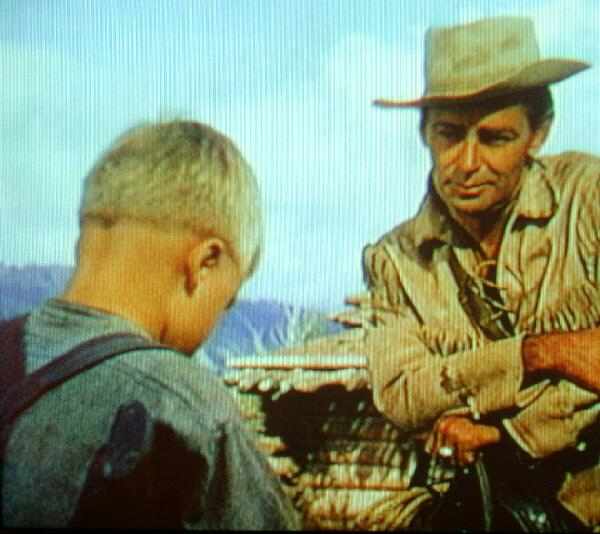
Figure 1.--It is Brandon deWilde's performance as Joey and relationship with the gunfighter Shane that helps to make this film perhaps the greatest Western ever made. There is none of the Hollywood kid sophistication, just purse innsence as the role demands. Notice Joey's bowl cut.
|
|
"Shane" is oine of the many Westerns that dealt with the range wars between the homesteaders and the ranchers. It is surely one of classic all-time favorite Westerns. The film is about a boy's attachment to a drifting gun slinger who saves his father. The father is a sod buster helping to organize fellow farmers against a wealthy rancher. The boy's father, however, has no chance against the gun man hired by the rancher Ryker. Shane steps in to take on the hired gun. Brandon De Wilde is a marvelous little actor. His expressions are perfectly done, one of the classic movie performances by a child star. His lines at the end, "Shane, come back Shane," are some of the most famous lines of all time. He wears a bowl-cut hair style which must have been very common for boys on the frontier. He also wears kneepants with ankle socks.
Filmology
This classic Western was made by George Stevens. It was based on the Jack Schaefer novel.
Cast
The film stared Alan Ladd as the drifting gun fighter Shane. Van Heflin plays homesteader Van Heflin. The cattle baron Ryker is played by Emile Meyer. Marian, Starret's wife, is played by Jean Arthur. Jack Palance plays the other gunfighter in perhaps the best of all hois many vilinous roles, This is a powerful film with many good performances. Ladd's rather ignomatic depiction of the gunfighter is perhaps his single most important performance. The most importance performance, however, is that of Brandon de Wilde who play's Joey. Actually he has rather limited lines, but the camer returns again and again to his face. Although the film is not show through his eyes, that is the overall impression left by returning again and again to his face. One reviewer wrote, "It is Master De Wilde with his bright face, his clear voice, and his resolute
boyish ways who steals the affection of the audience and clinches Shane as a most unusual film." As a result of Shane Hedda Hopper dubbed Brandon the king of child actors. The performance probably represents the premier performance depicting a child in the American West. The only real competition would be Claude Jarman, Jr in "The Yearling". Given Brandon's performance, it is interesting that Brandon was from Brooklyn. His costuming is the plain clothes of the American West during the late 19th century. ,
Setting
Wyoming's Grand Tetons provide the dramatic setting for the film. While a spectacular background, there are some problems with the setting. The Starrett family homstead is a log cabin, but in the various scenes there are no trees. Much more likely would have been a sod home. Of course a sod home in America doesn't have the same cachet of a log cabin. And it would have meant that all the chopping scenes would have to have been cut.
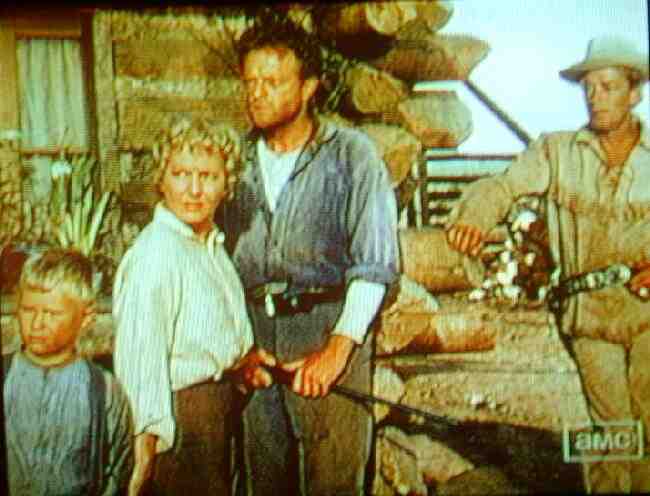
Figure 2.--Here Starrett and his family stand up to Ryker and his men who come to intimidate them or perhaps worse. Shane's presence unerves Ryker. Notice the log cabin. A sod home would have been more likely.
|
|
Plot
The film oopens with a wide-eyed Joey hiding in the tall grass stalking an elk. He first spots Shane (we never learn his first name) who stops at the family homestead to ask for a drink of water. Joey's father, homesteader Joe Starrett, is suspicious, especially when cattle baron Ryker arrives with his men to trample the family garden. They came to threaten Starrett, but are unerved by Shane's presence. Shane stays on to help on the homesteads and is soon attracted to Starrett's wife. Joey is almost immediately drawn to Shane, while not really understanding why, he realizes that Shane is different than his father and neighbors. At dinner he can't take his eyes off Shane's guns. Later in one of many brilliant scenes, Joey's reactioin to Shane's shooting is captured. Shane who is trying to move away from gun fighting becomes involved in the conflict between Ryler and the homesteaders. In part because he likes Starrett and his family and in part because he dislikes bullies. Actually why he lets himself is never fully explained in the film. The first confrontation comes when he goes into the town bar and asks for soda pop (for Joey). Romantic tension in the film comes from the fact that Mariana and Shane are drawn to each other. One is reminded here of Camelot and the Arthurian legend, althouh Shane unlike Lancelot does not run off with Guenivere. The film concludes with perhpas the most brilliantly staged gun fight of any Westerns. Again it is framed with Joey's expression as he watches under the swing doors of the saloon, and yells a warning to Shane as Ryker's brother tries to shoot him in the back.
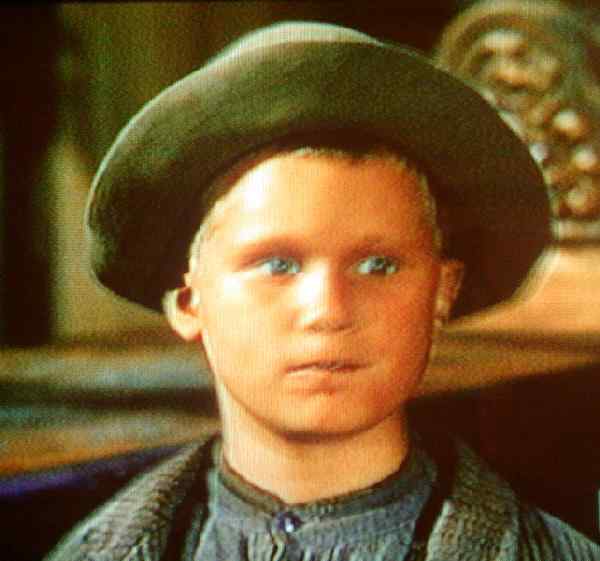
Figure 3.--Throughout the film, the action is framed with the amazingkly expressive face of Joey, none more so than the sectacular shoot out atthe end.
|
|
There are certain unforgettable scenes in novies. And 'Shane provides one of those classic scenes In fact it has to be very high up on that list. 'Shane' ends with Joey plaintifully yelling, "Shane, Shane, Come back Shane" as Shane rides off. He is too young to understand why Shane can not return with him to his parents.
Westerns
Many film critics consider "Shane" to be the greatest of all the Westerns. We are inclined to see it as one of the three greatests along with 'High Noon' and 'Hombre'" with 'Stage Coach' a distant fourth. In many ways 'Shanei is less compelling than the other two. The shootout at the end is pectacular, but the rest of the film drags a bit. It is DeWilde's performance that manages to bring 'Shane' into the ranks of the greatest Westerns. It surely is his best performnce.
Clothing
The most obvious garment worn by Joey is his rounded crown hat, a standard at the time for boys.
He usually wears it with brim up as we see here. We are not sure that is how boys usually wore thise hats. Joey wears knee pants with ankle socks. Here it's not clear if they are actually knee pants or long pants that he has outgrown. Knee pants were common at the time, but much more common in the cities than in rural areas. He also has suspeders wuich were common.
Hair
Joey wears a bowl-cut hair style which must have been very common for boys on the frontier.
HBC

Navigate the Boys' Historical Clothing Web Site:
[Return to the Main "Sh-Sl" movie page]
[About Us]
[Introduction]
[Activities]
[Biographies]
[Chronology]
[Clothing styles]
[Countries]
[Theatricals]
[Bibliographies]
[Contributions]
[Essays]
[FAQs]
[Glossaries]
[Images]
[Links]
[Registration]
[Tools]
[Boys' Clothing Home]
Created: August 20, 2003
Last updated: 4:59 AM 1/4/2018