|
Commercial radio began in America after World war I. Before the War, radio or wireless technology primarily involved sending morse code. Technical advances made dutring the War made it possible. The first American commercial radio broadcast took place on November 6, 1920, in Pittsburg, Peensylvania. The station was KDKA. A Westinghouse employee climbed into a wooden shack on the roof of a company plant and spoke into a converted telephine mouth piece. The first words were, "We shall now broadcast the election returns." He went on to provide details on the election of Warren Harding as president. It did not take long for radio to become a major industry. By 1925 about 10 percent of Americans had radios and by 1933, despite the Depression, 63 percent of Americans had acquired a radio. The radio industry is commonly viewed as primarily an intertaiment development. This is part of the story. Other very important aspects are the political and military import of the new industry.
Though forgotten today, these stations--which often featured popular broadcasters, and catered to working class and rural audiences--played an important yet overlooked role in shaping the future course of American broadcasting. Many of the television staples like news programing, detective shows, adventure shows, sitcoms, quiz shows, variety shows, evangelists, and others were all developed on the radio. So was the western, a now forgotten program type.
Commercial radio was a post World War I development. Wireless appeared in the early-20th century. It was a first sending morse code. It was how the RMS Titanic alerted other ships of the unfolding disaster (1912). Major advances were made during World war I (1914-18). Thus fter the War, the basic technology for commercial radio was in place. The first American commercial radio broadcast took place on November 6, 1920, in Pittsburg, Peensylvania. The station was KDKA. A Westinghouse employee climbed into a wooden shack on the roof of a company plant and spoke into a converted telephine mouth piece. The first words were, "We shall now broadcast the election returns." He went on to provide details on the election of Warren Harding as president. It did not take long for radio to become a major industry. By 1925 about 10 percent of Americans had radios
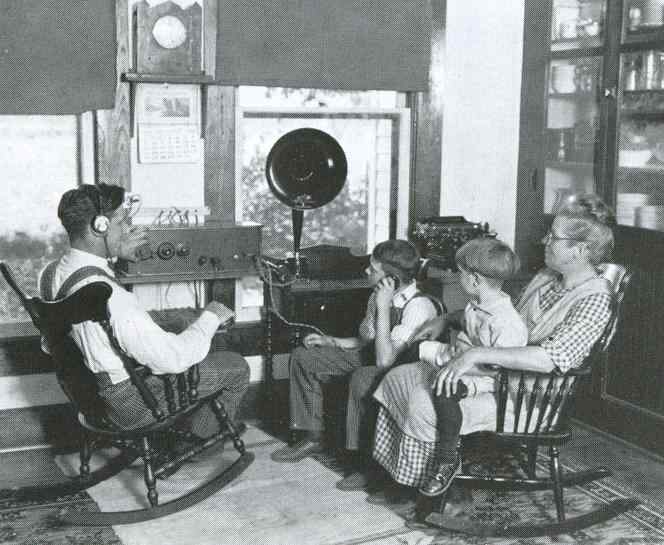
Radio came first to urban America. The early consumer sets were very expensive. The first stations had weak signals. Gradually at technology improved, spun forward by market forces stations with stronger signals were built. Despite the Depression, most American families had radios. An impressive 63 percent of Americans had acquired a radio (1933). The radio was given a place of honor in the living room. Even during the Depression, Americans had radios as the prices fell sharply due to mass production and the resulting market forces. This was not the case in Europe. Radio had continued througout the 1920s to be primarily an urban phenomenon. A major limitation in rural areas was that few farms had electricity. Electrical companies were unwilling to run lines into sparsely populated rural areas. The expense was enormous and the reurns much more limited than in the cities. This changed in the 1930s with the New Deal. The Rural Electrification Administration (REA) brought electrity to American farms. A reader writes, "The radio here is an electric appliance. We can see a set of plugs at rear. While farms were not connected to electrical lines, some farms had limited electricity generated by windmills which were once very common on farms in America and Canada. Before the rsadio here there was crystal radio. And batteries came only in the beginning of 50s." The radio was at the time a major piece of furniture. There were no transistors in 1941 and the vacume tubes used in radios made sets much larger than modern radios. Most American families would gather around the radio after dinner. Listening to news broadcasts and special programs on the radio was a familiar after dinner activity.
Radio began to reshape America after World War I. Commerrcial radio began to develop after the Waer with huge consequences for the economy and popular culture. Unlike the debelopment of radio in Europe, the Government played a minor role. And politics was one of the many aspects of american life that was affected. This began in a very minor way in 1920. Radio station KDKA in Pittsburgh, Pennsylvania, announced that Harding was the official winner of the 1920 election (November 1920). It was the first time that election returns were broadcast live. The new president was very interested in technology, perhaps because of his newspaper background. Harding recored a speech on an early 'phonograph' that recorded and played back sound on wax discs. Harding became the first president to atually own a radio and have one installed in the White House. There wasn't nuch to listen to at the time, but this very rapidly changed. President Harding addressing a crowd at the dedication of a memorial for Francis Scott Key, the composer of the 'Star Spangled Banner' and the event was broacast on radio, the first presidential speed to be broadcast (1922). The next major step was taken by President Coolidge. It was a huge step for the American presidency fundamentally changed with how presidents communicated with the American public. Previously a president could only address a small group or have his words convyed by the press. With radio a president could address the ebtire county without any filtering by the press. President Collidge was the first president to have his innagural address broadcast (1925). He was the first president to deliver a radio address and not an address simply carried by radio. President Hoover experienced a very different situation. By the time he was elected (1928), radio wasalready a major commercial activity. But Presidebt Hoover did not have a voice that conveyed well over radio. His sucessor President Roosevelt had a suited for radio and his radio addrsses called fire side chats would become a major part of hos presidency (193). Inthe same year President Roosevelt was inngurated, annother master of the medium seized power--Adolf Hitler. After President Roosevelt, the radio era ended and television began.
The Great Depression of the 1930s was the worst economic slump ever to affect the United States. A new era of the American presidency was initated on Sunday evening, March 12, 1933. Most Americans sat down after dinner in their living rooms to listen to the newly inagurated president. Most were worried. The Depression was rapidly paralizing the country and the Government seemed unable to take effective action. With all this gloom, a calm, reassuring voice came through the radio exuding confidence in the future. President Roosevelt explained in understandable terms just how the Depression had come about and what he planned to do to get the country out of the Depression. The radio seems almost made for President Roosevelt. It offered the ability to speak directly to the whole country with out the complications of visual images. The fireside chats were a revolution in communication and in many ways profoundly change the office. The presideny was a much more formal office before FDR. The fireside chats seem very casual and informal. They were of course swrewdly calculated. Primarily previous presidents communicated with the public through the press. Many important newspapers, however, in the 1930s were oriented toward the Republicans. Homey, "down-to-earth" language was carefully adopted so that the major issues of the day could be explained to the proverbial "common man". FDR had a wonderful feel for the power of words and phrasing. Terms like "lend lease" and the "arsnal of democracy" were used in the fireside chats to help win public acceptance of the administration's policies. Most of the fireside chats were dilivered from the White House, but a few were made at Hyde Park as well. They were carefully times. May were on Sunday knowing that the whole family would be home. Almost always they were in the evening, timed to catch the family after they had dinner and were gathering around the radio in the living room to listen to the evening programs. To many it was almost as if they were inviting the President into their living room for a personal chat. No other president had ever attempted talked to the average voter in this way. And none had the voice that the president possessed.
The radio by the late 1920s and especially the 1930s had become a major medium delivering news to Americans. Rhere were those marvelous fire-side chats from President Roosevelt in which he established a unique link with the American people. Most Americans listened ro Edward VIII abdigte over the radio. They listening to Edward R. Murrow describe the horrors of the NAZI blitz over London and many heard of Peal Harbor over their radio. Estimates indicate that Three-quarters of all Americans used the radio as a major source of information on the war. Parents would often update war maps after listening to overseas correspondents. Edward R. Murrow was best know because of his London broadcasts during the Blitz, but other correspondents such as Eric Severide and Robert Schrier also broadcast from Europe, insome cases from Berlin and some occupied countries before Hitler declared War on America in December 1941.
The electronics industry which developed around radio was one of many industrries to play an important role in World War II. The United States quickly developed the largest electronics industry in the world. And just a many low-income Americans had cars because of mass production, most low-income Americans by the 1930s had radios. A vast new industry grew up to supply not only these radios, but the broadcasting equipment as well. And as a result, major corporations developed around the radio and telephone industry. Now broadcasts of Jack Benny, Red Skelton, the Green Hornet, the Shadow, Glen Miller, and others may seem rather trivial, but they led to a vast new indudtry. And that new industry was one which had immense military significance. The German concept of Blitzkrieg which brought the early German victories was premised on mobile warfare where commanders directed their fast moving mobilized units by radio. Notavly French tanks did not have radios and French generals were sending out orders by messengers who often found positions were already taken by the Germans before they delivered theur messages. The United Srates made the greatest use of radio in the War. Virtually any American second leiutenant in an infantry unit could call in a devestating artillery barage. No other army in the War had that capability. But this is only the beginning of the radio story. A key element in Battle of Britain was radar. And here again the vast American radio industry assisted with British technology built radar sets in vast numbers and increasing capability. These radar played key roles in the Pacific War and crutical Battle of the Atlantic. American radar was not quite capable of preventiun Pearl Harbor, but as early as the Sollomons campaign began to play a key role in the Pacific. And it was vital in the Atlantic to track down a locate U-boats. The radio industry also played an important role in the signals intelligemnce vital to Allied code breaking, Magic and Ultra. And the American electronics industry built a communication device, unlike the German Enigma machine, that could not be cracked. These efforts led to another new, related industry--computers.
For the kids of course, especially the boys, it was those thrilling adventure series that attracted them to radio. Some parents also worried about the impact of the War reporting as well as some vilent radio programs would have on their children--a concern which has continued to this daty. Children listened to radio adventure programs an average of 14 hours a week, much less than the moder TV generation. Some of the programs most popular with children durig World War II were Captain Midnight, The Shadow ("Who knows what evil lurkes in the minds of men. The Shadow knows."), The Green Hornet, Jack Armstong--the all American Boy, Dick Tracey, The Lone Ranger, Tom Mix, Sky King, Terry and the Pirates and the most popular radio hero, Superman (who was introduced in 1938 just as the NAZI menace was becoming apparent to many Americans). These heros except for dated ones like the Lone Ranger pitched right into the War effort. The plots of many of the shows involved foiling the misdeeds of Japanese and German evil dooers. Many of these programs were based on popular comic strips and would be some of the most important eraly television programs after the War. The radio adventure programs as well as the daytime series had a simplistic moral tone of good versus. evil with justice always prevailing in the end. Listening to these programs today one is struck by how much more evil the Japanese milatarists and German NAZIs actually were than the comic book presentations. Children were often encouraged at the end of the program to help out in any way they could: collecting scrap materials, buying war bonds, planting a victory garden, writing to a service person, and a variety of other suggested activities. Radio continued to be important for a few years after the War before teklevision became dominate. There were more thrilling asventures such as Gang Busters and Gunsmoke.
Recent historical scholarship on American radio in the late 1920s has focused primarily on the emergence of the large, corporate-backed stations that were eventually consolidated into the major national networks. Other historians challenges this assumption by pointing out that many independent stations that flourished in this decade.
American radio is today stronger than ever. There are 10,000 radio stations in America. Most Americans tune in at least once a week. The average person in 1999 listed to 2 1/2 hours of radio daily, more than spent watching eith cable or satellite television. Of course the programing today is entirely different. Calls-in shows, music, and news/public affairs now dominate American radio, not the drama, sitcoms, and variety shows of pre-TV radio.
HBC is just beginning to collect information on radio. One of the most interesting references uinclude: Susan Douglas, Listening In. Other good sources are: Susan Smulyan, Selling Radio and Michele Hilmes Radio Reader.

Navigate the Children in History Website:
[See also the Main country trend radio page]
[Introduction]
[Biographies]
[Chronology]
[Climatology]
[Clothing]
[Disease and Health]
[Economics]
[Geography]
[History]
[Human Nature]
[Law]
[Nationalism]
[Presidents]
[Religion]
[Royalty]
[Science]
[Social Class]
[Bibliographies]
[Contributions]
[FAQs]
[Glossaries]
[Images]
[Links]
[Registration]
[Tools]
[Children in History Home]