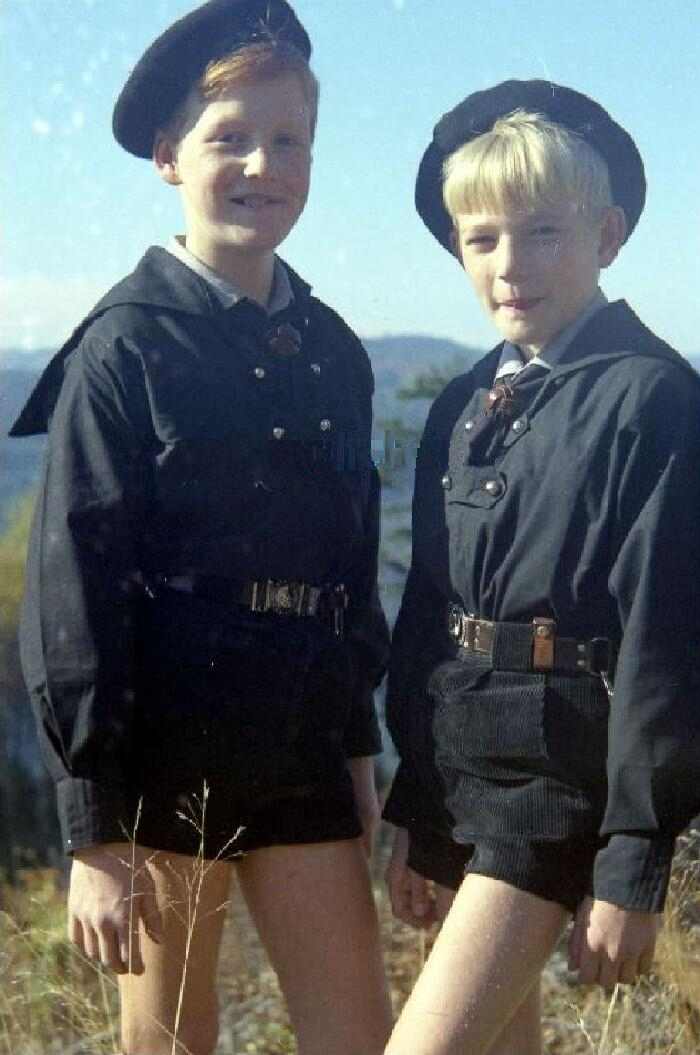
Figure 1.--The beret was a largely French headwear style. It was, however, adopted by youth groups in msny other countries. Here Germn Scouts in the 1960s wear berets. |

|
We have noted quite a range of different headwear types being worn by youth groups around the world. Virtually every type of hat has been worn by uniformed groups. Pillbox caps were worn by early Boys' Brigade units. The Scouts of course adopted the famed Smokey Bear hats. The Itlalian Fascist Baillal adopted campaign caps with tassles, a style which American Scouts adopted, without the tassles, after World War II. French Scouts wore berets, a style which was eventually adopted by English Scouts and even some
American Scouts. The American Scouts introduced baseball caps in the 1980s. Other headwear garments are worn such as turbans in India and Pakistan. A wide variety of of caps and hats have been worn by uniformed groups. Most have been military in origin. Prominant exceptions are the Cub cap and the American baseball cap. Some of these styles are specifically adopted by certain countries or groups of countries--such as the baseball cap ot turban. Other styles oriniginated in certain countries, but became very widely adopted.
While Americans boys increasingly turned away from caps beginning in the 1950s, one style remamined popular--the baseball cap. For this reasonm the American Scouts introduced baseball caps in the 1980s for both Scouts and Cubs. Many Scout groups had begun wearing baseball caps unofficially in the 1980s. Individual Scouts would also wear them instead of the official cap. A few other country's Scout groups have also adopted the baseball cap, but it is still not a widely worn cap style for youth groups around the world. The baseball cap is one of the few non-military styles to be adopted by youth groups. Some other scouts have also adopted the baseball cap, despite the fact that baseball is not played in their country.
Some French Scouts almost from the begining of the movement wore berets. Initially only French Scouts wore them, and not even all French Scouts, many of whom preferred the popular lemon-squeezer Scout hat of the day. Boys in some countries, especially America, saw the beret as a little boys' cap, or worse still for girls. World War II changed the image of the beret. The beret was eventually adopted by English Scouts and even some American Scouts. The beret is now the most commonly worn headgear by Scout groups around the world. Interestingly they are worn in many countries that boys would not still not normally even considering wearing a beret. Interestingly, French boys, except Scouts, would not even considerin wearin a beret.
We notice some boys wearing what is commonly called a bush or slouch hat. The bush hat is the more common term, but actually is a specific style of slouch hat. THe bush hat is primarily associated with Australia. This is a wide-brimmed felt hat, commonly made with a chinstrap because it was a military style often worn by calavalry troopers. It was a functional style because the wide brimmed protected the trooper from the sun, but the chin strap was needed to keep it from falling off. We are not enirely sure of the origins, but had the same functiionlity as the Mexican sombrero or the American stetson. The classic Baden Powell lemon-squeezer hat presumably had the same origins. One source places the origins to 18th century military hats. It was a style worn by British Empire soldiers (Britain, Australia, New Zealand, Rhodesia, and Southern Africa), but we notice soldiers in other countries wearing these hats are similar styles, including France, Germany, the United States, and other countries). The bush hat name came from Australia where the style became especially popular, presumably because of the vast Out Back and stfrong summer sun. The Australians adopted it as a kind of national symbol. We notec some German youth group with these hats during and immediately after World War I. We suspect it was an artifact of the short lived overseas German Empire. Use by youth groups is more limited.
German boys wore slouch hats of various design, including both bush hats and a related type, what Americans might call a boonie hat. The standaerd bush hat has one side of the brim turned up or actually pinned to the side of the hat with a badge or cockade. This style was adopted so the rifle could be slung over a shoulder and the brim would not interfere. The boonie hat was a less formally shaped slouch hat. Australian Scouts evenhtually adopted the bush hat as part of their uniform.
The Scouts of course adopted the famed campaign or Smokey Bear hats as they are called in the United States. Probably no single type of headwear is more associated with a youth group than the Smokey Bear hat is associated with Scouting. Like most of the headgear adopted by youth groups, it was originally a military style. It was worn by the U.S. Army at the turn of the century in the Spanish American War. I'm not sure why Baden Powell adopted it for British Scouts. I believe it was a British army style for scouts, but this requires further research. It was the most widely worn Scout headgear until World War II.
Some Middle Eastern Scouts wore the Fez, but it declined in popularity after Kemal Attaturk in Turkey outlawed it as part of his modernizing effort. We see some Egyptian Scouts wearing fezes in the 1920s and 30s.
A wide range of military-styled caps have been worn by youth group boys. Youth groups at first commonly adopgted mikitart-style uniforms, including the headwear. The German Wandervogel was an exception. The boys generally liked military styles nd part of the initial motivatuion for youth groups was discipline. The styles adopted have ro some extent differed from country to country and varied over time. As with a few exceptions, youth groups are 20th century phenonmena, this has primarily meant 20th century military styles like peaked caps and overseas caps. The major exception is the 19th-century pill-box cap adopted by the Boys' Brigade. The styles selected wre commonly adopted are commonly adopted from their country's military. We notice American and German boys, for example wearing fatigue caps. Eventually in the post-World war II period there was a shift away from miklitary styules with baseball caps becoming aopular choice.
The peaked school cap was adopted by the flegling British Wolf Cub movement in 1916. Virtually every other national Cub group also adopted it, including U.S. Cubs in 1930. Usually Cub groups retained the green color with yellow piping as used by the British wolf cubs. In a few instances the color varied. .Blue with yellow piping was chosen for American cubs. Many Cub groups have now adopted different caps, but a few countries retain the traditiojal English peaked caps.
The turban is a head dress of primarily Mohammedan origin. In consists of a scarfof solk, cooton, or other material. It is usually wound directly around the head, but some times a cap. It is most associated with India, even though the predominate religion is Hindu. This is because the rulers of many Indian principalities were Islamic even though their people were predomantely Hindu. Scouts in India, Pakistan and several other countries have worn turbans. Sijks are perhaps best known for wearing turbans.
Various styles of winter caps have been worn by youth groups. They often have various styles of ear flaps. The Hitler Youth had a kinf of winter cap also worn by the Whermact. The Boys Scouts in America had a kind of red winter cap, looking somewhat like a baseball cap.

Navigate the Historic Boys' Uniform Web Site:
[Return to the main headwear page]
[Return to the main garment page]
[Activities]
[Biographies]
[Chronologies]
[Countries]
[Essays]
[Garments]
[Organizations]
[Religion]
[Other]
[Introduction]
[Bibliographies]
[Contributions]
[FAQs]
[Questions]
[Unknown images]
[Boys' Uniform Home]
Navigate the Historic Boys' Uniform Web chronological pages:
[1900s]
[1910s]
[1920s]
[1930s]
[1940s]
[1950s]
[1960s]
[1970s]
[1980s]
[1990s]