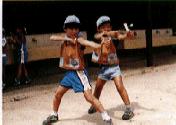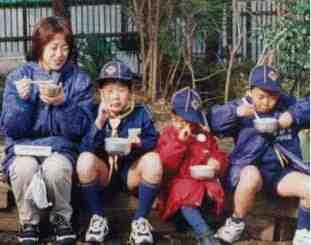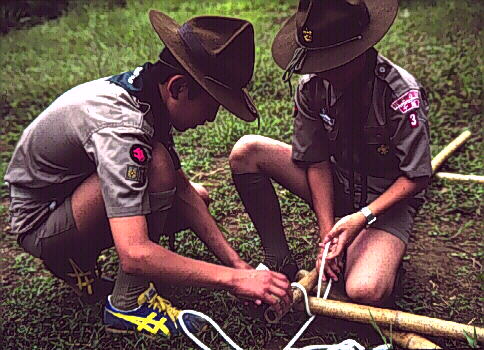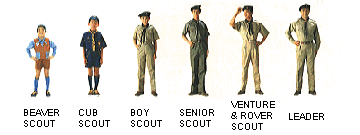
Figure 1.--Here are the uniforms currently worn by Japanese Scouts. The basic change in the 1990s is that Scouts now mostly wear long pants. |

|
The Scout Movement reached Japan in 1913 only a few years after it was founded in England during 1907 by Lord Robert Baden-Powell. The Japanese National Association was organized in Japan during 1922. Japan has since had an active if small Boy Scout movement. Since then, despite a short disruption during World War II, the Movement has steadily grown on the social, cultural and traditional soil of our country, and established an eminent place for itself in social education for
young people. Scoting has been seen by some as part of the country's modernization process. By others it was seen as a Western asault on traditional Japanese values. It was banned by the Japanese militarists during World War II. After the War, however, the Japese embraced Scouting as they did all things America. The national association was re-admitted as a full member of International Conference of the Scout Movement in 1950. Scouting is currently a popular activity, although
Japanese boys do not have the same amount of spare time as American boys, especially boys in secondary school.
The Scout Movement reached Japan in 1913 only a few years after it was founded in England during 1907 by Lord Robert Baden-Powell. The Japanese National Association was organized in Japan during 1922. Japan has since had an active if small Boy Scout movement. Since then, despite a short disruption during World War II, the Movement has steadily grown on the social, cultural and traditional soil of our country, and established an eminent place for itself in social education for young people. Scouting was still operating in 1938 in the years leading up to World War II. Scoting has been seen by some as part of the country's modernization process. By others it was seen as a Western asault on traditional Japanese values. I believe it was banned by the Japanese militarists during World War II, although I have no information on just when this action was taken. I also do not know if there was any natioanlist group like the Hitler Youth which replaced it. After the War, however, the Japese embraced Scouting as they did all things America. The national association was re-admitted as a full member of International Conference of the Scout Movement in 1950. Scouting is currently a popular activity, although Japanese boys do not have the same amount of spare time as American boys, especially boys in secondary school.
We have little chronological information on Japanese Scout uniforms at this time. We do not know yet know the uniforms changed over time. Even though Japanese Scouting was founded in 1913, we do not yet have details on the pre-World war II uniform. All of our information at this time comes from after World War II when Scouts were wearing a tan short pants uniform. They hve subsequently adopted long apnts uniform, but we do not yet know when this change was made.
T he Japanese national Scout association is named as Boy Scouts of Nippon, and abbreviated as BSN, through 1995. There is only one national association. BSN has opened the doors to the girls/female youth in all Sections in 1995. Thus the Boy part of the association name was dtopped.
The Scout Programme is divided into five sections by age: Beaver Scouts 6-8, Cub Scouts 8-11, Boy Scouts 11-14,. Senior Scouts 14-18 and Rover Scouts 18-24. The Progressive Training System in each section is arranged to suit the respective age groups . Each Scout progresses by taking part in weekly and monthly meetings, and their advancement is recognised by various Rank Badges, starting with Beaver Badge in Beaver Scouting and ending with Fuji Badge in Senior/Venture Scouting.
Cub section is for boys and and now girls who are aged 8-11 (3 years). The Japanese Scouts report, "Theme and the goal of this section are to have Cub Scouts recognize and accept cultural tradition and social model. It is educationally aimed that Cub Scouts integrate in the groups and learn discipline. They gain a lot through plays and games." The rank badges incluse: Age (Progress), Risu (Squirrel), Usagi (Rabbit), Shika (Deer), and Kuma (Bear). There are also 40 skill awards.
In recognition of proficiency in various skills, Merit Badges are awarded to Boy Scouts and Senior Scouts. There are 72 Merit Badges, including traditional skills as Japanese Fencing, Sumo Wrestling, Judo, and Strawcraft.
|
Japanese Scouts have traditionally given great attention to uniform. This seems to continue to be the case even after Scouts in other countriues began to deemphazize the uniform. A factor here may be the fact that many Japanese children wrear school uniforms. About a third of primary-age chikldren and virtually all secondary chikdren wear uniforms. Thus uniforms probably seem quite ordinary in Japan. As with many countries, the Cub and Scout uniforms are made very differently. This was an appraoach used so that the older Scouts did not feel they were wearing a little boy uniforms. The uniforms have changed little over n extended period. The principal change in recent yearscu=is that the Japanese Scouts now wear long pants, but the Cubs continue to wear short pants. A special uniform was ceated for the new Beaver program.
We are not sure about Beavervuniforms. This is a relatively new Scouting level. We have seen Beavers wearing diffefrent uniforms. The uniforms here are difficult to see s the image is so small. We have seen other Beavers wearing blie shirts with a brown vest and short pants.
|
Japanese Cubs wear blue shirts with yellow trim, similar to the old Cub uniform worn by American boys until the 1980s. The Japanese are one of the few countries to copy theAmerican Cub unifirm. We are not sure when Cubbing was introduced in Japan. It may have been after World War II. Many countries copied the British Cub uniform, but the Japanese at least since the 1950s have used the blue American uniform. I'm not sure what the Japanese Cub uniform was like in the years before World War II. While American Cubs in the 1950s mostly wore long pants, Japanese Cubs always wore shorts. The shirt and pants have yellow piping. Japanese Cubs still almost always wear the short pants uniform and with kneesocks, unlike the Scouts who now mostly wear long pants. The girls since the program was made coeducational also wear short pants. The caps were also the British school peaked style that American Cubs wore. The American Cubs changed their uniform style in 1981. The Japanese continued to wear the blue uniforms.
|
Japanese Boy Scouts have worn a uniform of tan shirts, short pants, and kneesocks. This was the year round uniform. Japanese Scouts did not wear long pants. One Japanese Scouter remembers shovelling snow in short pants after a heavy 1986 Tokyo snowstorm. He and other Scouts were helping elderly neighbors. Japanese Scouts, however, were virtually the only older Japanese boys, until recently, who wore short pants. Japanese boys after graduating from elementary school almost always wore long pants. Only recently have older boys began to wear casual shorts. The long baggy shorts popular in the America are increasingly common in Japan. Japanese Boyscouts in 1990 abandoned a year-round shortpants uniform for a long pants uniform designed by Ralph Lauren.
We have only limited information on Japanese Scoutuing activities at this time. Hopefully Japanese Scouters can provide some information to help understand the many varied activities with which Japanese Scouts at all levels are involved. There are differences with the activity program depending on the diffeemt levels of Scouting. Games are especially popular with the younger boys (Beavers and Cubs) as well as te younger Scouts. As far as we know, Japanese Scouts play the same games developed by Scouts in Europe and America. Perhaps there are uniquely Japanese games. Hopefully our Japanese readers will provide ome insights here. Religion is an interesting topic and the Japanese approach here is different than in America where Scouts and more importabtly adult Scouter are required to believe in God. Japanese Scouts are encouraged to believe in God, but not required to do so. This reflects a more relaxed attitude towrd religion in Japan than the West. The Japanese for the most part believe in a kind of amorpphous sythesis of Budddhism and Shintoism, but religious commitment for the most part is not as intense as in the West, especially America. But also the Japanese do not have the negative attitude toward religion that are often expressed by the Western political left. Scouts often participate in the many festivals held throughout Japan. These festivals are commonly a mix of both religious and civic pagentry.
Japanee Scouts like Scouts in all countries are involved in a wide range of outdoor activitie, surely the activities for which they are best known. This includes boating, camping, hiking, orientering, swimming, and other outdoor activitie. During the winter when outdoor activities are more difficult, boys may work on a range of outdoor skills like camp craft, compass usage, knot tieing, and others. Often the younger boys enjoy crafts and a variety of creative projects. And there has been an incresing emphasis on envirimental projecs and activities as is the case of most Scout movements around the world. This of course fits in nicely with the traditional Scouting emphais on nature and outdoor activitie,

Navigate the Historic Boys' Uniform Chronology Pages:
[Return to the Main chronologies page]
[The 1900s]
[The 1910s]
[The 1920s]
[The 1930s]
[The 1940s]
[The 1950s]
[The 1960s]
[The 1970s]
[The 1980s]
[The 1990s]
[The 2000s]
Navigate the Historic Boys' Uniform Web Site:
[Activities]
[Biographies]
[Chronologies]
[Countries]
[Essays]
[Garments]
[Organizations]
[Religion]
[Other]
[Introduction]
[Bibliographies]
[Contributions]
[FAQs]
[Questions]
[Unknown images]
[Boys' Uniform Home]
Navigate the Historic Boys' Uniform Web organizatiion pages:
[Return to the Main country page]
[Return to the National Scout page]
[Boys' Brigade]
[Camp Fire]
[Hitler Youth]
[National]
[Pioneers]
[Royal Rangers]
[Scout]