|
Henri-Jacques-Guillaume Clarke, 1st comte d'Hunebourg, 1st duc de Feltre (1765-1818), was a French military officer, diplomat, and politician. He served as Minister of War of the First French Empire (1807-14). Such an appointment over an extnded period must have meant that he was very close to Napoleon. He was interstingly made a Marshal of France during the Burbon restortaion (1816). Of course the very English/Irish name stands out. Clarke was born in Landrecies, northern France (1765). His parents were Irish from Lisdowney, County Kilkenny. We do not have family detils, but presumably thery fled Ireland because of oppresive British policies. Clarke strongly retained his Irish identity. He was one of the most influential and charismatic Franco-Irish generals in the French army during the Napoleonic Wars. The family is known to have hasd close links to the Irish Brigade in the French Army. His father served in Dillon's Regiment, and his mother's father and several uncles served in Clare's Regiment. Clarke married twice. His first wife was Elisabeth Christiane Alexander who was born in London (1768)). How the two met and when they marrie we doi not know. They seemed to hve married about 1788, just before the Revolution in France. Clarke at the time was a French Army officer ho made the transition from the royal Bourvon Army to the Revolutionary Army. Their first child Henriett was born in London (1790). There were three more children, including Alfred Henri and Charles. Clarke left active service to work as an attaché at the British Embassy in Paris (1790). When figting broke out with Britain, he returnd to active military service with Recolutioinary army. We are not sure about his politics before the Revolution, but the Revolution opened up opportunities for him. There was only so far commoners could rise in the royal army. Clarke rapidly rose in the Revolutionry Army, despite a brief arrest and imprisonment. Clarke served in the Army of Italy under Napoleon and participated in the coupthat briught Napoleon to power (1799).
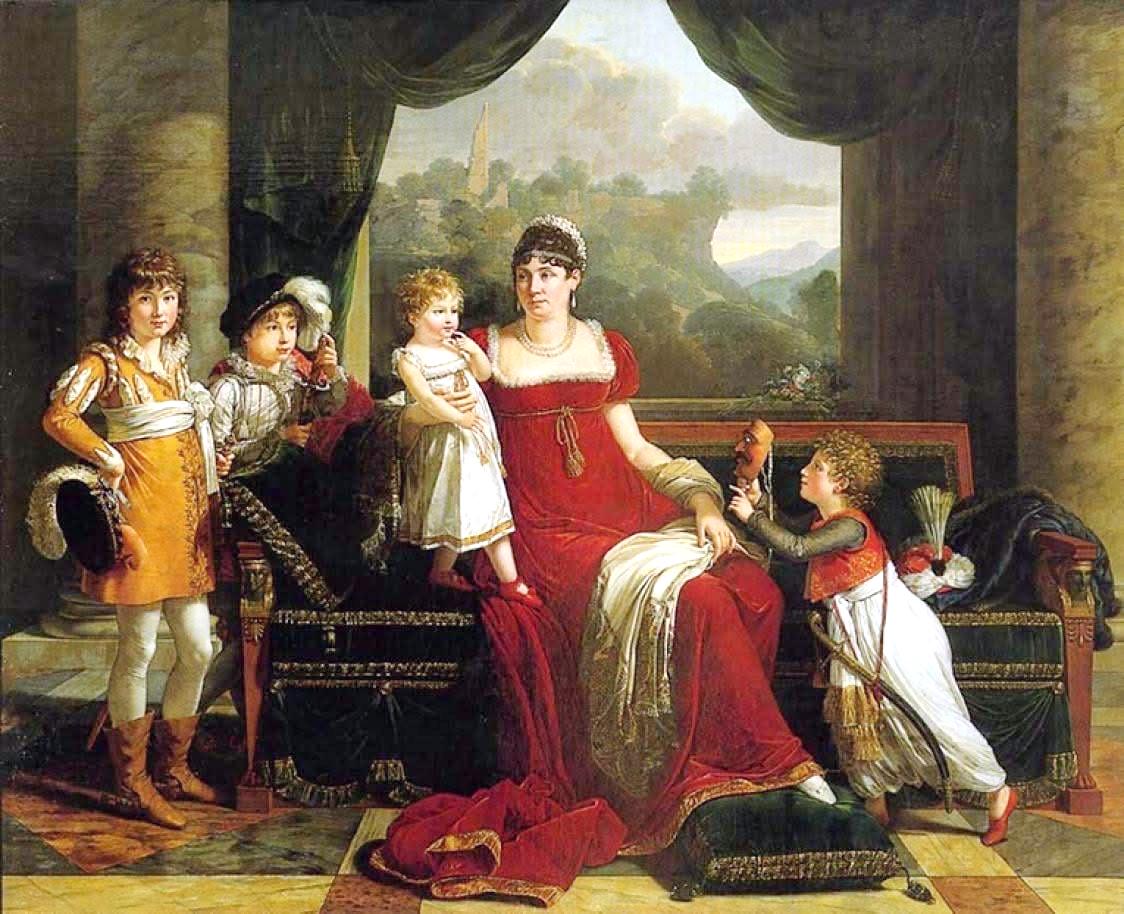
It is at this time he married his second wife -- Marie Francoise Josephine Zaepfel. She was born in Saverne, Bas-Rhin, Franceb (1768). She married Clarke in Bouxwiller, Bas-Rhin (1799). They had four sons who you can see here in the 1810 François-Xavier Fabre portrait (figure 1). The children are Edgar Clarke
(1799–1852, Arthur Clarke (1802–29). Alphonse Clarke (1806–50), and Elphride Clark (1808-13).
Clarke had a range of administrative posts as Napoleon's armies swept across Europe. Napoleon made him Minister of War (1807). He was for organizing the Grande Armée and effectively centralizing military administration.His organizational reforms significantly strengthened the French army during the Napoleonic Wars.
Napoleon created a Noblesse Imimpériale (imperial nobility). It was designed to replace the old nobility and integrate revolutionary middle-class elites into a stable Imperial elite. Napoleonic ennoblement began (1804). Princely titles were awarded to the Bonaparte family, such as the Prince Imperial (Napoleon’s son) and Princes of France went to close relatives. This was soon expanded. Napoleonic decrees established dukes counts, barons, and knights. Many of the most important creations went to his closest military commanders.
Feltre was a city of Roman origins uin northern Italy, partian of the Venitian state for centuries. After Venice fell to Naopleon (1797), the city eas ruled by France. He enobled Clarke, cearting him Duke of Feltre in 1809). The painying hre was executed 1 year later (figure 1). After the Congress of Vienna Feltre was assigned to the Austrian Empire (1814). As part of Italian uification. it became part of the Kingdom of Italy (1866).

Navigate the Boys' Historical Clothing Web Site royal pages:
[Return to the Main Napoleon pages]
[Return to the Main French Bonaparte royal pages]
[Austria]
[Belgium]
[Denmark]
[France]
[German Empire]
[German states]
[Italy]
[Luxenburg]
[Monaco]
[Netherlands]
[Norway]
[Romania]
[Russia]
[Spain]
[United Kingdom]
[Return to the Main royal pages]