|
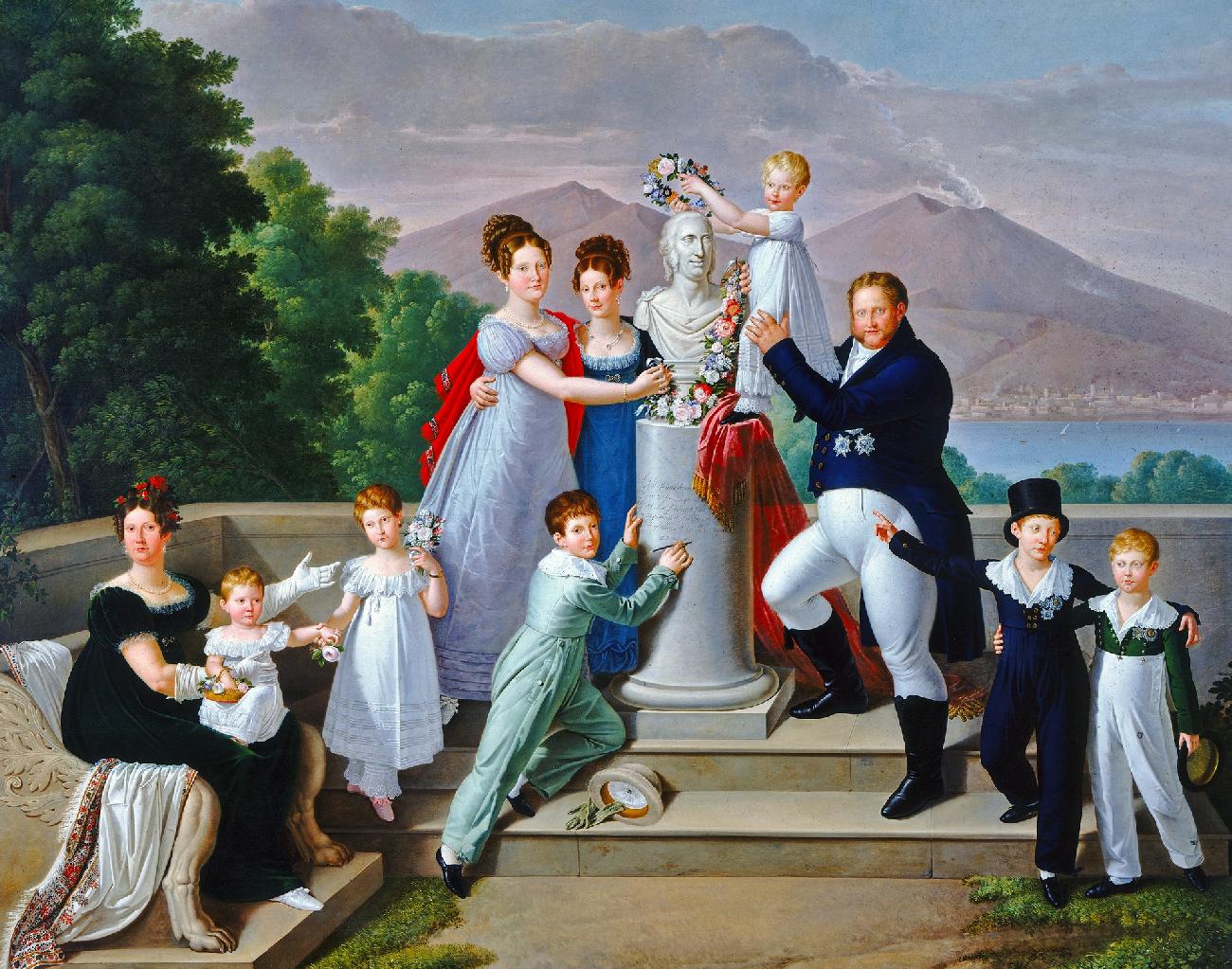
The Kingdom of the Two Sicilies was a 19th century Italian sovereign state . It controlled southern Italy (1816-61). It was formed after the Napoleonic Wars by fusing the Kingdom of Naples and the Kingdom of Sicily under the restored Bourbon dynasty. Both were historically referred to as 'Sicily" leading to the collective name -- 'Two Sicilies' (Utraque Sicilia). This was meant to distinguish the mainland and island territories. The name traces back to the historical division resulting from the War of the Sicilian Vespers (1282-1302). At the time the island of Sicily came under Aragonese (a Spanish monarchy) control, Aragon had aspirations of being a Mediterranean power. The union of Aragon and Castille under Ferdinand and Isabella would form modern Spain. The mainland remained under the Angevin rulers, who continued to claim the title of King of Sicily. Ferdinand IV of Naples became the first king of the Kingdom of Two Sicilies as Ferdinand I. The new kingdom included Sicily and most of southern Italy (Mezzogiorno). This made it the largest Italian state by land area and population before unification in he 1860s. The capital was Naples developing into the major Italian port on the mainland and Palermo on the island. The economy was largely agricultural. The Catholic Church was the major land owner (50-65 percent). Naples and Palermo were major cities. Naples had some 0.5 million inhabitants--the third largest Italian city (1800). The ruling family was Bourbons, in this case a cadet branch of the Spanish Bourbons. Southern Italy gained independence from Spain. And there was a brief period of Austrian control (1734). Until the fall of Napoleon, Naples and Sicily maintained separate laws and constitutions. The new Bourbon rulers attempted reforms, but these was resistance from entrenched conservative interests -- powerful lay and ecclesiastical feudatories. The situation in southern Italy was unstable. The Neapolitan Republic of 1799 was only suppressed with the help of none other than Admiral Horatio Nelson and Cardinal Fabrizio Ruffo. It was in Naples that Nelson met Lady Hamilton. . Francis I became king (1825). He died only 5 years later and his son Ferdinand II became king (1830). His reign was threatened as part of the popular revolutions that swept Europe (1848). King Ferdinand was forced to grant a constitution, using for a pattern the French Charter of 1830. Revolutionaries were suppressed in Sicily with much bloodshed. Ferdinand ruled until (1859). His son Francis II became king. Cavour and Victor Emanuel attempted to arrange a peaceful union with Francis, but he rejected all initiatives. The end came when when Giuseppe Garibaldi led the Expedition of the Thousand (1860). The Bourbon army had the ability to maintain control against an unarmed civilian population, but not against a well armed northern force. Garibaldi He overthrew the Bourbon monarchy first on Sicily and then on the mainland with surprising ease. His forces were received with great enthusiasm by the population. Union with the north was not just a military matter. A plebiscite was held--a unique phenomenon at the time. The population endorsed union with the Kingdom of Sardinia-- the major step in Italian unification. Victor Emmanuel II of Sardinia, proclaimed the Kingdom of Italy (1861).

Navigate the Boys' Historical Clothing Web Site royal pages:
[Return to the Main Italian monarchy page]
[Austria]
[Belgium]
[Denmark]
[France]
[Germany]
[Italy]
[Luxemburg]
[Monaco]
[Netherlands]
[Norway]
[Romania]
[Russia]
[Spain]
[United Kingdom]
[Return to the Main royal pages]