|
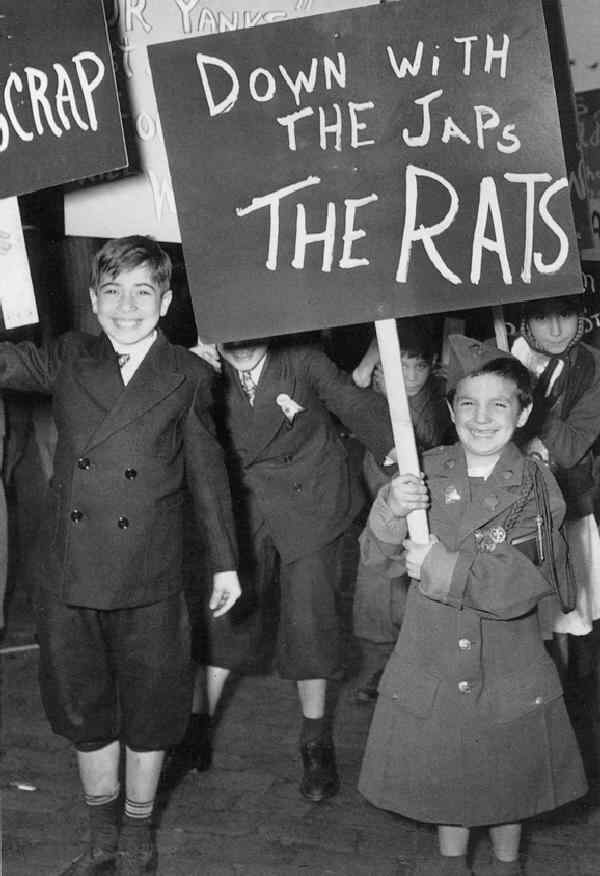
Racism was a key aspect of World War II. Racism was a primary factor within in the Axis military alliance. World War as conceived by Adolf Hitler was a racist war. Hitler clearly conceptualizes a great conflict against Jews and the only slightly more preferable Slavs. The Jews Hitler believed had to be purged from German life. This process evolved into the Holocaust. At least some of the Slavs would be allowed to survive because slave labor was needed for the new Reich. And Hitler saw the war as not a German war, but an Aryan war. For this reason, the people of the Nordic countries, the Netherlands, and the British would fit into the new Aryan nation. Hitler was frustrated at the beginning of the War because he found himself fighting the British and allied with the Soviets. The opposite of what he wanted. What he wanted of course was to be allied with the British and fighting the Soviets which he saw the worst possible combination of Jewish Bolsheviks overseeing the Slavic masses. Not all the people in Germany and racially acceptable countries were acceptable to Hitler. Genealogy became big business in Germany. To enter the SS one had to prove an Aryan ancestry back centuries. Had the NAZIs won the War, the SS would have evolved as a new aristocracy in Germany. The Japanese also had highly racist attitudes which showed in their treatment of Koreans, Chinese, and other subject peoples. Japanese atrocities are less publicized, but resulted in the deaths of even more people than fell victim to NAZI racist policies. Italy was less affected by racist notions. Italian Fascism rather emphasized Italian nationalism and cultural identity, but Italy proved to be a largely ineffectual military partner in the Axis war effort. Racism was not, however, limited to the Axis. America entered the War as a still largely racist country. The South was still strictly segregated with black Americans denied civil rights and prevented from voting. America fought the War with a segregated military. The anti-Japanese prejudice of the time was often intense and was reflected in the disgraceful internment of Pacific-coast Japanese-Americans simply on grounds of their ethnicity. One interesting aspect is that with all this anti-Japanese feeling, it virtually disappeared after the War. And all kinds of restrictions on Asians as to citizenship, employment, university admission also disappeared. It is a phenomenon I do not fully understand, but have been meaning to address. Such overt discrimination did not exist in Britain, but Britain at the time did not have a substantial minority population. The situation in the colonies was different. The situation in the Soviet Union is more difficult to assess. Communist doctrine was race neutral which was one reason that it appealed to many Jews. Of course Communist neutrality on race does not mean that racist beliefs were no prevalent among Soviet officials.
Earlier wars had been fought over territory, resources, and religion. Modern concepts of nationalism became important in the 19th century. Ideology and race became important in the 20th century. Neither were important factors in World War I,but only two decades later both were central to World War II. And explains why World War II was so much more lethal than World War I. Often the Holocaust and other race issues are considered as a kind of footnote to the war, although a tragic humanitarian disaster. Race was not a foot note to World War II. Race was at the core of World War II. The War would probably not have occured without Hitler and the NAZIs and for Hitler the destruction of the Jews, Slavs, and other was a primary war goal.
Racism was a key aspect of World War II. Racism was a primary factor within the Axis military alliance. Except for the Haitian Revolutionary wars, the American Civil War, and the Mexican Revolution race has not been a factor in many wars. This thanks primarily to the NAZIs and Fascist allies, made race a major factor in the War. World War as conceived by Adolf Hitler was a racist war. It was not a foot note in the history of the War, tt was a primary German war goal. Hitler clearly conceptualizes a great killing campaign conflict against Jews and the only slightly less objectionable Slavs. The Jews Hitler believed had to be purged from German life. This process evolved into the Holocaust. The German hatred of the Jews and the Holocaust is well known, but only a part of the race war they launched. They planned and had begun a much larger killing program in Eastern Europe--Generalplan Ost. And that was to be just the beginning if their race war. At least some of the Slavs would be allowed to survive because slave labor was needed for the new Reich and NAZI war effort. And Hitler saw the War as not a German war, but an Aryan war. For this reason, the people of the Nordic countries, the Netherlands, and the British would fit into the new Aryan nation. America entered the War as a still largely racist country. These racist ideas, unlike Germany and Japan, did not significantly affect its foreign policy. The South was still strictly segregated with black Americans denied civil rights and prevented from voting. America fought the War with a segregated military. The anti-Japanese prejudice of the time was often intense and sharply reflected in American war propaganda that is today very disturbing. There are lots of blatantly racist images of slanted, weaker eyes Japanese with over-sized glasses. Of course this was exacerbated by Pearl Harbor. Anti-German propaganda was not racist, of course, because so many Americans looked like Germans. Anti-Japanese racism was reflected in the disgraceful internment of Pacific-coast Japanese-Americans simply on grounds of their ethnicity. he Soviet Union needs to be considered as a third force in World War II. It was the Soviets along with the Germans who launched the War as a result of the NAZI-Soviet Non-aggression Pact (August 1939), as unlikely allies. The Soviet Union unlike Germany was a multi-national state. Both countries, however, proceeded to carry out a long series of aggression against neighboring countries and conducted terrible atrocities in the countries they occupied. The NAZI atrocities were more race based than the Soviets, but the Soviets carried out ethnic atrocities of their own, deporting several national groups and like the NAZIs set you to destroy Poland as a nationality. And Stalin sought to alter the ethnic balance in the Baltics by deporting Balts and encouraging Russian emigration. The NAZI-Soviet alliance was abruptly broken with the German invasion. And as a result, the Soviets finished the War as key part of the victorious Allied coalition. The racial policies in the Soviet Union is more difficult to assess. Communist doctrine was race neutral which was one reason that it appealed to many Jews. And none other than Lenin was of mixed race origins, including central Asian ancestors. Of course Communist ideological neutrality on race does not mean that racist beliefs were not prevalent among Soviet officials or as we have noted, Stalin did not pursue a range of racist policies.
Latin America at the time of World War II, except for the Caribbean area consisted of some 30 independent republics, most of which achieved independence during the Wars of Liberation (early-19th century). They are highly variable, but include European, Amer-Indian, and African populations as well as mixed races (Mestizo and Mulatto). The Latin American republics mostly cooperated with the Allies in World War II, although in Argentina in particular there was pro-Axis sentiment. And Latin America was an important source of resources for the Allied war effort. The pro-Allied orientation probably reflects the fact that their main export markets were the Allied countries and the Allies controlled the sea lanes. In World War II, the Latin Americans expressed little sympathy for the Jews, probably reflecting the impact of Catholic teachings. In fact, Argentine officials refused NAZI offers to release Jews with Argentine nationality. Thy saw NAZI racism as basically aimed at Jews. There seems to have been little understanding that NAZI racial doctrine abhorred racial mixing such as the mestizos ad mulattoes comprising much of the region's population. Based on our experience, there still is little or no understanding of that throughout the region.
North America is primarily composed of two countries, the United States and Canada. Both are culturally similar because of their British roots--probably more similar than the Canadians like to admit. But they are not identical. Canada: Canada's principal related issue is the substantial French minority, but this deals with culture and not race. The primary racial issue was Native Americans. Here the story is similar to what occured in the United States, although by the late-19th century, the Canadians began to take a more humanitarian approach. One of the most significant difference between America and Canada is slavery. Few Africans reached Canada. Cotton does not grow well in the tundra. Many of the blacks that reached Canada was because Canada was the terminus of the Underground Railway (1820s-50s), although the number was smaller than often represented. . After the Civil War in America, Europeans began to migrate to the United States in large numbers. The Canadians were less willing to admit Eastern Europeans. Canada was not dissimilar to the United States, however, in racial attitudes. The British Empire conceived of the idea that imperial subjects could move anywhere in the Empire. the Canadians objected, however, when (Asian) Indians tried to migrate to Canada (1910s). For a time, Chinese immigrants had to pay a a $50 head tax. The Canadians also were not happy with Jewish immigrants. Jews would play a much smaller role in the development of Canadian culture than would be the case in America. In the years leading up to World War II and despite reports of NAZI oppression, Canada did not open its borders to Jews. Canada dutifully joined Britain and declared war on Germany after the NAZIs invaded Poland (1939). President Roosevelt was correct, the only way to save European Jews was to destroy the NAZI tyranny. And here Canada certainly did its pat, although the french minority generally did not embrace the war effort. Canada would, however punch well above its weight throughout the Ear. It played a major role in the Battle of the Atlantic and one of the D-Day beaches (Juno) was Canadian. Canadian forces went on to play an important role in the liberation of Western Europe. After the War, Canadian immigration polices began to open up. United States: America entered the War as a still largely racist country. These racist ideas, unlike Germany and Japan, did not significantly affect its foreign policy. In fact, America found itself fighting a war against racism, although this was not entirely evident to most Americans including political leaders until after the War. NAZI anti-Semitism was well known, but not what the NAZIs were planning for the Slavs in the East. The South was still strictly segregated with black Americans denied civil rights and prevented from voting. America fought the War with a segregated military. (Ironically there were Jews in the German military.) The anti-Japanese prejudice of the time was often intense and sharply reflected in American war propaganda that is today very disturbing. There are lots of blatantly racist images of slanted, weaker eyes Japanese with over-sized glasses. Of course this was exacerbated by Pearl Harbor. Anti-German propaganda was not racist, of course, because so many Americans looked like Germans. Anti-Japanese racism was reflected in the disgraceful internment of Pacific-coast Japanese-Americans simply on grounds of their ethnicity. The internees included American citizens and not only Japanese nationals resident in America, as was the case for Italians and Germans. One interesting aspect is that with all this anti-Japanese feeling, is that racist attitudes toward Asian Americans declined sharply after the War. And this process continued even when the Korean War turned into a war with China. All kinds of restrictions on Asians as to citizenship, employment, university admission also disappeared. It is a phenomenon I do not fully understand, but have been meaning to address. The War in many ways also set in motion the Civil Rights movement that ended racial segregation in the South. The virulence of racism and the social consequences exposed during the War was surely a factor in the American decision to attack domestic racism after the War.
Discussions of racism in World War II primarily focus on the German NAZIs. A central tenant of Fascism was hyper-nationalism and with it racism. The NAZIs were only the most extreme manifestation of this. And the Allies also had racist sentiments as well. All to commonly ignored are the racist attitudes prevalent in Asia. This is a complicated issue given the number of countries involved, but racist feelings were prevalent in the three major countries and many smaller countries as well. Chinese racism existed, but was not a major factor in the War. The Chinese from the start of the War were on the defensive and not involved in occupying other countries. India was a British colony. Again Indian racism was not an important factor in the War, but very strong racist sentiment existed in India. People with lighter complexions had greater status and skin color was an important factor in Indian marriages. India is a large country and racist attitudes varies regionally and toward people from different regions. And of course untouchability was a major problem. This was a caste, but there were racial overlaps as many untouchables had darker skin that the higher-status castes. The Japanese had very strong racist attitudes. While professing pan-Asian values, in fact they looked down on other Asian peoples, a factor in their savage behavior in China and conquered Asian countries. Another country with strong racist attitudes was Iran. The country changed its name from Persia to Iran before the war, in part to emphasize the Aryan origins of the Persian people. As with the Arabs, African slavery continued into the 20th century.
World War II was without doubt the most intensely racist war in human history. Race was actually a relatively modern construct in warfare. Race was not a foot note to the War. It was central to the German war effort as in reading of Hitler's Mein Kampf. The NAZIs did not only want to rule foreign lands, they wanted to eradicate many foreign peoples so they could colonize a land cleared of the existing population. It was also important to the Japanese war effort. The Japanese saw themselves in their island nation as a pure people undiluted with immigration from foreign lands, in sharp contrast to America which they saw as a mongrel nation. The Allies did not have racist goals in fighting the War. The Allied populations, however, to varying degrees had racist feelings. And in the case of the United states, racist laws existed in parts of the country. It should not be thought that racist attitudes only existed in the West. Given the intensity of the racial animus during the War, the aftermath of the War is stunning. The occupation of Germany and Japan was conducted without racial animus. This was obvious in Germany as the Allies were not racially different. It was somewhat surprising in Japan given the racial difference and the terrible war crimes committed by the Japanese military. It would of course have been a very different story had the Axis won the War. There was a sharp shift in racist thought throughout Western Europe an the United States. Western Europeans and Americans seeing where racism led began to moderate their attitudes toward other races. This shift was most notable in America which had a substantial non-European population. Prejudice toward Asian Americans despite the Japanese war crimes practically disappeared over night. It also set the Civil Rights Movement in motion. Today in the West, one of the worst things you can say about another person is that they are racist. The situation in Soviet-controlled Eastern Europe was different. Socialist ideology criticizes racism. Soviet policy, however, included some racist elements. And unlike the West, racist thought while suppressed during the Cold War emerged after the fall of the Soviet-imposed Communist regimes. Change in racist attitudes in the Third World was less dramatic. There racial and ethnic differences were less affected by the War.

Navigate the CIH World War II Section:
[Biographies]
[Campaigns]
[Children]
[Countries]
[Deciding factors]
[Diplomacy]
[Geo-political crisis]
[Economics]
[Home front]
[Intelligence]
[POWs]
[Resistance]
[]
[Refugees]
[Technology]
[Totalitarian powers]
[Bibliographies]
[Contributions]
[FAQs]
[Images]
[Links]
[Registration]
[Tools]
[Return to Main World War II page]
[Return to Main war essay page]