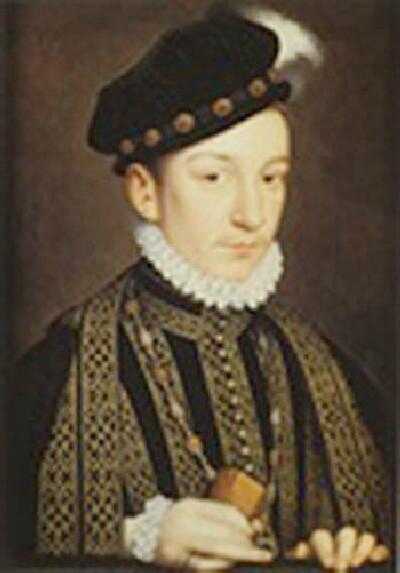
Figure 1.-- This is another Clouet royal portrait. I'm not sure precisely when it was painted. He looks to be 17-18 years old and would have been king at the time. |


|
The Wars of Religion (1562-98) weakened the power of the last Valois kings. Militant Catholics were intent on destroying Protestantism in France and the Proestants resisted militarily. Roman Catholic and Protestant factions dominated politics during this period. Charles succeeded his sickly brother Fran�ois II who reigned only a few months. He came to a throne at an even younger age than Francis. Charles was only 10 years old. His mother Catherine deMedici served as regent. Charles IX also not strong physically. He also was easily led by his mother an advisers. Ctherine decided to end The Third War of Religion and ad Charles sign the peace of Saint-Germain which granted freedom of worship to the Huguenots and allowed them several fortified towns, including La Rochelle (1570). France next fought an undeclared war with Spain in Flanders where support was given the Protestants. Catherine eventually decided to ined to destroy the Huguenots in France. Paris had a substantial Protestant population and many more came to Paris to attend the wedding of Henry of Navarre. Catherine and Prince Henry conspired to massacre the Huguenots, especially the Huguenot leaders. The attack on the Huguenots took place on Saint-Barthélemy (1572). Throughout his reign, Charles endured the clear preference of Catherine for his younger brother Henry. Charles was pleased when Henry left to become king of Poland, but died soon after.
Prince Charles was the son of King Henri II and Queen Catherine de Medici. Charles would be dominated by his mother both as a boy and young man. Catherine deMedici (Caterina Maria Romula di Lorenzo de' Medici) was born in Florence, Italy, the stronghold of the Medici (1519). Her father was Lorenzo II de' Medici, Duke of Urbino, and Madeleine de la Tour d'Auvergne, Countess of Boulognea--a Bourbon princess related to many of the French nobility. Both parents died within weeks of her birth leaving her a princess and orphan. Catterina married well for a princess from a small Italian principality, althoiugh at the time it was not expected she would be queen of France. She married at only age 14 Prince Henry, the second son of King Francis I of France and Queen Claude. She became queen consort of King Henry II of France (1547). Henry strictly excluded Catherine from any political influence. He was much closer to his mistress--Diane de Poitiers. Henry's death framatically changed Catherine's role (1559). She as the mother of the sickly 15-year-old King Francis II was made regent. Francis died only a year later (1560). She then becme regent for her 10 ten-year-old son King Charles IX. As regent for such a young boy she came tp exercise sweeping powers.
King Henry II and Queen Catherine had 10 children, only one of whom did not survive. Charles was the middle brother. Two other bothers became king. Older brothers François II and younger brother Henri III also were French kings. His brother Henry was Catherine's favorite son. Other siblings included Elizabeth (Queen of Spain), Claude (Duchess of Lorraine), Margaret (Queen of Navarre), François (Duke of Anjou), Joan of Valois, and Victoria of Valois.
Charles was born Charles Maximilien in the royal chateau at Saint-Germain-en-Laye (1550).
He was the third son of King Henry II of France and Catherine de' Medici. We have little information about his childhood. He and his older brother François were reportedly sickly children.
Charles was styled at birth Duke of Angoulême. He was created Duke of Orléans after the death of another older brother Louis, his parents' second son who died (1550). He and his silings, The royal children. were raised under the supervision of the governor and governess of the royal children, Claude d'Urfé and Françoise d'Humières, under the supervision of Diane de Poitiers. His father died unexpectedly (1559). He was only 40 yers old. He was injured in a jousting tournamenbt and his wounds festered. He was succeeded by Charless elder brother, King Francis II. Francis's had only a brief rule. As a result, 10-year old Charles was proclaimed king (1560). All of this of course mnust have had a huge impact on his childhood and relations with hus mother. When Francis II died, the Privy Council appointed his mother, Catherine de' Medici, as governor of France conveying sweeping powers. She acted as regent for Charles. The instability resulting from the ineffectualrule reigns ofthe three brothers (Francis II, Charles IX, and Henry III) was a factor in the bloody Frebch wars of religion.
The French monarchy had a special relationship with the Church. French kings had generally avoided the kind of open split with the papacy like the Investiture Controversy that so divided Germany. The Pope gave the kings of France the title of "Most Christian King." Each French King took an oath to "extirpate" heresy in his realm. The French Church despite the close relationship between th moinarch an papacy had evolved considerable independence from the papacy. The French monarchy had perhaps more authority over the Church in his country than any other prince in Western Christendom. This was further recognized on the eve of the Reformation by the Concordat of Bologna which confirmed Francis I's authority to make appointments to benefices. As a result, many of the conditions which led to
the Reformation in Germany were less apparent than in Germany. The Concordot provided for the rights of both pope and king, but made the king clearly dominant over the French Church. While religious issues are most commonly discussed in connection with the Feformation, financial matters were a major concern at the time. The monarchy in France had enormous control over the disposition of the wealth and income of the French Church and routinely used the authority to appoint bishops, abbots, and other church officers to reward faithful followers because there was considerable income associated with many of these offices. As a result, the princes of the French Church included many worldly people, often uninterestred in spiritual or doctrinal matters, but often quite nationalistic. The Pope had a veto on
such appointments, but out of defference to the monarch, rarely exercized it. Thus there was a considerable fusion of church and state in France very different than the situation in Germany. The University of Paris (the Sorbonne) during the late Medieval era served as a kind of scholastic think-tank for both Church and state.
Charles for most of his reign was largely controlled by his mother, in part because of his age. He temporarily after 1570 came under the influence of French Huguenot leader Gaspard de Coligny. Catherine feeling she was losing her contol of Charles and thus her power, convinved her vasilating son to authorize a mass action against the Huguenots. Charles' brother Henry and Catherine helped plan the massacre. It proved to be the most notorious attrocity of the Religious Wars. civil wars was the St. Bartholomew's Day Massacre. Catherine and her son Charles IX signed a peace treaty with the Huguenots granting freedom of worship (1570). They made a point of maintining friendly relations with Huguenot leaders, often calling de Coligny to court to seek his advise. Lulled into a sence of security, they were totally unprepared for what transpired. On St. Bartholomew Day, thousands of Huguenots in Paris and other French cities were murdered. The Duc de Guise personally killed Coligny.
Charles married Elisabeth of Austria (1570). They had only one child--a daughter, Princess Marie-Elisabeth (1572-78) who died as a child. He and his mistress, Marie Touchet, had an illegitimate son, the duc d'Angoul�me.
Charles was pleased when his brother left to become king of Poland (1573).
Charles became king of France upon the death of his brother François (1560). He was crowned King in the cathedral at Reims (1561). Like his brother François, their mother served as regent and even after achieving his majority, Catherine continued to be a controlling influence. Charles proved to be a weak king and ruled in his dominering mother's shadow.
Charles IX appears to have been shocked by what transpired on St. Bartholomew Day (1572). He was from childhood fragile, emotionally and physically. Contemprary sources report he becane increasingly moody with wide swings. At times boasted about the axtion taken and the need for severity. At other times he complained of hearing the screams of the Huguenots. He increasingly blamed his mother, "Who but you is the cause of all of this? God's blood, you are the cause of it all!" Catherine began referrung to him as alunatic.
Charles appears to have contracted tuberculosis. Some attributed the psycological strain ensuing from the Massacres weakened him phyically. That is speculation, but his health clearly declined. Hoarse coughing turned bloody (spring 1974). His doctors reported increasingly severe bleeding. Finally he became bedridden at the Ch�teau de Vincennes, Val-de-Marneand seriously delusional. He is reported to have cried to his nurses, "What blood shed! What murders! What evil council I have followed! O my God, forgive me ... I am lost! I am lost!" [Durant] At the end, Charles called for his brother-inlaw, Henry of Navarre. He embraced him and insisted, "Brother, you are losing a good friend. Had I believed all that I was told, you would not be alive. But I always loved you... I trust you alone to look after my wife and daughter. Pray God for me. Farewell." [Guizot] Shortly after he died (May 30, 1574)
Charles was suceeded by his younger brother Henri III (1574).
Durant, Will. The Story of Civilization, Vol. VII, p. 355.
Guizot, F. The History of France (London, 1887), Vol. III, p. 415.

Navigate the Boys' Historical Clothing Web Site royal pages:
[Return to the Main French Valois royal pages]
[Return to the Main royal pages]
[Austria]
[Belgium]
[Denmark]
[France]
[Germany]
[German states]
[Italy]
[Luxembourg]
[Monaco]
[Netherlands]
[Norway]
[Romania]
[Russia]
[Spain]
[United Kingdom]