|
The Saxons became know to history during the Roman era. Theyt were a Germanic people inhabiting the North Sea coast and the lower Elbe (Holstein) when the Roman began writing about them (2nd century AD). 【Ptolemy】 They were referred to as the Saxones. They consisted of loose tribal confederations. This included Westphalians, Angrians, and Eastphalians. Thery were ruled by chieftains who organized both defense and raiding other Saxons as well as other trines as well as the Romans in occassion. They of course were pagans. The religion honored sacred groves, pillars like the Irminsul, and deities such as Woden. Their religious rituals reinforced social cohesion and imprtantly martial readiness. During the Migration Period, the Saxons and other Germanic tribes were presured by war-like Steppe people rsulting in migration west into the the Roman Empire (4th–6th centuries). The Saxons were known for their seax (a type of knife). Sorbian tribes, a Slavic period) moved into the area and other areas of central Europe. The Sorbs in Saxony were assimilated. Charlemagne waged the Saxon Wars to subjugate and Chritianize the pagan Saxons (772-804 AD). It as bloody undertaking, the destruction of the Irminsul and the Massacre of Verden (782). Thisd involved killing 4,500 Saxons who resisted Chritinization. At the end of the campin, Saxony was fully incorporated into the Frankish Kingdom (804). Christinization was pursued with bishoprics and missionary activity. Saxony became a stem duchy within East Francia. T he Liudolfing (Ottonian) dynasty was established. Henry the Fowler was elected King of Germany (919). This was the beginning of the Saxon dynasty of German kings and emperors. There were several ruling dynasties, including the Billungs, Guelphs, and then the Ascanian dynasty. Saxony was split into Saxe-Lauenburg and Saxe-Wittenberg (1260 ). The Wittenberg line was awarded the electoral privilege (1356). This cinfirmed Saxony’s political influence within the Holy Roman Empire. The diviion of Germny anong powerful elctors prevnted the emgence of Germany into a naton state like England Framce, and Spain until the 19th century. .
The Saxons became know to history during the Roman era. Theyt were a Germanic people inhabiting the North Sea coast and the lower Elbe (Holstein) when the Roman began writing about them (2nd century AD). 【Ptolemy】 They were referred to as the Saxones. They consisted of loose tribal confederations. This included Westphalians, Angrians, and Eastphalians. Thery were ruled by chieftains who organized both defense and raiding other Saxons as well as other trines as well as the Romans in occassion. They of course were pagans. The religion honored sacred groves, pillars like the Irminsul, and deities such as Woden. Their religious rituals reinforced social cohesion and imprtantly martial readiness. During the Migration Period, the Saxons and other Germanic tribes were presured by war-like Steppe people resulting in migration into the the Roman Empire (4th–6th centuries). They were known for their seax (a type of knife). The Saxons were one of the Germanic Anglo-Saxon tribes that migrated to Britain (5-6th century). Sorbian tribes, a Slavic period) moved into the area and other areas of central Europe. The Sorbs in Saxony were assimilated (6th century).
Charlemagne waged the Saxon Wars to subjugate and Chritianize the pagan Saxons (772-804 AD). It as bloody undertaking, the destruction of the Irminsul and the Massacre of Verden (782). Thisd involved killing 4,500 Saxons who resisted Chritinization. At the end of the campin, Saxony was fully incorporated into the Frankish Kingdom (804). Christinization was pursued with bishoprics and missionary activity. Saxony became a stem duchy within East Francia. T he Liudolfing (Ottonian) dynasty was established. Henry the Fowler was elected King of Germany (919). This was the beginning of the Saxon dynasty of German kings and emperors. There were several ruling dynasties, including the Billungs, Guelphs, and then the Ascanian dynasty.
The rule of the House of Wettin began with in 1089 when Heinrich von Eilenburg became Margrave of Meissen (1089). The House governed Saxony for 829 years.
Saxony was split into Saxe-Lauenburg and Saxe-Wittenberg (1260 ). The Wittenberg line was awarded the electoral privilege (1356). Saxony was divided between the brothers Albert and Ernst (1485). Albert took the eastern territories, largely corresponding to the present-day federal state of Saxony.
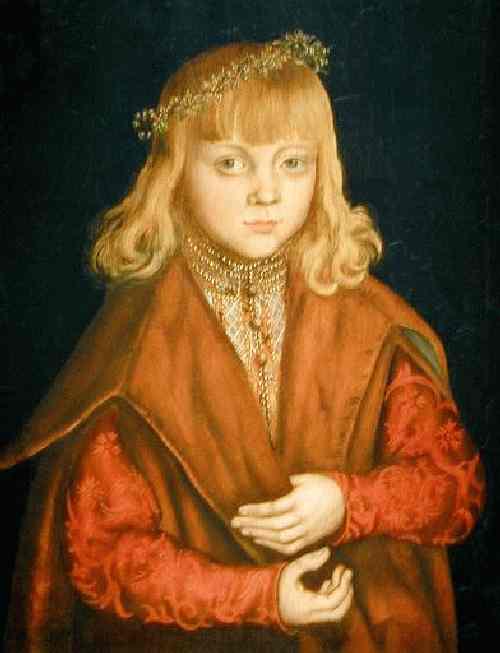
A painting exists entitled "Portrait of a Saxonian Prince", which was done by Lucas Cranach of the German School. He lived from 1472 to 1553. It pictures a young robed boy waering what look likes a luxurious red silk tunic. He wears a crown of flowers on his head. He may be the son of Frederick III, we need to investiagte this.
Augustus the Strong, Elector of Saxony, was crowned King of Poland (1697) Under the rule of Friedrich August I (Augustus theStrong) and Friedrich August II, Dresden became a centre of European art and culture.
Saxony fought on the side of Napoleon at the Battle of Leipzig and lost. As a result, substantial territories had to be ceded to Prussia. Early industrialisation at the end of the 19th century brought prosperity but also social tension to Saxony. In Leipzig Ferdinand Lassalle founded the Allgemeiner Deutscher Arbeiterverein (General German Workers' Association). In Chemnitz August Bebel founded the e Sächsische Volkspartei (Saxon People's Party), from which the Social Democratic Party later emerged.
King John of Saxony was born in 1801. His father was Duke Maximilian of Saxony (1759- ). His mother was Caroline (Bourbon) of Parma (1770- ). They had four children. Both Albert (1828-1902) and George (1832-1904) were to succeed their father as kings of Saxony. The other two children were Anna (1836- ) and Margaret (1840). John acceded in 1854 and was kaised from a duke to a king. He died in 1873.
Albert (of Saxony) (1828-1902), king of Saxony (1873-1902), noted for his military ability. At the age of 21, he served as a captain in the army of the duchies of Schleswig and Holstein in their war against the Danes. He married Caroline Frederica Francisca (Vasa) in 1853. They had no children. Albert in 1866, during the Austro-Prussian War (also called the German Civil or Seven Weeks War) commanded a Saxon corps, which distinguished itself at the decisive Battle of Königgrätz by a firm stand against the Prussians. In the
Franco-Prussian War of 1870-1871, in which Saxony (Sachsen) fought on the side of Prussia and the other German states, Albert commanded the Saxon army that helped defeat the French at Gravelotte, France. He was
then placed in command of the so-called Fourth Army, which
fought at Sedan, France, and took part in the siege of Paris. After the armistice, Albert commanded the German army that occupied France, and upon the declaration of peace he became an inspector general and field marshal of the German army. During his reign, Albert encouraged industrialization and administrative reforms.
King George was born in Pillnitz during 1832. His father was King John of Saxony (1801- ). I do not know whomis mother was. He married Maria Anna of Saxe-Coburg-Gotha in Lisbon during 1859. They had three children: Frederick Augustus III (1865-1832), Maria Josepha (1867- ), and Johann George (1869- ). Maria Josepha married Grand Duke Otto (Habsburg-Lotharingen) of Austria in 1886. Their only child Emperor Karl I, the last Emperor of Austria. King George acceded to the throne late in life on the death of his older brother Albert and only ruled for 2 years before dieing in Pillnitz during 1904.
|
The last king of Saxony was Friedrich August III. He was born in 1865 and acceded to the throne in 1904. His father was King George of Saxony (1832- ). His mother was Maria Anna of Saxe-Coburg-Gotha (1843- ). He married Louise Habsburg-Lotharingen in 1891, but they divorced in 1903. They had one child, Prince Ernest Henry (Werrin) of Saxony (1896- ). He married Sophie von Nassau in 1921 and they had three children. Friedrich-August was deposed on November 12, 1918 in the aftermath of World War I. When the deposed king journeyed through Saxony after the 1918 revolution, Saxon people waved to him at railway stations. Whereupon the deposed king is supposed to have said in broad Saxon dialect: "You're a fine lot of Republicans." He died in 1932. Saxony and other German states still had broad power within the Weimar Republic, but with the NAZI seizure of power state authority was centraliized. After the NAZI defeat in World War II, Saxony fell within the Soviet zone of occupation and until unification was a part of the German Democratic Republic (DDR), East Germany (1989).
Ptolemy. Geographia.

Navigate the Boys' Historical Clothing Web Site royal pages:
[Main German royal page]
[Main royal pages]
[Austria]
[Belgium]
[Denmark]
[France]
[German Empire]
[Italy]
[Luxenburg]
[Monaco]
[Netherlands]
[Norway]
[Romania]
[Russia]
[Spain]
[United Kingdom]