
United States Boy Scouts: Camps
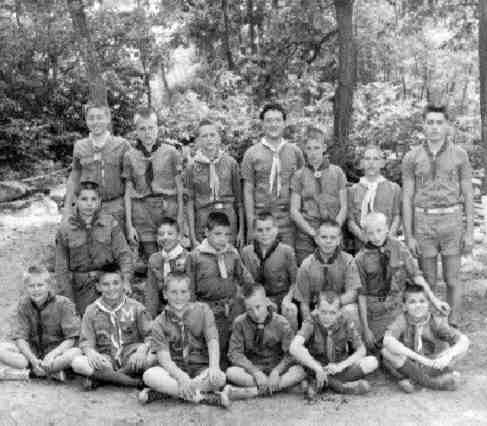
Figure 1.--These American Scouts all wear the short pants uniform that most American Scout camps required, even though many Scouts did not wear the short pants uniform until the 1970s. Note the short hair cuts the boys wear. This dates the photograph to the 1950s or early 60s.
|
|
Camping was at the beginning of the Scout movement the most popular activity. Scouting was a first organized around camping. The camps were at first makeshift affairs held in rural areas with the permission of local landowners. Gradually as the movement gained momentum, local Scout groups purchased land and built permanent facilities for camping. Perhaps the best known American camp is the Philmont Scout ranch, but many Scout Councils now operate camps throughout the country. Most camps had regulations about the uniforms to be worn. As the major season for caming was the summer after school was out, many camps selected the short pants uniform. American Scouts, especially Scouts in the northern states, did not wear shorts until the 1970s. This often meant that the boys had to buy a special uniform for the camp.
The American Boy Scouts were founded at atime that the American summer camp movement was already underway, although at an early stage. Both occurred shortly after Americ made the transitioj from a majority living in rural areas to a majority living in urban areas. Thus there was an increasing interest on the part of boys and parents to seek out outdors and wldreness activities. Thisas a part of the appeal of camping. Summer camp is a long established ritual for American boys which has roots in the late 19th century. It is a tradition that has now spread to many other countries. It is noted in lesser annals of the American national saga that organized camping for children began just a mite over a century ago, in 1861. Founding father and spiritual leader of summer camping was one Frederick W. Gunn. The two most important groups involved in American camping have been the Scoutsm both Boys and Girl Scouts anf the YMCA/YWCA. The Camp Fire Girls, now Camp Fire were also important. Many private camps for affluent children appeared in the 1920s, some earlier. Many of these camps also had uniforms, often short pants. For some boys, the only short pants they wore were their summer camp shorts. Many other camps did not have uniforms, but boys often wore shorts. Many camps in 1920s through 50s had camp uniforms that all the boys wore. These were often the expensive fee-paying camps for children from affluent families.
Scots began caming from the earliest days of Scouting. In fact there was Scouting by predecessor groups even before the Boy Scouts of America (BSA) were fonded (1909). A vast trasure of photographs exist from these camps. They illustrae activities and the uniforms worn at these camps over time. The image here shows American Scouts at camp about 1960. The letters from the boys are another fascinating source of information from the camps over time. They are alwatys facinating to read. One HBC reader describes his letters home in 1972. They are an amusing read. One tells about their activities at camp, including cave exploring ("we saw bats and everything imaginable"), hiking ("I have 9 blisters"), and "scinnydipen", and end with "Hurry with the money. PLEASE." The other one tell about hiking "15 miles to the highest waterfall west of the Appellachens" and ends with "I spent 4 dollars on something you will see when I get home. I need 6 more dollars. P.S. Send Fast."
Development
Camping was at the beginning of the Scout movement the most popular activity. Scouting was a first organized around camping. The camps were at first makeshift affairs held in rural areas with the permission of local landowners. Gradually as the movement gained momentum, local Scout groups purchased land and built permanent facilities for camping.
Perhaps the best known American camp is the Philmont Scout ranch. Every year large numbers of American Scouts participate in various programs at Philmont. There are, however, many other Boy Scout camps. Everu Scout Council operates camps throughout the country. There are now Scout camps established in every state of the union as well as some of the various territories. Most are known only to local Scouts. There is, however, a huge photogrphic record of these various camps as the boys and youth leaders loved to take photographs and of course the Scouts were founded after amateur photography became so simple and afordable. This we have a very extensive and detailed photographic record. We will archive some of these images here to view Scout camps around the country.
Extent
The Boy Scouts opersate one of the most extensive summer camp programs in the World. At first Scout camping was informal, conducted in the countryside on private land or in state and national parrks close at hand. Gradually the Scout groups began acquiring land and building permanent facilities. Without such permnent facilities it was difficult to acquire and store equioment, including popular items likecnoes and boats. It also enabled the camp mananagers to build fcilities like cabins, dining rooms, nd recreational facilities. This turned the camps into all weather facilities opening up range of rainy day acivities. Germaby also had a large number of summer camps, all taken over by the Hitler Youth movement. The Young Pioneers in the Soviet Unioin had a larger system involving more children bevause membership was essentially voluntary. But with the disolution of the Soviet Union the Pioneer movement quickly disappeared. We are not sure what happened to all the Pioneer camps. The American Boy Scout camp system is now the largest in the world. Along with the YMCA it is the major operator of American summer camps.
Seasonality
As the major season for caming was the summer after school was out, many camps selected the short pants uniform.
There were many stanndard activities at camp including hiking and camp craft. Here Daniel Carter Beard inspired countless ideas about camp craft of varying practicality. Another standard actibity at camp was water activities, including swiming and boating. Gradually a host of new activities were added to the camp experiences, depending in part on the facilities at the camp and the capabilities of the staff. One of the features of Scouting has bee the tendency to add techonolgical innovations to the activities program. Thus radio became popular in the 1930s and each susscessive generation updated the program to include merit badges with the latest technology. Scout camps, however, tended to stress the essential basics of Scouting. While facilities have changed sinificantly over time, the basic activities have retained their popularity.
Many camps had regulations about the uniforms to be worn. Early ad hoc camps show the boys wearing a wide variety of uniforms. Gradually as the camps became more established, uniform standards developed. One notable development was that boys at camp began wearing short pants. This is notable because the standard Scout uniform for American Scouts at the time was knickers. The United States was one of the few countries that did not adopt a short pants uniform for regular wear. Yet at the camps boys mostly wore short pants. Presumably the camp organizers began to require boys to wear short pants. I am not sure just when this developed and to what extent it was a centrally organized policy. The camp shown here clearly had a uniform policy. American Scouts, especially Scouts in the northern states, did not wear shorts until the 1970s. This often meant that the boys had to buy a special uniform for the camp. Thus wearing shorts at camp meant purchasing special garments just for the camp.
HBC

Navigate the Historic Boys' Uniform Chronology Pages:
[Return to the Main chronologies page]
[The 1900s]
[The 1910s]
[The 1920s]
[The 1930s]
[The 1940s]
[The 1950s]
[The 1960s]
[The 1970s]
[The 1980s]
[The 1990s]
[The 2000s]
Navigate the Historic Boys' Uniform Web Site:
[Activities]
[Biographies]
[Chronologies]
[Countries]
[Essays]
[Garments]
[Organizations]
[Religion]
[Other]
[Introduction]
[Bibliographies]
[Contributions]
[FAQs]
[Questions]
[Unknown images]
[Boys' Uniform Home]
Navigate the Historic Boys' Uniform Web organizatiion pages:
[Return to the Main U.S. Scout page]
[Return to the National Scout page]
[Boys' Brigade]
[Camp Fire]
[Hitler Youth]
[National]
[Pioneers]
[Royal Rangers]
[Scout]
Created: February 26, 1998
Last updated: 10:55 PM 6/16/2015