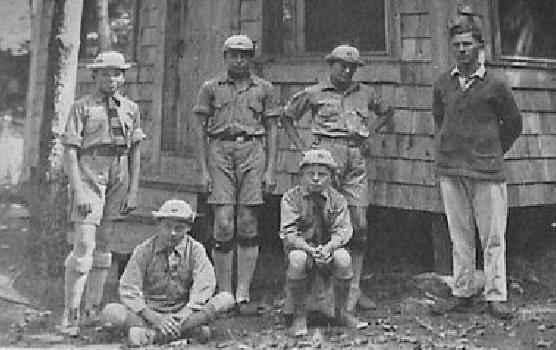
Figure 1.--Here we see a cabin at Camp Mowana. It was a boys' camp with a required uniform rather like the Boy Scouts. |

|
Summer camp is a long established ritual for American boys which has roots in the late 19th century. It is a tradition that has now spread to many other countries. It is noted in lesser annals of the American national saga that organized camping for children began just a mite over a century ago, in 1861. Founding father and spiritual leader of summer camping was one Frederick W. Gunn. The two most important groups involved in American camping have been the Scoutsm both Boys and Girl Scouts anf the YMCA/YWCA. The Camp Fire Girls, now Camp Fire were also important. Many private camps for affluent children appeared in the 1920s, some earlier. Many of these camps also had uniforms, often short pants. For some boys, the only shorts they wore were their simmer camp shorts. Many other camps did not have uniforms, but boys often wore shorts. Many camps in 1920s through 50s had camp uniforms that all the boys wore. These were often the expensive fee-paying camps for children from affluent families.
Summer camp is a long established ritual for American boys which has roots in the late 19th century. It is a tradition that has now spread to many other countries. It is noted in lesser annals of the American national saga that organized camping for children began just a mite over a century ago, in 1861. Founding father and spiritual leader of summer camping was one Frederick W. Gunn, a Yale man, whose inspiration it was to hitch several boys to a wagon and a cow, thereby insuring a fresh supply of milk, and blaze a trail into the wilds of Milford, Connecticut, where they set up a camp-site. "Gypsying," it was called in those days. Mr. Gunn might be at a loss to know what to call it now. Among professional camping people it is no idle question, having split their ranks and poised them upon the sharp edge of an agonizing reappraisal: What, they ask "eying the $1,000 tuitions, the toirid pursuit of Culture, the gentle amenities of plumbing, screening, and innerspring mattresses" what the devil is camping in these splendidly appointed times?
Summer camp is a long established ritual for American boys which has roots in the late 19th century. It is a tradition that has now spread to many other countries. The popularity of summer camps has varied greatly from country to country and over time. We have noted that summer camps are especially popular in America, France, and the Netherlands. Summer camps in other countries such as England, Germany,
Italy, and the Sovirt Union were more associated with the youth organizatios in hose countries which were in some cases state supported. Some counties like American and France had programs to provide summer camp experiences to poor children, variously supported by private or state charities.
The two most important groups involved in American camping have been the Scoutsm both Boys and Girl Scouts anf the YMCA/YWCA. The Camp Fire Girls, now Camp Fire were also important. American Scouts who wore knickers until the 1940s and mostly long panys until the 1970s, did wear shorts for campong. The YMCA also was a major factor in promoting summer camp. I believe that some "Y" camps had uniforms--the only I attended in the 1960s did not.
Many private camps appeared in the United States during the early 20th century. We are entirely sure about the chronology. We know theee were private camps in the ealy 20th century, perhaps even the late 19th century. We have some impages from the early 20th century, but most of the images we have found come from the period after World War I. We have found large numbers of images from the 1920s on. Many of these camps also had uniforms, often short pants with vertical stripes. For some boys, the only short pants they wore were their summer camp shorts. Many other camps did not have uniforms, but boys often wore shorts at these camps as well. These camps were mostly for children from affluent families, both middle-class and well to do families. Some pf these camps were very expensive. Others were more modestly priced. Facilities varied widely. Many were located on a lake because swiming and boating were commonly an important part of the program. A lot of the camps we have found come from camps in the Northeastern states, but we note camps in other regions as well.
The early summer camps in America were primarily focused on outdoor activities like camping and hiking. An outgrowth of camoing became fireside programs. There were also skits which became a part of evening programs. Wide games were another popular activity. Sports were not a major focus, although they were no entirely absent. This varied from camp to camp. What was present at most camps were water activities, especially swimming and boating. Boating activities varied, but canoeing and sailing were usually very important. Another popular activity at early camps was handicrafts. I am not sure, but I think a factor here may have Dan Beard and his influence on Scouting. Gradually the programs at cazmp expanded, especially after World War II. This has lead to the modern situation in which there are a wide variety of summer camp programs with many specialized camps.
Many camps in 1920s through 50s had camp uniforms that all the boys wore. These were often the expensive fee-paying camps for children from affluent families. Often the uniform was a "t" shirt, often with a camp logo, and short pants--usually simple boxer shorts--sometimes with a side strope. While comfortable, they had the disadvantage that there no or few pockets. This was a major disadvantage for any red-blooded American boy who liked to put away little treasures from frogs to rocks. Often less expensive or charity camps did not have uniforms.
We would like to collect some information about individual summer camps but have not yet been able to find very many accounts. One reader has forwarded information about Camp Mowana for Boys. Early camps often had Native American names. Most early camps were for boys and when girl's camp first appeared they were separate fromn the boys' camps. Camp Mowana was located for Boys on Echo Lake, Readfield Maine. The camp had a variety of activities. There were black cooks, but no black campers. The campers competed for all sorts of awards. The camp had a required uniform rather like a Boy Scout uniform (figure 1).
We are unsure just when family camping began. The get back to nature ethos is probably dated with Henry David Thoreau and Walden ((Life inthe Woods) (1854). But most Americans for most of the 19th century were primsrily interested in getting away from nature and enjoying the comforts of the city. But American cities changed with theindustrial revolution. And we see the growth of suburbs, in part a get back to nature response to the growth of large industrial cities. The American summer camp movement began to develop in the late-19th century. The idea here was primarily to get children out in the fresh air and sushine, at first boys and then girls as well. Family camping was more complicated. Children could be sent by train and later busses to camps in the country with prepared facilities. Family camping with tents and equipment required transport. And horse-draw transport during the 19th century was not suitablle. Not only was it slow, but few city people had horses and buckboards. As with many aspects of American life, Henrt Ford dramatically changed this. The Model-T (1908) gave mobility to the Americam family. And not only wealthy families. Wealthy families summered in country homes. The average worker of course did not have a country home. They could, however,
afford a Model-T. And this meant the fmily was mobile, although roads outside the cities were at first rudimentary. Another factor was paid vacations which after the turn-of-the 20th century became increasingly prevalent. We are not entirely sure when the first family camping trips began, probably in the 1910s. Here the existence of the Boy Scout and YMCA movement were powerful examples. We know there was family camping after World War I (1914-18) as there are many examples in the photographic record. The same did not occur in Europe, primarily
because European manufacturers did not create a car within the buying power of the average worker. And we not only see families setting up tents in the country, vut we begin to see trailers bringing the comforts of the city with them. Today family vacation are an American instituio enjoyed by large numbers of families.
We notice teenagers and young men going camping. Here the idea was primarily fishing and hunting. This all varied depending on the economic situation. These outings were rather rustic when they incolved low-income rural young men. Younger brohers might be taken along, usually younger teenagers. Often dogs were taken along, meaning hunting dogs that had a practical role to play. In addition to the hunting and fishing, there was also an interest in determining who had the best hunting dog. We do not have any photographs of these outings. Photographs do exist of what they bagged after they came home, both fish and game. This was after the development of the amateur snapshot. Youths from more prosperous families might make more of an expedition of it with all kinds of camping gear such as a large tent. A dog was also often brought a long. This appears to be more of a late-19th century activity. It often went along with the idea of university athletics an muscular Christinity. This was a philosophical movement that first appeared in England (mid-19th century) that venerated patriotic duty, manliness, the moral and physical beauty of athleticism. While gymastics ans sports may have been the focus, out hunting and fiuhing were also important. It was prevalent among the Northeastern Protestant upper class.
Early camps did not have uniforms. One of the leading groups prompting summer camp was the Boy Scouts which of course did have unififorms. American Scouts who wore knickers until the 1940s and mostly long panys until the 1970s, did wear shorts gro campong. The YMCA also was a major factor in promoting summer camp. Many private camps for affluent children appeared in the 1920s, some earlier. Many of these camps also had uniforms, often short pants. For some boys, the only shorts they wore were their summer camp shorts. Many other camps did not have uniforms, but boys often wore shorts. Ecventually a style of short pants appeared in America that was specifically designed for camping. Theswe camp shorts hada major impact on the American Scout uniform.

Navigate the Boys' Historical Clothing Web Site:
[Return to theMain U.S. activities page]
[Introduction]
[Activities]
[Biographies]
[Chronology]
[Clothing styles]
[Countries]
[Bibliographies]
[Contributions]
[FAQs]
[Glossary]
[Images]
[Links]
[Registration]
[Tools]
[Boys' Clothing Home]