|
The first references in modern Europe that I am aware of was in England. As an island people surrounded by the sea, the English have an historic fascination for the seaside. The English in the 18th century began taking the waters at Bath and then ventured to the coast for sea bathing. This began the modern trend for bathing and seaside outings. Few Englishmen now live more than two hours travel by road or rail. Of course the best known are those close to London like Brighton, but there are many more. The English have a varied coast. From the rocky, craggy Cornish coastline, to the fabeled limestone cliffs of the Channel coast, to the flatlands of East Anglia, and the wild North Sea cliffs of East Yorkshire.
The English in the 18th century began taking the waters at Bath and then ventured to the coast for sea bathing. Although the rich in the 18th century were able to spend time amusingly at theseaside on the advice of their doctors, it wasn't until the19th century that Britons in their masses were able to get there.It was during the Victorian era in the mid-19th century that seaside resorts came into their own. Britain's first seaside resort was apparently Scarborough. The Industrial Revolution had drawn much of the population from the agricultural areas to the townsand cities. Many were able significantly to improve their lot, and when the railways were builtn during the reign of Queen Victoria (1837-1901), holidays by, and day trips to the seaside became a reality for millions. Large hotels andterraces were built to accommodate the new holiday makers. In fact so well werethey built that Victorian buildings are not uncommonly used for holidayaccommodation in the major resorts today.
Most Seaside towns have been there for centuries. From these towns and villages fishermen had for centuries ventured out ti sea to earn aliving from the sea. Traders and merchants to look for opportunities beyond the coast. Facilities for bathers and vacationers were, however, usually developedduring the Victorian era when visiting the ocean became fashionable. Therefore seaside towns tend to have the same general characteristics. A promenade, backedby rows of Victorian houses which often serve as hotels or guest houses. The town center where the major shops are often located some distance from the beach front, in small towns this is not very far but in larger towns it can be a few miles. Most British people do not consider this too far to walk and will often walk from their homes several miles away to the beach carrying all the items that theyneed, small children will walk too. Very little modern development of the seafronthas occurred in most towns since the Victorian buildings are well built and add to the charm. The British don�t suffer from the desire to tear everything down and build new like many American town seem to. Some of the seaside towns have become noted esorts like Blackpool and Brighton. Others are lesser known but important locally. One of the most popular English seaside resorts was Eastbourne--because it was close to London.
A holiday camp is a vacation resort offering basiv, udially seaside accondations and activities devloped in England. The vacationers are encouraged to stay within the camp site boundary. They provided entertainment and meals. The camps appeared anout the turn of the 20th century. Despite the bame, it was not realky camping because camp accommodation typically consisted of chalets, accommodation buildings arranged individually or in blocks. As car oenership began to become common, camps began adding static caravan accommodation. Today caravans camos are commomly called holiday camps. Cunningham's Young Men's Holiday Camp at Douglas on the Isle of Man may have been the first holiday camp, but it dischave tents rather than accomodation nuildings. Cunningham's was still open by the time Billy Butlin, one of the most important opperator, opened his first camp (1936). Some huts were built with hut-based accommodation. Another early camp was John Fletcher Dodd, Caister Camp in Caister-on-Sea (1906). Impressed by visits to Caister Camp, 'Pa' Potter opened a similar camp in Hemsby, Norfolk called Potters Camp. It moved to Hopton-on-Sea in 1925 and to another site within that village in 1933. We have archived an arriving group at an unidentified camp (about 1930). Camps took on a larger scale with the establishment of substantial chains like Butlins. These camps were severely hurt when cheap air fairs mafe vacations in Spain and Portugal possible. Today, the term is not commonly used by young people. Instead they are called resort or holiday centres. A reader writes, "Yes most holiday camps were on the coast. Some on the East coast. West coast and on the south coast. Billy Butlin was not active until the 1950's but I think he was starting out in the late 1930s. These days there are not so many. The ones owned by the Britannia group are not as popular as Butlin's. I stayed in in the Butlin Minehead camp twice. One was a freebee. A group of friends booked but some eone could not go and I was offered the place. It was quite pleasant."
Britain is an island nation. Its maritime tradition is well known. Britain's island configuration also means a long and varied coastline. All of the country lives within a three-hour drive of the coast. Most live even loser. The seaside is primarily associated with the beach and fun in the water and sand. Little kids can play in the sand and ride the donkeys. Older kids can enjoy the surf nd dig in the sand. Teenagers can swim. British beaches are, however, different than America beaches. For one thing the water is much colder even in the summer. Also a lot of the beaches are rather rocky rather than sandy. So the amusement piers and promenade are very important part of the seaside fun. An English seaside pier is rather like the American boardwalk, only it juts out into the ocean. The piers became important as soon as the railroads turned the seaside into mass entertaiment for ordinary people.
Beach experienced in the 18th and 19th century were far different than the modern experinces. What was thought to be healful at the time was the seawater, not the sun. In fact female beauty demanded a lilly white complexion. As a result bathing costumes were actually more modest than modern casual dress, although mem until the mid-19th century commonly did not wear swimwear. Modest or not, men and women were not susposed to catch glimses of each other. And there was no laying about on beaches to get a tan. The idea was to get into the water with as little time on the beach as possible. And it was an adult activity. The younger kids were left at home. And there was a strict separation of men and women. As part of all this the British invented, the bathing machine. It was not exclusively used in Britain, but was more common in Britain and British Empire colonies than any other countries. The bathing machine was a device that enabled bathers to modestly change out of their orinary clothes and into swimwear. They were used by both genders, but were virtually mandatory for the ladies. It must be remembered that people wore much more elaborate clothing in the 18th and 19th century so changing was not a small matter. But this was not the only function. Horses were used to pull the batching machine off the beach into usully waist deep water. This allowed the bather to frolic out of sight of the bathers of the opposite gender. Some were very substantial wooden structures. Others were more flimsy using canvas. This only changed at the turn-of-the century when British beachers were no longer segregated by gender (1901). The bathing machines did not immediately disppear. They were parked on the beach as changing rooms.
A necessary part of getting to resorts was the travel involved. This could be expensive. For this reason resorts in the 18th century were for the affluent, if not the rich, certainly the well-to-do. The industrial revolution changed everything. It generated vast wealth nd expanding the middle-class and comfortable working class. People had more disposable income, meaning they could splurge with holidays. And the industrial revolution also brought steashis and railways. The railways meant cheap fares. And only short, inexpensive trips were necessary to take anyone in England to the coast, no matter where they lived.
Traveling to the seaside resorts in the 18th century was typically by horse-drawn stage coach or what ever the British call it. This would have been mostly in America and probably France as Amercans didn't have seaside resorts in the 18th century and it was only the rich and well to do that "took the waters".
|
It was in the 19th century that seaside vacations became a summer ritual. It was a democratic development. The seaside proved an attraction to the rich and poor. The sweltering summers in the densely packed industrial cities created great interest in a visit to the seaside. At part of the industrial revolution that expanded the great cities of Europe and America, the railroad appeared. By the late 19th century, the middle-class and even industrial workers could inexpensively travel to beach resorts located near the great industrial cities. The appearance of photography in the 19th century provide a fascinating record of the clothing worn to the beach.
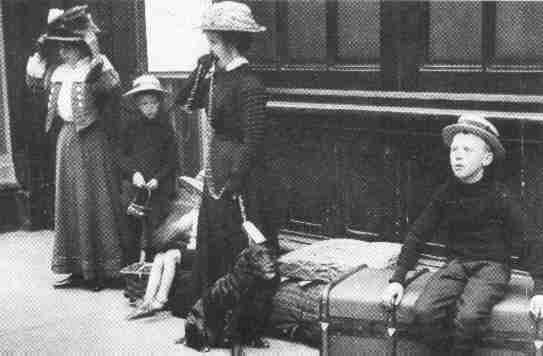
By the turn of the century, a summer trip to the beach was a well etablished summer event. Most Brits would travel to the seaside resorts on the railroad. This continued until well after World War II (1939-45). It was only in the 1950s that it became increasingly common for average people to own cars and plan family vacations in them.
As seaside holiday began to become fashionable, they at first were for the rich and well-to-do. Holiday makers stayed in grand, very expensive hotels. This began just as thee industrual revolution was beginning (mid-18th century). With the industrial revolution creating unpresidented wealth many more people were able to also experience seaside holidays. This began the tradition of a summer holiday. There was a huge expansion of the middle-class. Eventually the working-class also was able to take holidays. The development of a rail system provided rapid, inexpensive ways of reaching the seaside which in England is not very far away from any inlnd city. And boarding houses opened providing modestly priced accomodations. They would not be on the ocean front like the grand hotals, but would not be very far from it. There bording houses for all price ranges, but far less than the grand hotels. The noarding houses also provided meaks, further reducing the cost of these holidays.
What was at first called sea-bathing as a fashionable activity was invented in Britain. The bathing terminology is why swimsuits are commonly called bathing suits. It all began in the late-18th century, but just for the upper class who could afford expensive resorts and travel and had leisure time. It was a mixture of pleasure and helth. Sea bathing began to be seen as an outdoor ctivity with health benefits. It was an outdor extension of the older European health regime of the spa. Early bathing resorts were commonly spa-like resorts. In some cases they actually were combination spa and bathing resorts. Many spas were promoted by what one author describes as an 'entrepreneurial medical men'. [Walton]. The same author also describes a popular sea-bathing tradition prevlent in coastal Catholic Europe. Unlike the spas, this was more of a popular tradition, but only important along he coasts, primarily in southern Europe. The same author describes Catholic Europe as seeing the sea 'as having prophylactic powers at the August spring tides'. The beggining of the shirt of popular sea bathing to more refined participsnts and a commrcial actibity occurred at Whitby and Scarborough, in North Yorkshire (about 1720). Interesting that it occured in Yorkshore with its bracing North Sea coast.
This new activity was limited in extent. England still had a largly agricultural economy. Before the industrial revolution, the great bulk of the population had little o no leisure time or the wearwithall to afford seaside hilidays. The wealthy did, and we begin to sea seaside resorts, most alomnhg the southeast at Margate, Brighton and Weymouth. The southern climate and location near London were kimportant fctors. The stress was on luxury and pleasure at spa like pleasure resorts. The Prince Regent (future George IV) Brighton royal patronage from the future George IV created a hedonistic pleasure palace at Brighton, alled the Brighton Pavillion (early-19th century). He essentially provided royal patronage to sea bathing resorts. And the seaside resort became a fastest-growing type of English town during the early-19th century. Brighton was one of the fastest growing towns in England. But these resports were limited to the well to do. Then two major developments occurred at mid-century. The Industrial Revolution began the creation of unprecedent wealth and the expansion of cities with a growing industrial proleterit and middle clss, both with higher incomes than was the case of agricultural workers. And as part of the Industrial Revolution, the railroads began to spread across Britain providing an in expensive way for even workers to get to the seaside. And soon inexpensive accmodations and attractions appeared to accomodate them. Attraction packed piers became popular. Blackpool became the world's first working-class seaside resort (late-19th century). And very quickly virtully the entire English and Welsh coastline had resorts of different sizes and appeal (ealy-20th century). There were not as many in Scotland, reflecting both distance from the major English cities and water temperature. Ther were over 100 important resorts. Expansion of these results continued through two world wars. Beaches were closed off during world sar II. Some were even mined. As car ownnershio increased we have new caravan parks. This suddenly changed when cheap air fares opened up inexpensive beach resports in Spain and Portugal (1970s). With his the English resorts which could not compete with the warm climate and water began to decline. The prosperity generated by the Thatcher era and market reforms increased the purchasing power of English families and the ability to aford seas-side holidays (1980s).
English people when they went to beach resorts mostly stayed in hotels or other accomodations. The affluent stayed in elegat beach-front hotels and dressed to the nines. The families with more modest incomes stayed in inexpensive boarding houses. We are not sure when camping began. We note unidentified campers in Brighton as early as the 1880s. The modern concept of camping was not yet evident. We are not sure how common that was. After World War II, Brirish families began acquiring cars. And it became popular to stay in caravans (campers). Even people without cars could do this. There were caravan parks where you could either park your caravan or rent one.
England was the wealthiest country in Euroe with incomes above Germany and France and other European countries. Generally a country's photographic record was a function of percapita income. But income was not a perfect determinant of photography. Europe's largest photographic record appears to be German. As far as we can tell the largest number of photographs seem to come from Germany. We are not sure about 19th century studio photography, butwe have found far more snapshots from Germany than any other European country. We can only assume that more Germans had cameras than the English. We have found what look like English snapshots in the first half of the 20th century. But on reflection many of them were actually taken by professional photographs set up on the streets. There were of course also studios where photographic portraits were raken. But the stree photographers were much less expensive and more cnenient. Beach resorts and parks were especially common places to have family portraits taken. A British reader tells us, "My parents never owned a camera so all the photographs are of holidays. Thesr were taken as we walked along the prom and collected a day or so later." We see a lot of German park and sea side photographs as well, but they look more like family snapshots.
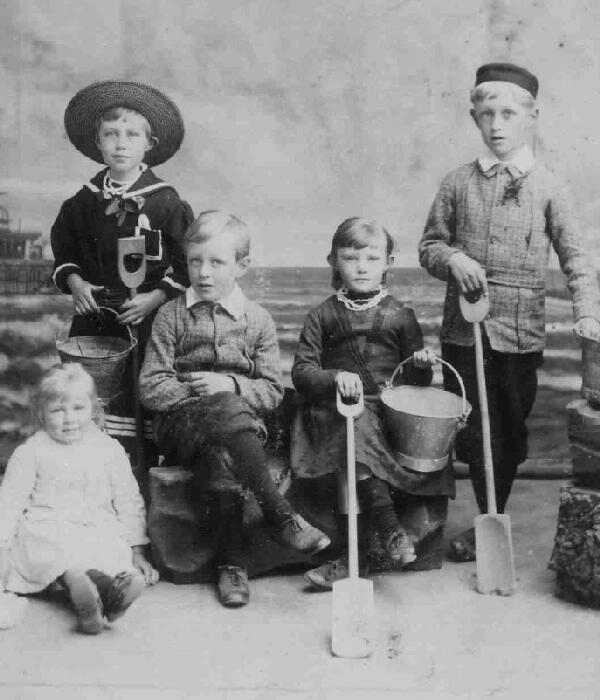
We note a wide range of clothing worn to the beach, both swimsuits and more generalized play clothes. British boys have worn quite a few different types of swimsuits. The styles of swimsuits or bathing costimes have changed dramatically over time. Swimsuits in the 19th century were very modest. We note a far greatr range of swimsuits in the 20th century. English children did not always wear bathing suits to the beach. Here changing conventions about swimming as well as climate were factors. Many children even in the early 20th century might wear suits and other outfits, especiall sailor suits. Wide brimmed hats were commonly worn. English children commonly went to the beach without swimsuits. Children commonly enjoy playing in the sand more than actual swiming. Thus beachwear was often not swimsuits. Many times they only waded or played in the sand. Modern readers might think they were dressed very formally. We commonly see boys at the seaside wearing Norfolk suits and Eton collars in the early 20th century. Gradually we see boys wearing more casual clothes. Here we have two types of clothing. The first are actual swimsuits or bathing costumes and the second are outfits worn at beach resorts, but not actual swimsuits.
Walton, John K. "The seaside resort: A British cultural export," The Sea: History in Focus Website. (Autumn 2005).

Navigate the Boys' Historical Clothing Web Site:
[Return to the Main seaside resort country page page]
[Return to the Main English beach page]
[Return to the Main English outings page]
[Introduction]
[Activities]
[Biographies]
[Chronology]
[Cloth and textiles]
[Clothing styles]
[Countries]
[Topics]
[Bibliographies]
[Contributions]
[FAQs]
[Glossaries]
[Images]
[Links]
[Registration]
[Tools]
[Boys' Clothing Home]
Navigate the Boys' Historical Clothing Web Site:
[Sailor suits]
[Sailor hats]
[Buster Brown suits]
[Eton suits]
[Rompers]
[Tunics]
[Smocks]
[Pinafores]