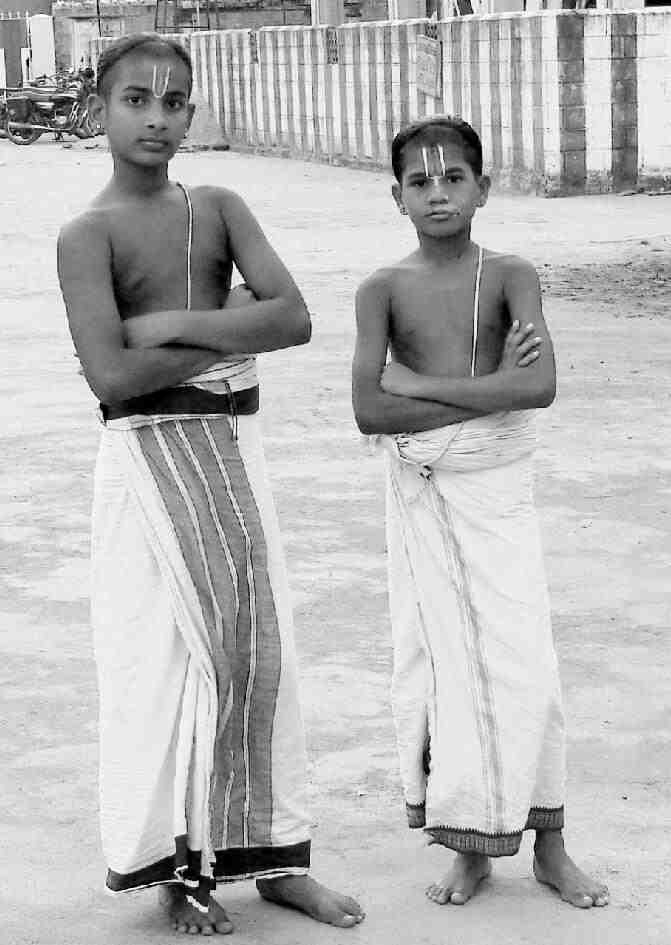
Figure 1.--This photograph taken in Chennai (Tamil Nadu, Southern India) shows two Brahmin boys. In the temple Brahmins wear only the lungi or the dhoti. In India bare feet are mandatory not only in Hindu temples, but in all religions sites. |

|
There are some 700 million Hindus, mostly located in India. The only other countries with large numbers of Hindus are Nepal, Sri Lanka, and Indonesia (Bali). Hindus refer to their faith as Sanatana Dharma, the eternal faith. Hinduism is seen by some as not precisely a religion. Rather it is a code of living based on the practice of Dharma. Veda provides an elaborate explanation of Hindu beliefs. Unlike other major religions, there is no known founder of Hinduism. There is no elaboracte ceremony in becoming a Hindu. Anyone who practices Dharma can call himself a Hindu. Also unlike many other religions, there is no sin of heresy. Any Hindu can question the authority of any Hindu scriptureand even the existence the divinity. A Hindu as he matures in his relgious understanding moves from ignorance to Truth. The teachings of the seers give the Hindu the basis and a path for spirituality. Hinduism appears to be the oldest of the world's great religious traditions. Even so, the truth realized by the seers are seen as beyond time. The Hindu principal Hindu scriptures are the Shruti (meaning 'heard'), Smriti (meaning 'remembered') and nyaya (meaning 'logic'). These apelages are based on the origins of the scriptures. The shruti means that the sages heard it directly from the Gods. In contrast smriti refers to a text that was written down and remembered. Shruti is the most authoritative scripture as it came directly from the deity. The Shruti is composed of Vedas. Vedanta-sutras (vedanta aphorisms) are lnown as Nyaya. Other religious texts are known as smriti. Nyaya always agrees with shruti.
There are some 700 million Hindus in the world today. The numbers are growing, primrily because of the population growth rate in India.
Most Hindus live in India. The only other countries with large numbers of Hindus are Nepal, Sri Lanka, and Indonesia (Bali). While only a small proprtion of Indonesians are Hundus, about 90 percent of the people on Bali are Hindu. There are relatively small Hindu populations in a mumber of other countries, including the United states and Britain.
Hindus refer to their faith as Sanatana Dharma, the eternal faith. Hinduism is seen by some as not precisely a religion. Rather it is a code of living based on the practice of Dharma.
The Hindu principal Hindu scriptures are the Shruti (meaning 'heard'), Smriti (meaning 'remembered') and nyaya (meaning 'logic'). These apelages are based on the origins of the scriptures. The shruti means that the sages heard it directly from the Gods. In contrast smriti refers to a text that was written down and remembered. Shruti is the most authoritative scripture as it came directly from the deity. The Shruti is composed of Vedas. Vedanta-sutras (vedanta aphorisms) are lnown as Nyaya. Other religious texts are known as smriti. Nyaya always agrees with shruti. Veda provides an elaborate explanation of Hindu beliefs.
Hinduism appears to be the oldest of the world's great religious traditions. Unlike other major religions, there is no known founder of Hinduism. Rasther Hinduism seems to be an almagem of the relgious traditions that developed over time on the sub-continent. Many local gods and traditions over time were absorbed into the Hindu pantheon.
Most Hindus worship (puja) every day in their homes where they have small shrines or even a puja room. These shrimes are highly variable, they can be a room, a small altar or simply pictures or statues. Family members often worship together at these shrines. They make offerings to a murti, a sacred stautue of a god or goddess. Communal worship is conducted at a Mandir (Hindu Temple).
The temple (Mandir) plays a much smaller role in the life of Hindus than many other religions such as Christianity, Islam, and Judaism where the church, mosque, and synagogue are very important. It is not mandatory for Hindus to visit a temple on even a weekly basis. Hindus usually have a shrine at home for daily prayers and worship. Hindus generally visit a temples only on special days. This can include auspicious occasions or religious festivals where communal celebration is important. Hindu temples notably do not play a crucial role in marriages and funerals. Rather the temple is the meeting place for religious discourses as well as ‘bhajans’ and ‘kirtans’ (devotional songs and chants). The various mandirs are dedicated to different gods and are the focus of Hindu religious life, although not individual worship. The temple is perhaps more important outside India, where Hindus are not a majority. Hindus outside India may gather at the mandir at the weekend and it becomes a focus of community life. Worshipers in the temples commonly repeat the names of their favorite gods, goddesses, and the associated mantras. This is commonly done individually. They offer water, fruit, flowers and incense to the gods. Hinduism began as a fusion between local beliefs and those of the Indo-Aryans who conquered the sub-continent during the Vedic period. At this time there were no temples. The principal object of worship was fire which came to be seen as the physical appearance of God. Worshipers would light the holy fire on a platform out in the open under the sky. Worshipers offered oblations to the fire. Historians are not certain when the Indo-Aryans first began building temples. This may have occurred at about the same time that idol worship began. Temples gradually became important as a sacred meeting place for communal worship and celebration of important festivals. As daily or even weekly communal worship was not seen as important, convenience for the worshiper was not as important as other religions. Thus Hindus often chose scenic locations for important temples, including river banks, hill tops, coastal locations. This is different than say Christianity where early churches were often built at locations where early Christian services were conducted in secret. Smaller temples, including open-air shrines, can be found at virtually any place. They can be found along the road or under a beautiful tree. Temples have been built at important Hindu holy places. Beautiful Hindu temples can be found at Amarnath, Ayodha, Brindavan, Banaras, Kanchipuram, Kanya Kumari, and many other towns.
A variety of ceremonies are celebrated by Hindus. Interestingly, there is no elaboracte ceremony in becoming a Hindu. Anyone who practices Dharma can call himself a Hindu. And no sanction is required by a religious authority. Hindu ceremonies vary widely on a regional basis. There are even differences from village to village and among inviduals. Hinduism is the least authotitarian of the great religious traditions. And there is a wide degree of toleration for varying cereminial traditions. This is in sharp contrast to the Catholic Church's supresion of heresies in the Middle Ages and the religious wars of the 17th century. It also contrasts to the lack of toleratiion in the Muslim world, especially the violence between Shiites and Sunnis. Hindu traditions seem tgo have developed over time in locations all over India and no authoritative religious hierarchy guided or controlled the process as was often the casde of Judaism, Christianity, and Islam. (We are lest sure about Buddhism. There are some unifying themes among the seeming cacophony of Hindu relgious ceremonies. Perhaps the strongest unifying them in Hindu ceremonies and rituals is the focus on purity and pollution. Perhaps no religion focuses on prification more than Hinduism.
vinvolving the cleansing values of water. Christian batism is an example of this and Mulisms ritually was before prayers.
Hindus must not only purify themselves before religiousd ceremonies, but they must actively avoid the impure in daily life.
This oncludes killing animals, eating meat, contct with dead things, and bodily fluids. Individuals and groups who avoid the impure are granted great respect. Another important aspect of Hinduism is the importance of sacrifice. Here the term is widely defined as some kind of offering inckluding recitations and manipulations of religious objecrts.
Unlike the other great religions, the home is the focus for worship and religious ceremonies. It is at home that most Hindus worship and conduct daily rituals. And fot this both dawn and dusk are particulasrly important. Particularly devout families may performm religious rituals at various times during the day as well. In msny Hindu homes, the day begins at dusk when the women of the housdehold draw geometric designs in chalk or rice flour on the floor or the doorstep of the home. Recitations from religious texts commonly punctuate dawn and dusk.
After a bath, Hindus conduct personal devotions before a family shrine to a favored god. This commonly involves ritually lighting a lamp and offering foodstuffs while reciting prayers in Sanskrit or a regional language. English is widely spoken in India, bit not used in these devotions.
One aspect of the lack of authoritarianism in Hinduism is that unlike many other religions, there is no sin of heresy. Any Hindu can question the authority of any Hindu scripture and even the existence the divinity. We suspect that this may hasve been a fasctor in the success of democracy in India since independence. This is in sharp contrast to the authoitarian nature of Islam and the difficulties experuenced with democracy in Paskistan.
A Hindu as he matures in his relgious understanding moves from ignorance to Truth. The teachings of the seers give the Hindu the basis and a path for spirituality.
The truth realized by the seers are seen as beyond time.

Navigate the Boys' Historical Clothing Web Site:
[Teturn to the Main religion page]
[Introduction]
[Activities]
[Biographies]
[Chronology]
[Clothing styles]
[Countries]
[Bibliographies]
[Contributions]
[FAQs]
[Glossaries]
[Images]
[Links]
[Registration]
[Tools]
[Boys' Clothing Home]