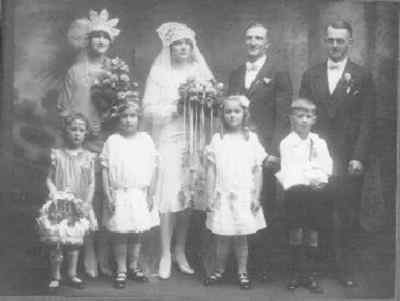
Figure 1.--The participants in a wedding are shown here in a photograph taken about 1925. |

|
Roman Catholic, Anglican, and Orthodox Christians accept marriage as a sacrament. Union in marriage creates a new family. The commitment is to love each other and be life companions. Some denominations see it as a permanent union and do not permit divorce. This issue has made history. Henry VIII was a defender of the Catholic Church, but the pope's refusal to allow him to divorse Catherine of Aragon led to the Proterstant Reformation in England. Other demominations are more lenient on divorce, coming to the realization that not all marriages can be saved. Weddings are the most formal event in which most people participate. For many it is a once in a lifetime event. Wedding services vary from demonimation to denomination with varying rituals, but all include promises that the couple make to each other. Wealthy families can spend huge amounts on society weddings. Even middle class families can spend large amounts. It is normally the the dride's family that pays the bill. Unlike many formal events, children are incouraged to participate in weddings. The most formally dressed children are the ring bearers and pages, but all the children are normally dressed up for a wedding. While the wedding party is understandably the focus of the wedding and wedding photographs. Other photographs taken of the wedding, such as of the guests, also provide valuable information.
The whole topic of marriage is an interesting social phenomenon. As far as we know, early homonoids including man were polygamous. This is the general pattern among primastes. And it continued to be the dominant form of social interaction in the ancient world. A lonely exception was the Jews which passed on monomgamy to the Christian tradition. This was an easy tradition because Greek and Roman philosophers promoted monogamous marriage as “natural and necessary” to foster mutual love, respect, and companionship between the husband and wife. Monogamy was slower to develop beyond the West. It is not altogther clear why monogamy gradually triumphed. One author suggests largely economic reasons. Apparently monagamous marriage raises the value of men in relation to women. [Porter] His argument is that polygamy tilts the male-female ratio in the woman's favor, rasing the vlue of women, enabling them to 'mate above their station'. Monogamy is also a factor in social cohesion. A study of countries around the world tends to show that monagamous countries are less corrupt, less brutal (use of the the death penalty), and more affluent. Here assessing modern societies is complicated by other factors besides marring patterns, especially Islam. Polygamy has continued into the modern world, in societies where Christianity has has little impact, meaning primasrily the Muslim world.
Many of our modern weding traditions are fairly modern, established furing the Vicirian Era, many by Queen Victoria and Prince Albert (19th century). But the llebrations have been extended during the last century to a much wider proportion of the population (29th century). This is the result of the economic progre brinhing widely shared prosperity to the world. The result has meant that weddings which were once simple ceremonies have evolved into elegant even glamorous events. And with rising mobility, traditions from many different countries andreligions have defused. This has all affected the dresses and suits, traditions, flower arrangements, venues, vows, and much more. By the turn-of-the 20th century Ewardiam Era brides were a vision of purity with white lace and puffy forearms (1900s). Gloves were common. A narrow share of the population could stage a formal wedding because prpsperity was not yet widespread. Working class people simply could not afford a formal wedding. It should be noted thi wa not because the system was explotive, but necause workers were not as prpductive as modern workers, This gradually changed because of tevhnological cahnge and investment. There was also still an expectation tha the groom be well enough fixed finamcially to suppot a family. This led to many marriages with substantial age gaps. As modern industrial economies develpped we see more marriages with pairs close in age. The prosperity following World War I saw more formal marriages as well as wedding parties (1920s). Our interest tensd to be the children. And we see an increasing tendency to involve childrn in the wedding with flower girls, ring bearers, and pages. And we see them being dressed formally, often coordianted with the brides maids and groomsmen. The Depression and the economic decline had a major impact on both weddings and the ceremonies (1930s). There werecfewer and less expensive weddings. World War II also affcted weddings. War0time weddingsvthdnded to be short and quick (1949s). This all changed with post-War prosperity boom in the West (1950s). The rise of Communism in eastern Europe also bhad an inpact, attacking religion and preventing the economic success of the West. Not only vdidcthe baby-boom occur, but people had money to spend on expensive weddings, often chosing tradutionnal ceremonies. This continued into the next decade (1969s). Couples began to want more modern approaches (1980s). Princess Diana influenced wedding trends, especially the dresses. She createdv the paradigm of a fairytale wedding,
Large, elegant receptions became popular and couples wanted to capture their wedding on video.
New trends appeared with the turn-of-the 21st century (2000s). New styled, less traditional wedding dresses became popular. We see strapless, hip hugging, and simetimes provactive gowns. The gowns might cost $1,000 or more The whole ceremony might cost $30,000 or more and we are not taking about society weddings.
The ring bearer in the wedding ceremony is the young boy who brings the ring to altar--traditionally on a pillow rimmed with lace and ribbons. The ring bearer brings the pillow down the aisle before
the wedding ceremony. He is usually attired formally, although the actual costume he wears varies greatlt from wedding to wedding. Many believe that the ring bearer and other children serving as attendants can add a nice touch to a wedding. The ring bearer is often accompanied by the flower girl or girls. He and the flower girls usually walk before the bride and her escort but behind the rest of the bridal party. Flower girls usually lay a bed of rose pedals for the bride to walk on. Trainbearers walk in pairs following the bride and her escort, holding the bride’s train.
Weddings often seek to involve the entire family in some way. And her are may roles that family members of all ages and both genders can play. This includes even very young children. In American weddings the youngest boy in the family above a certain age serves as the ring bearer. The younger girls serve as the ring girl or girls. Unlike the ring bearer, there can be multiple flower girls. There are strict gender gender roles. Although the children are usually not old enough to understand the difference, the adults are. Apparently American decided that carrying flowers was appropriate for girls, but not for boys, even younger boys. This of course makes sense as families do not always have children of the right age and gender for the more definitive American roles. The same is not the case in Europe. While we do not have detailed country information, we note both boys and girls with flowers, there were both flower girls and flower children. We see that in both France and Germany. We are not sue yet about England, but are constantly expanding our country coverage. we are not sure why this difference developed between America and Europe.
The youngest boy in th wedding party normally serves as the ring bearer. Older boys can assist as pages. Employing boys in formal weddings as attendants is deriving from the ceremonial functions medieval pages performed in royal courts. There are two such roles for boys in a formal wedding, that of pages and ring bearer. In modern days the page is the boy or more commonly boys who hold the long train of a bride's gown at a formal wedding. Generally pages are school age
boys. A younger boy at a wedding may be employed as a ring bearer.
Many of the traditions associated with modern weddings were established during the Victorian era when the modern concept of family began to take form. Choosing a young boy to serve as a ring bearer was one of those traditions set in Victorian England and which spread to America and other European countries. Of course each country in Europe has added its own rich traditions to the modern wedding ceremony. The
Victorians choose to dress ring boys as pages harkening back to previous centuries. A page was a originally youth of nobel birth employed in the service of a royal or nobel. He would have been much older than the small boys who now serve as wedding ring bearers. Pages were employed in early times among many early civilizatins, such as the Persians and Romans. More recently pages were a special feature of feudal chivalry in the Middle Ages. These are the pages that seved as a model for the Victorian ring bearer. The degree of the page was preparatory to the further degrees of esquire and knight. The Victorian ring boy and page costumes tended to draw
on contemporary or 17th Century Caveler dress.
The costumes for boys serving as ring bearers and ushers at formal weddings are often based on historic styles which have remained remarkably consistent over time. Some imaginative costumes were seen in the early 20th century, but have since become more standard. Many of our modern customs, practices, and conventions concerning the wedding ceremony developed during the Victorian era. The ring bearer at a Victorian wedding could be dressed in contemporary clothes or dressed in period costume.
Weddings are a formal occassion and a time for dressing up. There are infoirmal wedding, but in most cases people dress us for weddings. In some cases the clothing is very formal. The center piece iof course is the bride and her wedding dress. At formall wedding the groom wears a kind of tuxedo and the best men an and other male azttendents matching outfits. The bridal attendants on the other hand often wear fancy dresses selected not to over shadow the bride. In less formal weddings the adults men just wear suits. Children's outfits are more bsried. In some cases they mastch that of the adult wedding pasrty. In other dases they wear special juvdnile outfits. The fancier outfits worn by ring bearers and pages at formal weddings were specifically tailored for those functions. The blouses with lace collars or white suits might only be worn by the ring. The more ordinary costumes like Eton suits or other short pants suits might be worn by both the ring bearer and other children invited to the wedding, but having no official role.
Other photographs taken of the wedding, such as of the guests, also provide valuable information. Especilly in the early 20th century, we note that it became increasinly common to take a group portrait of the wedding couple surrounded by all the guests. These images provide very useful illutrations a to how to people dressed up. I believe this is because of advances in photography. Such photographs are much less common in the 1890s than in the 1900s. Often the portrait was taken in front of the church. e notice many of these photographs from the United States, but are less sure if this dvelopment was as common as in other countries.
we have not yet begun to seriously reserch country wedding trends. Our archive of wedding images is very limited. Here we are primarily interested in aspects of the wedding that affect weddings. We suspect that social class differences are more important than national differences. Having elaborate weddings with costume ring bearers and flower girls as well as pages and other attendents are more likely among affluent than middle class families. There are also religious differences that cross nstional boundaries. We will add information here as more images become available on weddings in different countries. Hopefully readers will provide us information about wedding traditions in their countries. We suspect that Victorian England played a sajor role in establishing modern wedding conventions. Of course a country like the United States people with immigrants from many different countries has a widde variety of wedding trafditions.
Here are some personal accounts describing weddings.
A Catholic who served as an altar boy tells us about his experiences and the weddings he oserved as a choir boy.
Porter, Eduardo. The Price of Everything (Portfolio, 2010), 296p. Porter is an editorial writer for the New York Times. He has some interesting observations, such as his discussion of marriage. Other interesting observations such as why concern nover animaks is more pronounced in the West and why men are attracted to women with large breasts. Much of his book, however, is disapoointing, typical hack journalism. Porter explains why our major problems are essentially due to Bush, the Republicans, and capitalism. For this you do not need to buy the book. Anyone who reads the New York Times or most other large city newspapers and
Navigate the Boys' Historical Clothing Web Site religious pages:
Navigate the Boys' Historical Clothing Web Site:
HBC

[Return to the Main Christian sacraments page]
[First Communion]
[Ring bearer]
[Victorian wedding]
[]
[Introduction]
[Activities]
[Biographies]
[Chronology]
[Clothing styles]
[Countries]
[Bibliographies]
[Contributions]
[Essays]
[FAQs]
[Glossaries]
[Images]
[Links]
[Registration]
[Tools]
[Boys' Clothing Home]
Created: October 15, 1998
Last updated: 11:50 PM 1/24/2020