
Working Boys' Clothing: Home Piece Work
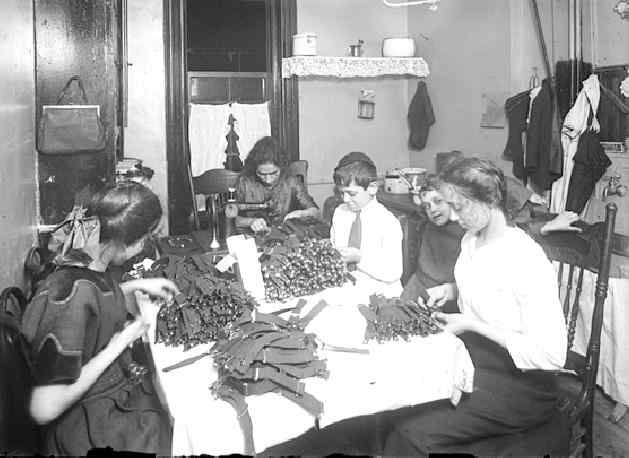
Figure 1.--This American Jewuish family, almost certainly from Russia, is involved in piece work for the garment industry about 1910. Notice the
boy's yarmulke. Mother is working and supervising the children. This was done to suplement the father's income, or if the father was missing or incapciated might be the sole means of support. The children would work after school or even be made to stay home from school. Notice the boy hear is wearing a tie while working. This family is making elastic garters/stocking supporters. Source: Library of Congress-- m198500870012>
|
|
Piece work, although not often thought of as child labor, was in fact an activity that involved many children. It essentially turned the home into a work plsce for many children. This was the case well before the industrial revolution. Many families helped make ends meet by doing piece work in their homes and tenaments. Parents were paid by the piece for completing a wide range of work. this was epecially common in te 19th century before the advent of factories. Piece work is especially associated with the garment trade, but was not in the 19th century limited to it. As factories became increasingly important, piece work declined in importance. Even so there were many operations for which machines had not yet been invented. The fact that many families lived in desperate circumstance, meant manufactures could find people willing to perform the needed opearations at low cost. This discouraged the mnufacturers from making substntial investments in expensive machinery. Whole families were involved in piece work before the industial revolution. Gradually in the 19th century it became increasingly an activity perormed by women and children. The children might even be kept home from school to do piece work.
Immigrant Labor
Many immigrants, Italian and Jewish especially, flooded into New York City, especially Manhattan, and many other northeastern cities. This began in the late-19th century and continued until World War I. Many crowded into tenements where families crowded together in very small and unsanitary quarters. Even the tenements, however, were better than their housing in Europe. New York City was the first city to regulate tenaments and address some of the worse abuses.
Many immigrants struggled to make a living and, to put bread on the table. One way of adding a little family income was piece work of various kinds. This of course is all quite true. And from our comfortable 21st century lives, it seems terrible. But from an historical view it is not the full story. These immigrants were not dumb. They knew very well what theuy were doing in coming to America. As oppressive as these conditions may seem to us today, for the vast majority, conditions were far better than in the countries from which they came. Jewish immigrants escaped from the terrible Tsarist pogroms and legal constraints on their lives and economic opportunity. Their children could attend excellent, free public schools. Their youth would not be conscripted for years of service in the Tsarist Army. And the universities were not closed to them. And they were better housed and feed than in Russia and Russian-occpied Poland. Italian immigrants were not fleeing pograms, but they were fleeing poverty and a life without economic opportunity. Like the Jewish immigrants, the children were better fed and provide free public schools. For historical purposes, readers should compare these images with conditions in Europe at the time and not with modern Manhattan. There are acacademic studies of reltive affluence. But the proof of rela\tive Amnerican affluence is obvious. If this was not the case, the immigrants woukd have returned home, Rather they came in rising nymbers just because conditions in america were so much better than those from which thery came. Unfortunatekly, this is a basic principle of historiography that few modern American textbooks make.
Examples
We have found a few examples of children doing piece work at home. We believe this was very common. The photographs suggest that it was an activity created by the Industrial Revolution. This was not the case. Only photography made it possible to record it. And rising prosperity and social conscicousness meant tht it was something by the turn-of-rhe 20th century that many Americans thought was not right, especially the involvement of children. It was the awareness oif this as a social probken that was new in the earkly-20th century. The practice itself was not new. One of the commonest types of piecework was making hose supporters which nearly all American children, both boys and girls from 2 to 14, wore. We learn from various advertisements that hose supporters for children and young women could be purchased at dry goods stores all over the nation for as little as 10 cents a pair. Immigrants took the parts of the supporters home (safety pins, strips of elastic, buckles, button-and-metal-loop fasteners) and assembled them in the family living space--women and small children participating. Some minium sewing was involved. The finished supporters were then delivered to the distributor in large cloth sacks and sold to clothing stores all over the nation. In order to make a profit from such work, the owners paid the families as little as one or two cents a pair and in some cases even less. Children worked long hours at this tedious labor.
Elastic Garters (New York, about 1910)
This American family about 1910 is involved in piece work for the garment industry. Mother is working and supervising the children. This was done to suplement the father's income, or if the father was missing or incapciated might be the sole means of support. The children would work after school or even be made to stay home from school. Notice the boy hear is wearing a tie while working. This family is making elastic garters/stocking supporters. A reader writes, "I'm curious about this picture. Do we know where it was taken? The
boy seems to be wearing a yarmulke. Is the family Jewish?" Unfortunately, HBC has no additional information about the phorograph. I supose it could be a yarmulke. It certainly looks like a cap and we question if mother would have allowed her son to wear his cap in the home. Somehow I have it my mind that yarmulkes were knitted with patterns. This looks to be a solid color. If I was to guess, I would think that the photograph was taken in New Yorl City, because the garment industry was so important there. It could, however, be a tenament in any large northern city. Of course Jewish immigrant families were heavily involved in the garment trade. Remember the Triangle Shirt Waist Fire which occurred about when this photograph ws taken. Many of the girls who died were Jewish. A reader writes, "Modern-day yarmulkes are often plain black skull caps, sometimes made out of velveteen, but sometimes also with embrodiered patterns. I have observed them at Jewish funerals, often supplied by the funeral home. I suspect that the boy in this photo is wearing a yarmulke, but I'm not sure what they looked like in 1910. I agree that the setting is probably New York City." I am not sure, but boys wearing yarmulkes was not very common in the early 20th century, or t least that is the impression I get from available photographs. I am not entirely sure why. Given the level of anti-semtism, manyboys may not have anted to draw attentin to the fact that they were Jewish.
This photograph was taken in 1912 and throws some light on the labor practices of 1912 in New York City. The Jewish father was out of work, so he enlisted his whole family (wife and children) as well as neighbor children in helping to make children's pin-on hose supporters--an item that nearly every child, male and female, wore in 1912 up to at least age 14 since long stockings for children at that time were virtually universal. The popular color for supporters was black because of their
not showing soil, although supporters could also be bought in white. We don't know the name of the family, but we do have a few details about their work habits. The younger children worked several nights a week until 9 PM (their bedtime)--those ten or younger--while the older children stayed up until 11 PM working on the garters. This was take-home work from a local business (perhaps Stein?) that manufactured the supporters and advertised them very widely in newspapers and
magazines. The families took unfinished hose supporters home from the factory in large cloth bags, finished them (notice the large basket for the completed garters on the floor) and then returned them to the factory when the work was done the next morning. Notice the girl's large hairbow, the older boy's dark flat cap (worn indoors according to Jewish custom), and the girl's sailor suit.
HBC

Navigate the Boys' Historical Clothing Web Site:
[Return to the Main working boys page]
[Return to the Main U.S. immigration page]
[Introduction]
[Activities]
[Biographies]
[Chronology]
[Clothing styles]
[Countries]
[Girls]
[Bibliographies]
[Contributions]
[Essays]
[FAQs]
[Glossaries]
[Images]
[Links]
[Registration]
[Tools]
[Boys' Clothing Home]
Created: December 31, 2003
Last updated: 7:32 AM 12/7/2010