|
The Arabs did not begin the African slave trade. African slaves were known in the Roman Empire and a major sevtion of the Roman Empire was North Africa. It was the Arabs, however who founded the African slave trade during the modern era. Thi occurred early in the Islamic era. The Arabs during the Islamic expansion began setting up trading posts along the Indian Ocean coast of Africa. Other Arab traders penetrated through Caravan routes. Much more is known about the European segment of the African slave trade, in part because records are much more readily available. And there is much more human evidence of the Atlantic slave trade--namely the large Afro-American populations in Brazil, the United States, and other Western Hemisphere countries. Much less is known about the Arab segment of the African slave trade. The slave trade in East Africa was carried out by agents of the Sultanate of Zanzibar in cooperation with some African tribes. The Arab slavers had various ways of obtaining Africans. Armed gangs of Arabs and Muslim Africans would conduct raids and simply seize Africans. The Arabs had three major routes for transporting their captive Africans to slave markets in Norh Africa and the Middle East. The Eastern slave trade differed from the Atlantic slave trade in that there were many more women involved. The reason for this was that the sex trade was an important part of the Muslim market for slaves. The use of slaves, however, depended upon the chronological era and the country wherethey were enslaved. They were also used for labor, largely agricultural labor.
The Arabs did not begin the African slave trade. African slaves were known in the Roman Empire and a major sevtion of the Roman Empire was North Africa. We do not know a great deal about the dimensions, but based on available sources and the genetic characteristics of modern omans, Italians, it was limited. The Arabs may have used the same caravan routes accross the Sahara that the Romans used.
Arab traders brought Islam to East Africa soon after the success of the religion in Arabia. Islam did not, however, at first penertate beyond coastal trading settlements. The Sudan and Somaliland did gradually become both Arabized and Islamized, primarily through the influence of Arab traders. At a much slower pace Islam entered West Africa. Here rather than maritime tradersas in East Africa, it was Arab merchants traveling with camel caravans that crossed the Sahara. Muslim sultanates were established in Mali and Timbuctu in the West and Harar in the East. These trading centers also became important centers of Islamic leaming. The Arabs were the first to enter the African slave trade. Arab traders gradually established trading posts along the African Indian Ocean ports. Slaves could be sold to the Arab traders operating from Indian Ocean ports. As the powers of the Arabs increased they began actual raids on villages to seize blacks that could be sold in Middle Eastern slave markets.
Much more is known about the European segment of the African slave trade, in part because records are much more readily available. And there is much more human evidence of the Atlantic slave trade--namely the large Afro-American populations in Brazil, the United States, and other Western Hemisphere countries. Much less is known about the Arab segment of the African slave trade.
The history of the slave trade has focused on the European Atlantic slave trade. Much less attention has been given to slavery in the Muslim world. There are several reasons for this. One, the long history of Muslim slavery dating from the very early years of the Arab expansion. Few records are availabe from the early historical periods which bega in the early medieval era. This makes it especially difficult to assess the dimensions of slavery in early Muslim society. Two, the fact that slavery is firmly rooted in the Koran means that it cannot be question and thus Islamic scholars have tended to avoid the question. Three, slavery is not something Muslim historians want to honestly address. Western scholars now address a range of historical issues (colonialism, war, racism, nationalism, religion, ect.) with often brutal honesty, even if reflects poorly on their society/country. Thi is not a common practice among Muslim scholars. Nor isf it a safe practive. Muslim writers who publish books which reflect poorly on Islam or even Muslim society can be putting their lives in danger. Another fator here is that some in West see work on Arab/Muslim slaveryas an attempt to lessen the onus placed upon the Atlantic slave trade. Here another facror is the extensive documentary evidence available on the Atlantic slave trade compared to the must more limited information available on the Arb slave trade. Historians in paticular have widely different estimates on the dimensions of the Arab African slave trade.
The African political structure is difficukt to describe over the very long period in which the Arab slave trade in Africa took place. The rade was conducted over 12 centuries, riughl;y from 650-1900. It is important, however, to roughly sketch the political structure to understand the ebvironment in which both Europeans and Arabs conducted the slave trade. North Africa was conquered by the Arabs from a very early stage of the Islamic expansion. Arab traders penetrated into sub-Saharan Africa through desert caravans, the Nilr River, and by estanlish trading postas along the Indian coast of the continent. The black African kingdoms they encountered as they moved into the interior varied over time. Europeans had little access to Africa, blocked for centuries by Arab control of North Africa. This only began to change in the 15th cenntury with the European voyages of discovery with the Portuguese edgeing their way down the African coast. Like the Arabs along the Indian Ocean coast, European influence along the Atlantic coast was first limited to coastal regions.
The Arabs in conducting the African slave trade and perpetuating slavery had a range of motivations. The central reason was surely economic and the power disparity between the Arabs and African peoples. Throughout history power disparity has usually resulted in the exploitation of the weak by the powerful. Thoese involved in the slave trade profited greatly. Cities on the main trade routes became rich, in part based on the traffic in captive Africans. This include both cities in the Saharan region and along the Indian Ocean coast of Wast Africa. Profit was, however, not the only reason. Social values were also involved. Possessing slaves was asign of wealth and social status. There was no aprobium directed at slave holders in the Arab world. For those wealthy enough, harems were formed. And the principal source of harem women were slaves. Harem women were not necessarily African women, but Africans were a part of Arab and other Muslim harems. Religion was another factor. This is hard to assess, much as it is with the Spanish Conquistadores in campaigns against Native Americans. Spreading Islam was undoubtedly a factor, but one has to ask if it would have been as widespread without the economic enducements of trade trading. The actions were justified on religious terms, both punishing criminal Muslims or the just fate of pagan peoples. The Muslim leaders North Africa, the Sahara and the Sahel all sponsored slave raiding parties. The justification was to persecute infidels. Througout the medieval era Islamisation was largely superficial beyond the mahor cities in Sub-Saharan Africa. The population practiced largely animistic religion. Thus for Arabs these pagan people were fair game. Race seems to have been another factor, but probably not as importabt as the other factors. There are racist writings in Arab texts. Ibn Khaldun in the 14th century wrote, "...the Negro nations are, as a rule, submissive to slavery, because (Negroes) have little that is (essentially) human and possess attributes that are quite similar to those of dumb animals..." [Ibn Khaldun] Racism can not, however, have been a primary factor as Muslim slavery was not race based. European, Arab, and Oriental people were also enslaved. Race may not be a major cause of the African slave trade, but it may help explain the the extent and severity of the African slave trade.
The subject of the Arab slave trade in Africa is riddled with a range of complexities. One of these is just who an Arab is. Here there are both ethnic and linguistic costructs which must be ddressed. The Arabs are a semetic people with largely cacausoid features. Their origins are associated with the Aabian Peninsula. As a result of the Arab outbust (7th century) theArabs conquered many areas throughout the Mddkle East and North Africa. Thuis included mnt non-Arab peoples fom the Ferticle Cressent west to Spain. Egypt was had an especually large popultions. Over time many of these peole were Islamicized, begn speaking Arabic, and inreasingly saw themselves as Arabs. The Arabs who conquered Egypt, for example, added a substantial new population to what is know known as Arabs.
+- Thus the Egyptian people tday seem hmselves as Arabs even though the Arab admixture is limited. This is even more the cse a one gie up the Nile. The norhern Sudanese often have African features, but think of themselves as Arabs. There were ethically caucasoid Arabs involved in the African slave trade, but there were also ethnically Egyptian, Berber, and sub-Saharan Africans involved that spoke Arabic, often as a first language. How does one describe these people? There is no probelm calling the Egyptian, Summerian, nd Berber people Arabs. Some are less willing to use the term Arab for sub-Saharn Adricans. bnd of course through inter-marriage there were endless variations of these main groups as well as sub-groups involved. The Arabized/Islamicized Africans played an especially significant role in the Arab African slave trade.
The Arabs during a very early era of the Islamic expansion began setting up trading posts along the Indian Ocean coast of Africa. One of the most prominant of these posts was Zanzibar. Zanzibar (including Pemba and othr small islands) was attractive for a number of reasons. One it was an island and for Arab traders with naval vessels this provided an elment of security that no coastal port could offer. Two spices (especially cloves) flourished on the island and these spices were valuable trade goods. The history of Zanzibar is a major story in itself. It hasbeen controlled by Arab and Persina Muslims, Muslim Africans, and the Portugese. At the time the British began to move against the Indian Ocean slave trade, Zanzibar was controlled by an Arab sultan and ws the center of the Indian Ocean slave trade.
The slave trade in East Africa was carried out by agents of the Sultanate of Zanzibar in cooperation with some African tribes. The Arab slavers had various ways of obtaining Africans. Armed gangs of Arabs and Muslim Africans would conduct raids and simply seize Africans. This might be done surrepticiously or by outright attacks on villages. This was often done with great brutality. According to a Muslim account, the Arabs "are the most savage human beings that exist. Compared with sedentary people, they are on a level with wild, untamable animals and dumb beasts of prey." [Ibn Khaldun] Slavers would often raid villages at night and simply killthose who resisted or tried to run away. The Arab slavers might also use trade goods such as cloth trinkets and metal goods to barter for captives from local chiefs. African tribes and kingdoms were not uncommonly involved in warfare with neighboring groups. Thus they often had captives taken in war. In some cases knowing that there was a eady market for these captives helped to promote raids and attacks among African groups. Arab slavers would play African tribes against each other. The tribal wars helped to weaken the Africans kindoms and made it asier for the slavers to operate.
The Arabs traders had two major routes for transporting their captive Africans to slave markets in Norh Africa and the Middle East: 1) Trans-Saharan and 2) Indian Oceane routes. The Shanra Desert was a huge barrier to the movemnent of peopole--penetrated only by the Nile Valley in the east. The acquisitiinn of cammels made dsert carvans possible and thus much (4th century AD) and thus much larger numbers of Aricans began to be tranoported across the Sahara. This largely occurred during the Isalamc era (beginning in the 8th century). There was also nothern, eestern and southern maritimne routes. The two northern maritime routes of the western Indizn Ocean (Arabian Sea) were the Red Sea abd and Persian Gulf which allowed captive Africans to be transported north into the heart of the Middle East. Thed eastern route followed the northern coast of the Aranbian Sea on to India and Asia beyond. The southern route was a relativeky recent develooment (16th century). European involvement only occurrd in the southern route. It was dominatd by the Portuguese in Mozambique. This provided slaves to the small French Indian Ocean Islands and added to the Atlantic Slave Trade. The importance and nature of these route varied over the 12 centuries during which the Arab slave trade continued. We initially thought that the maritime routes were the most bimportnt, but recent scholadhip suggests that it was the Trans-Saharan route that ws the most important. Ignoring the earlier phase of the slave trade for which data is almost totally lacking. Various estimates exist. One niddle of the road estimate is that 11.5 million captive Africans were caught up in the eastern slave trade (1400-1900). Some 9 million Africazns were driven acroiss the Sahara, although onkly about 3.6 million wre sctually exported. Somn 2.5 million were caught uo in he Indian Ocaan save trade. (Austen, pp. 21-44). We of course know most about the 19th century when the British began their effort to end the slave trade before the wide-spead European colonization of Africa. The nature of the trade in the 19th century, however, was significantly different because many of he captive Africans were employed in Africa itself rather than being transported to North Africa and the Middle East.
The Sahara (الصحراء الكبرى, Aṣ-Ṣaḥrā´ al-Kubrā), the Great Desert in Arabic is the world's largest hot desert. It covers most of North Africa and creates a barrier between tge Arab-Berber peoples of Noth Africa and the Black African peoples to the south. The Sahara began to form about 2000 BC, driving some of the population of this formerly verdent area into the Nile Valley. Sesertification is believed to be the result of shifts in the Earth's axis which increased temperatures and decreased precipitation. As aesult of the climate chnge, the well watered savannah changed into the dry and very hot sandy desert know today. The same phenomenon affected the Fertile Cressent. The transition was not gradual, but occurred in two specific and abrupt episodes. The first milder event (about 4000 BC) and a second, brutal, event (about 2000 BC). [Claussen] The African slave trade developed subsequently. It began during the early phase of Mediterranean society. The two most important trading centers were Egypt and Carthage and was continued by Rome which destroyed Carthafge and conquered Egypt. Trade across the Sahra would have been limited had it not been for the Cammel, The dromedary, or one-humped camels, is native to the Middle East and the Horn of Africa. They were introduced to the Sahara as part of trade caravans from the Arabian Peninsula (about 200 AD). Unlike the horses it replaced, the camel was perfectly suited to the harsh Sahara climate. Its soft feet also allowed it to easily move over sand. With the collapse of the Western Empire (5th century AD), Arab armies conquered Noth Africa and eventually Islamicized the Berbers. The Ghana Empire was the first great African empire to participare in the Saharan slave trade. Subsequent empires were Muslim empires. The Sahara slave trade thus became dominated by Muslims. The cammel caravans that crossed the desert laded with valuables and slaves were tantalizing targets for maurading desert tribes, especially the Taurag. The wealth involved in a successful raid was almost unimaginable to these people. The rulers of North Africa built desert fortresses in oasises that provided secure restuing places for the caravans. Many Muslim polities throughout the Sahara had economies in which African slaves played a major role. This extended into sub-Saharan areas such as northern Nigeria. The Hausna/Kano Kingdom-Kano Emirate had a major slave economy. The Kano Emorate had a population of about half slaves even after the British had ended the Atlahtic Slave Trade. They lived in slave villages.
The Indian Ocean from the early Islamic conquests (8th century) to the European voyages of discovery (15th century) was essentially an Arab lake dominatd by armed Arab traders, contested at times by the Persians. One of the important commodities transported over the Arab-controlled Indian Ocean was enslaved Africans. The principal port of embarcation for Afrians taken by Arab slavers was entrepôt Zanzibar. Not a lot is known about Zanzibar and the slave trade until the 19th century. By the time the Royal Navy moved against the Arab Indian Ocean slave trade, it wasargely in the hands of the Sultanate of Zanzibar. The Sultanate's expanding plantation operations in the early 19th century were worked mostly with slave labor. Theprofits fom the East African plantations induced the Sultan of Oman, Sayyid Said, to relocated his capital from Oman to the east African island of Zanzibar (1840). The Sultan's sovereignty at the time extended from southern Somalia to northern Mozambique. One source estimates that 1850 when the British Royal Navy was just beginning to turn its attention to the Indian Ocean slave trade that Arab traders were shipping about 20,000 Africans to slave markets annually. An even larger number of Africans would have been killed in the attacks taking slaves and on the the sad columns of Africans that winded their way from the interior to the Indian Ocean coast. The mortalities in the Eastern slave trade were especally high because the Arabs wre primarily after women and children which meant the men had to be killed. This was not, however, a largely naval problem. The Arab slave trade had once been focused on bringing slaves to Middle Easten markets. Now with the growth of palm oil and spice plantations, there was a need for large number of slaves in East Africa itself.
The Eastern slave trade differed from the Atlantic slave trade in that there were many more women involved. The reason for this was that the sex trade was an important part of the Muslim market for slaves. The use of slaves, however, depended upon the chronological era and the country wherethey were enslaved. They were also used for labor, largely agricultural labor.
Women appear to have been used both for domestic servants abd for sexual purposes, The sex trade was an important part of the Muslim market for slaves. For that reason not only women were in large demand, but young girls as well. It is difficult to say just what proportion of women and girls were usd in the sex trade. Given the perpondarance of femnale slaves thatiseemso have been a very important part of the demand.
The African boys taken by the slavers were often castrated before puberty (at the ages of 8-12 years). Th purpose was to fill the demand for eunuchs. No one knows the numbers involved. Estimates suggest that hundreds of thousands of boys suffered castration. It is believed that a very large number of those castrated bleed to death or died of infection because of the unsanitary conditions involved.
Men were involved in the Eastern Slave Trade to a much lesser degree than the Atlantic slave trade. There was not the demand for agricutural labor in the Middle East as was the case in the Western Hemishere. As a result, the Arab slavers seemed to have killed the men in large numbers, knowing that there was relatively little demand for them. The men had to be killed because otherwise they would attempt to free thier captive wives and children. This is not to say that men were not also enslaved. There were requirements for labor, especially agricultural labor. Many slaves never left Africa and were employed on date palm and spice plantations in East Africa, especially in Somalia and on Zanzibar. In the Persian Gulf region slaves were used as soldiers, concubines, pearl divers and domestic servants, and enuchs. Slaves in southern Iraq they worked mainly as farm laborers. [Ricks, p. 65.]
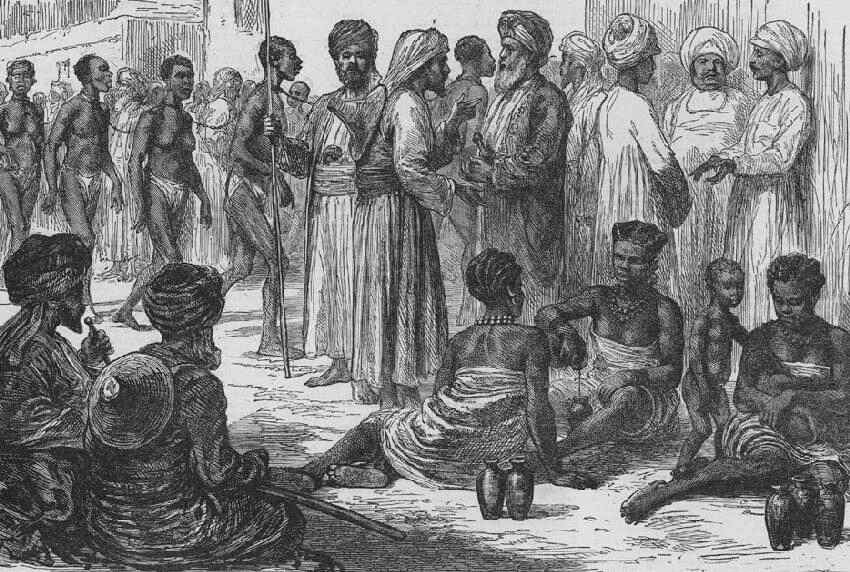
Arab slave traders sold large numbers of Africans in markets located in North Africa, the Arab Middle East, and Persia. There were also sales to markets in the Ottoman Empire and even India before the British Raj. Africans were not the only people sold as slaves. European Christians captured in the Mediterranean or on raids in Europe were also sold. Also slaves taken by the Ottomans in the Balkans and what is now the Ukraine and southern Russia appeared in these markets. The composition varied over time. There were also war captives. There were many important slave markets. Here we are just beginning to collect informtion. Zanzibar, Muscat, and Cairo were three of the most important. There were several other important markets (Ceuta) and many smaller ones. Muslim buyers (usually men) would inspect the human merchandise. Their inspection depended on how the slkaves were to beused which was entirely up to the buyer. African women and young girls were probed in a demeaning fashion by male buyers to determine the sexual worth of their potential purchases. Muslim women also had slaves. I believe the actual purchases, however, were usualy done by her husbands or other male representative. But here we still have very limited information. A slave who did not sell were killed to avoid expenses on unwanted merchandise. African slaves by the 19th century were being sold in large numbers in African markets (especially Zanzibar and Mombassa) as agricultural labor. This shift was the result of the development of plantations along the coast of what is now modern southern Somalia and Kenya and on Zanzibar and slave labor was needed for these plantations.
Quantifying the numbers involved is much more difficult than the Atlantic slave trade. This is because the Arab slave trade began much earlier, about the 8th century and few if any records exist for this early period. The slaves taken by the Arabs were for the most part not worked on plantations or other institutions for which records were kept. Estimating he dimensions of the Eastern slave trade is thus difficult because of the scarcity of documentation. Estimates as to the dimensions of the Arab African slave trade vary widely. We note authors with estimates from about 8-25 milliom Africans, but these estimates should be taken with some caution because of the limited evidence available, especially for the early period. The lower estimate tend to believe that fairly small numbers of Africans involved during the early phase. While some reasonable estimates can be made on dimensions of the later phase of estern slavery, there is just no way of wstimating the dinenbsions of the early phase. And this is the crux of the wiudekly bvarying estimates. The higher estimates tend to think that even in the early phases that substantial numbers of Africans were being enslaved. One of the lower estimates suggests about 8 million Africans were enslaved. [Alencastro, p. 902.] Another author providesa comparable figure of 10 million. [Shahadah] He stresses that the numbers of Africans involved in the early phase were probably quite small. He questions the motivation of historans with higher numbers. Another historian suggests about 17 million. [Pétré-Grenouilleau] One of the higher estimtes is a stunning 25 million souls. [Bairoch]
What ever the actual number, it is quite clear that very large numbers of people were involved. Historians have a much better idea of the dimensions of the Atlantic slave trade--something probably exceeding 10 million Africans. Work on the Arab slave trade suggests that it was comparable to the Atlantic slave trade and probably exceeded it in the number of people killed and enslaved.
Arab slave traders as part of the Trans-Saharan/Indian Ocean slave trade sold large numbers of capative Africans in markets located in North Africa, the Arab Middle East, Turkic empires, Persia as well as smaller numbers in other narkets further east. Africans were not the only people sold as slaves. European Christians captured in the Mediterranean or on raids in Europe were also sold. Also slaves taken by the Ottomans in the Balkans and what is now the Ukraine and southern Russia appeared in these markets. The composition varied over time. There were also war captives. While we have soime unfirmation on the slave trade, we have less infornation on the actual experiences of captive slaves once they were transported and sold into slavery--largey in Muslim lands. We have only limited informatioin on how they were emoloyed, wehat reguklations giverbed their lives, how they were treated, and their decendents in modern states. In this regard thare are differences between the fricans caught up in the Atlantic and and Trans-Saharan/Induan Ocedan slave trade. First, One of the most imprtant is that slavery was never race based or at least firmly race-based as was the case in the Atlantic slave trade. This is one of the great accomoplihments of Islam. Second, the Koran frowned on holding other Muslim as slaves. Thiretically cative Afruicans who convered could obtain their freedom. This inevitably impated the status of slaves. This did not prevent many Muslims from doing so, but over time had an imoact. Third, many male captives were castrated. Castrated slaves commanded a higher price than non-castrated captives in Middle Eastern slave markets. This of course had a major impact on the etnic impact on importing African slaves. Fourth, because slavery had Koranic validatiin and most Muslims believe that the Koran is the literal word of God, slavery has persiusted in Muslim countries into modern times. Fifth, some of the captive African were armed and empoloyed in military roles and as body guards, somethin that rarely if ever occurred in the West. Here is the information we have gathered on the condition of disposition of slaves caught up in the Trans-Saharan and Indian Ocean slave trade.
The Arabs were not only involved with the Eastern Slave Trade, but also played an important role in the Atlantic Slave Trade.
There was a major difference between the European and African slave trade and that was the purposes for which the slaves were to be used. The Europeans did not bring the slaves back to Europe. There was no need for a working class in Europe. Europe had more than a sufficent population. In fact the European population at the time of the slave trade was emigrating to the Americas and other areas. What was needed was workers in the largely unpopulated New World. This was especially important after European diseases had dramatically reduced the Native American population. The Arabs on the other hasnd did bring Africa slaves back to their countries. Here there was a well established peasant class. As a result, the Africans brought to Arab countries were less intended for field labor. A major purpose was sexual pleasure which is why so many of the Africans taken by Arab slavers were women and children.
The evils of the Atlantic slave trade was well publicised by the work of Abolitionists in both Britain and America. And because of the work of the British Royal Navy and the Civil War in America, the Atlantic slave trade while not ended was dramatically reduced by the 1860s. Very little, however, was know about the Eastern or Arab slave trade. This changed with the reports submitted by Dr. David Livingstone from East Africa. The reports of Arab atrocities while enslaving Africans caused considerable revulsion among the British public. They helped enegize the abolitionist movement. Many abolitionist had thought that with the Royal Navy's success in the Atlantic and President Lincoln's Emacipation Proclamation (1862) that their job was done. Livingstone made it all too clear that this was not the case.
The Royal Navy's task in East Africa and the Indian Ocean was even more difficult than in the Atlantic. This was in part because of the support for slavery among Muslim powers (both Arabian and Persian). The Royal Navy for the first half of the 19th century focused its resources on the Alantic slave trade. This was the portion of he slave trade most known to Europeans. It was an enormous undertaking, taking the even subatantial resources of the Royal Navy. It was only after mid-century that the Royal Navy began to address the slave trad in the Indian Ocean. The Royal Navy at first focused its efforts in the Indian Ocean on Zanzibar (1870s). There were notable ahievements. The Royal Navy capturing Arab slave ships and liberating thei enslaved cargo. The Arab adjusted o the Royal Navy's operations around Zanzibar and bgan operating out of other ports. The Royal Navy's answer was set up a 'waiting net' along the northern coast of the Arabian Sea. The Royal Navy assessment that the bulk of the slavers were headed toward markets in Arabia. This also proved successful in capturing many Arab slavers and freeing those enslaved. The task of intercepting small, fast Arab dhows in the often short passages off of Africa’s Indian Ocean coast proved to be a more difficult task than stopping the Alantic trade.
As with operations in the Atlantic, the Royal Navy anti-slavery operations in the Indian Ocean ceated many diplomatic challenges which the Foreign Office had to address. Sir Bartle Frere headed a diplomatic mission to the area (1873). He succeeded in signing treaties with the sultans of Muscat and Zanzibar. These treaies considerably strengthened the Royal Navy's ability to persue its anti-slavery operations. Frere suggested that a Royal Navy guardship be permanently stationed along the Zanzibar coast.
It was the European "Scramble for Africa" in the late 19th century that finally put an end to the Arab slave trade though vestages have persited in the Sudan and other Countries. The 19th century Indian Ocean slave trade had centered on the Sultan of Zanzibar. Briatain used both diplomacy and naval power. The effort was aided by the fact that so much of the Indian Ocean/East African slave trade was concentrated in Zanzibar. This allowed the Royal Navy to focus its limited resources. Limiting the inland trade and slavery itself proved to be much more difficult. Eventually Zanzibar was made a protectorate. The British, French, and Italians seized the Somali coast. The Ehiopians managed to remain independent, defeating an Italian Army (1896). It was the only Europan army to be defeatd by Africans. Britain colonized Kenya and Tanganika. The French colonized Madagascar. The Portugese retained control of Mozamnbique. Actions against slavery varied from colony to colony.
Some historians of the slave trade believe that more Africans were captured and sent to the Muslim world (primarily Arab countries and Persia) than were shipped to the entire Western Hemisphere by Europans. The Eastern Trade began earlier and lasted much longer than the Atlantic slave trade. Yet the human evidence of the slave trade is not readily apparent in Arab countries, Iran, or Turkey. Given the number enslaved Africans, one has to ask, what happened to those people. If as if many historians claim, millions of Africans were enslaved and sold as slaves in the Middle East, you would expect to see sunstantial numbers of Africans or Multtoes as in the Americas. One assessment claims, "Yet the near east today has almost no descendants of these slaves. Their treatment – obviously so for the thousands who were made harem guards but apparently also for the rest – seems not to have been of a kind to favour it. The much greater ease of obtaining fresh slaves, relative to any part of the western hemisphere, seems highly pertinent to this." We know tha huge numbers of Africans were killed by Arab slavers in the process of obtaining and transporting slaves. The question now becomes what happened to the large number of slaves that reached the Arab slave markets. And also what hapened to their descendents. One source of information is DNA. We note one summary, "Genetic studies of the Arabian Peninsula are scarce even though the region was the center of ancient trade routes and empires and may have been the southern corridor for the earliest human migration from Africa to Asia. A total of 120 mtDNA Saudi Arab lineages were analyzed for HVSI/II sequences and for haplogroup confirmatory coding diagnostic positions. A phylogeny of the most abundant haplogroup (preHV)1 (R0a) was constructed based on 13 whole mtDNA genomes. RESULTS: The Saudi Arabian group showed greatest similarity to other Arabian Peninsula populations (Bedouin from the Negev desert and Yemeni) and to Levantine populations. Nearly all the main western Asia haplogroups were detected in the Saudi sample, including the rare U9 clade. Saudi Arabs had only a minority sub-Saharan Africa component (7%), similar to the specific North-African contribution (5%). In addition, a small Indian influence (3%) was also detected. CONCLUSION: The majority of the Saudi-Arab mitochondrial DNA lineages (85%) have a western Asia provenance. Although the still large confidence intervals, the coalescence and phylogeography of (preHV)1 haplogroup (accounting for 18 % of Saudi Arabian lineages) matches a Neolithic expansion in Saudi Arabia." [Abu-Amerro, et. al.] Here we sun-Saharan componers in Saudi Arabia (7 prcent) and North Africa (5 percent). We are not entirely sure how to interpret this in terms of the interpreting the large numbers of Africans that were sold in Middle Eastern slave markets. Perhaps readers can provide some insights.
Since World War II, quite a number of black Americans have embraced Islam. Many apparently do so because they associate slavery with white Christian Europe. As far as I can tell, many that do so are unaware of the nature and dimnsions of the Arab slave trade. It seems understandable that many African-Americans would want to shed their white Anglo-Saxon Protestant "slave" names. Yet what most seem to be doing is to adopt Arab names rather than actual African names. They are in effect giving up one set of slave names for another set. Embracing African names and culture seems unsderstandable. Many Americans of European ancestry are fascnated by their European heritage. What seems difficult to understand is why American blacks are so eager to embrace both the Arab names and the Islamic faith of the slavers who wreaked such havoc throughout Africa for 12 centuries and even today are involved in both slavery and a genocide against Africans in Darfur.
Abu-Amero KK, González AM, Larruga JM, Bosley TM, and Cabrera VM. "Eurasian and African mitochondrial DNA influences in the Saudi Arabian population," BMC Evol Biol. (March 2007) 1;7:32. The research was done at the Mitochondrial Research Laboratory, Department of Genetics, King Faisal Specialist Hospital and Research Center, Riyadh, Saudi Arabia.
Alencastro, Luiz Felipe de. "Traite", Encyclopædia Universalis (2002), corpus 22.
Bairoch, Paul. Mythes et paradoxes de l'histoire économique (1994).
Barnard, Frederick Lamport. A three years cruize in the Mozambique Channel for the suppression of the slave trade(London: R.Bentley, 1848). Reprinted 1969.
Claussen, Martin, et. al.. "Sahara's Abrupt Desertification Started By Changes In Earth's Orbit, Accelerated By Atmospheric And Vegetation Feedbacks," Geophysical Research Letters. (July 15, 1999).
Beachey, The Slave Trade of Eastern Africa.
Ibn Khaldun, The Muqaddimah trans. F.Rosenthal ed. N.J.Dawood (Princeton 1967).
Heers, Jacques. Les négriers en terre d'islam.
Pétré-Grenouilleau, Olivier. He relies heavily on work by the economist Ralph Austen, African Economic History (1987).
Ricks, Thomas. “Slaves and Slave Traders in the Persian Gulf,” in William Gervase Clarence-Smith, ed., The Economic of the Indian Ocean Slave Trade in the 19th Century (London: Frank Cass, 1989).
Shahadah, Owen Alik. "African Holocaust". Shahadah charges that higher numbers are inspired to focus attention away fom European Atlantic slave trade.

Navigate the Children in History Website:
[Return to the Main Arab slave trade page]
[Return to the Main African slave trade page]
[Introduction]
[Biographies]
[Chronology]
[Climatology]
[Clothing]
[Disease and Health]
[Economics]
[Geography]
[History]
[Human Nature]
[Law]
[Nationalism]
[Presidents]
[Religion]
[Royalty]
[Science]
[Social Class]
[Bibliographies]
[Contributions]
[FAQs]
[Glossaries]
[Images]
[Links]
[Registration]
[Tools]
[Children in History Home]