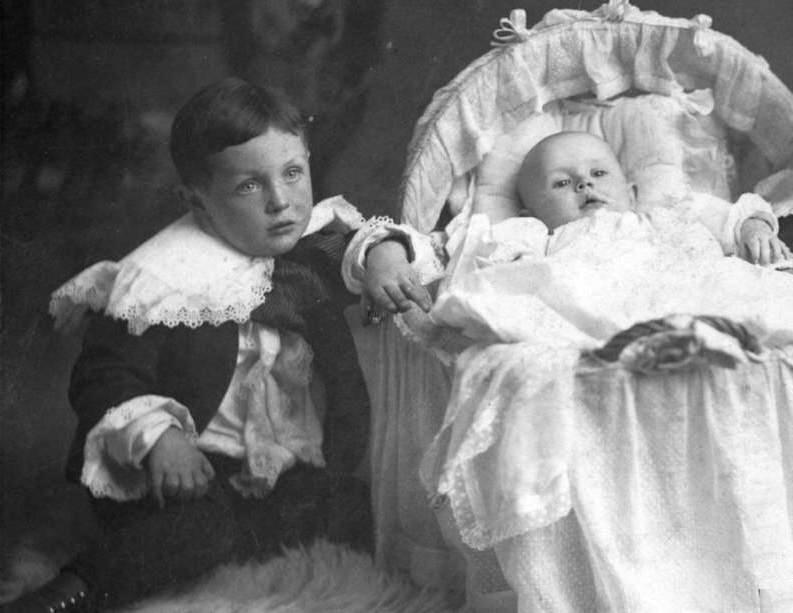
The HBC biography section is for people or families that have achieved some degree of notariety or fame. HBC readers in many cases have submitted family portraits. HBC has until now not added them to the biography section. We believe now that this is a mistake. Many of the HBC readers contributing family portraits can also provide details about the boy and him family. This background information help us to assess social trends and put the fashions involved in perspective. This is just why the biographical section is an important part of HBC. As a result, HBC has decided to create pages for these relatively unknown people, when some basic family data is available. Incidentally if you find a relative here, please do tell us somehing about him. Here we are listing these biographies alpahabetically to facilitate looking up individual names. The alphabdetical list is the primary data base in this section. While we have not persued geneolgical resreach on these individual, having the names and in many cases the loaction provide the potential to acquire more back ground information in the future which may provide additonal insights into the fashion and life style trends.

This cabinet card portrait shows two boys wearing sailor suits and hats. Note the long pans with stripes. We re unsure about the colors, but you would guess that the suits are basically blue. The boys are identified on the back as, “Lester Earl” age 11 and “Elmo St. Clar”, age 12 ½ years. Now er think that the boys are brothers and Earl is a middle name, but they could be cousins and Earl is a family name. The portrait was taken by Hoyt in Hillsboro, Oregon. Wewould guess that it was taken in the 1890s. The dealer estimasted 1899-1901, but that seems a lirrle early to us.
Here we have a pprtrait of an American boy about 6 years old. Hus family name was Sanborn, but we do not know his first name. He was from Minneapolis, Minnesota. It is a little difficult to tell how he was dressed because his Fautleroy blouse and bow were so large. The blouse has pleated floces, bith on the lrge collar and the dleeve wrist cuffs. He looks to be wearing a grey flannel cu away jacket and matching kneepants which he wears with black stockings. The kneepants have some decoration at the knee hem. We know the portrait was taken in 1888 or after because the photographer received a prize award in 1888. We would date the portrait about 1890.
We note stand-up paper frames in the 1930s. We think most portraits came in stand up frames. We are not yet sure about the color and decoration. We note one portrait measuring 3 1/2" by 5". It is in a studio cardboard folder and frame that measures 4 3/4" by 7 1/2". The frame is printed on the lower right corner "Hollingshead Woodland, Cal." At the bottom of the cardboard frame is the fold-back flap to make it stand up. On that written in ink is "John Louis Sanstrum April 1935". Notice the decorated blue border around the actual portrait,
Here is a portrait of the Victorien Sardou family in their house at Marly-le-Roi near Paris. Victorien Sardou (1831-08) was an important French playwrite. The Sardous family lived at Le Cannet, a village near Cannes, They owned an olive esate. When it failed Victorien's father moved to Paris and dabled at several, mostly academic professions. Victorien was left on his own when his father failed. He was unable to continue his medical studies. He had some difficult years, but his writing proved a success. His best know work was "La Tosca" (1887). The play was the basis on which Giacomo Puccini's famed opera "Tosca" (1900) is based. The fedora hat is named after another play. The Sardou family portrait was painted by Auguste de la Brely (1838-1906) in 187?. The museum legend reds, "Victoien Sardou (1831-1908) ey su familledans le grand salon se leur maison de Marly le Roy. Il fat des auteurs framatiques les plus féconds et les pl? applaudis de sons temps. Ses plus grnds succés (Théodora, Fédora la Tosca, Gisnonda, Patría, Madame Sans-Géne, etc.), fure souvent écrits pour Sarah Berrnhardt. Le decor de son salon illustre bien le retour du gilout pour le XVIIIe
siècle du gioùt pour le XVIIIe siècle dans laseconde moit su XIXe siècle. Don de Mme Victorian Sardou, 1932." he painting is a wonderful view of the home life for an affluent French family in the late 19th century. There are three children in the painting. Note the the boy on the right playing with a gun. He is wearing a pleated skirt. The portrait is in the Carnavalet Museum in Paris.
Here we have a formal studio portrait of two brothers Royce Arthur Saunderson (born Sept 9, 1920) and Heriman Hind Sauderson (born 14 years March 22, 1926). The boys were 10 and 14 years old on their birthdays. The portrait was taken sometime in 1930. The boys wear matching three pice, single breasted suits. They are both knickers suits. While they wear identical suits, they have different ties and knee socks. Boys still commonly wore staid, solid colored long stockings in the 1930s, but in the 30s brightly colored pstterned kneecocks became very popular.
The photo is mounted on a matte folder that when closed is about 6.5" x 9.5". The photo itself is about 4.75" x 7.75". The boys were from Worcester, Massachusetts. The script is difficult to read, but it looks like the Heny Studio.
Here we see a little American boy in 1915. He was the neigbbor of Frank Avery in Spokane, Washington. Avery was an avid photographer. We don't know his first name, but his last name was Schaefer. He wears a plain white dress. Outfitting little boys in dresses was becoming uncommon in the 1910s, but was not yet unknown.
This undated cabinent portrait was taken about 1900-05. The clothes he is wearing could have been worn any time during the 1890s, but the mount style suggests that the portrait was taken after the turn-of-the 20th century. It was a cabinent card, sized 4 1/4" wide by 6 1/4" high. The card was not the traditional cabinent card style, but rather a greyish-green mount with a the portrait done in an oval area. The photographer was L Miller which was imprinted in the corner of the mount. The boy was Frank H. Scherer who is photographed standing by a chair. . Frank looks to be about 3-4 years old. His hair is done in shortish ringlet curls. He wears a fancy Fauntleroy blouse with a moderzte-sized polka-dot bow, knee pants, and long stockings.
Brazil had a small German population. I know little about it at this time. Some of the Brazilian German boys wore Lederhosen. A good example is Alexander Schultz whose father worked with a Sâo Paulo museum. Alexander spent a summer living with the Amazonian Indians.
This is a wonderful folky watercolour portrait of a boy standing on the seashore. He is wearing a black tunic with a broad belt at the waist and a deep white collar tied with a blue ribbon, over trousers. He's holding a large peaked hat. His costume is truly typical of the 1830s.There is a family tree inscription on the reverse of the portrait that identifies the child as Jethro Scowcroft (1829-1880), son of Thomas Scowcroft. Jethro was may be about 7 or 8 years old when this portrait was painted, but probably less than 10 years. The portrait is watercolor on card.
We notice two CDV portatits of Edson Shellcross. He was from southeastern Pennsylvania. The first portrait was of Edson at age 13 in 1869. The portait shows the longer hair styles still worn by men and boys in the 1860s. Unfortunately we don't see much of his outfit. It is notable because he is wearing what seems to be a jacket with very small papels. The second shows Edson several years later. This portrait is not dated, but we would cuess was taken in the late 1870s. He is shown with two children, oresumably girls but they are not identified. We assume they are his younger sisters. The girls wear matching dresses. They are too old to be daughters and the posr is probanly too intimste to be cousins.
The first portrait was taken by John Schofield in Frankford, Pennsylvania. The secoind portrait was taken at by J. B. Gibson in nearby Coatesville, Pennsyvania.
An English boy, William Silvester, had a minature watercolor portrait painted in the early 19th century. William was 11 years of age. Miniature Length 3 1/8", Width 2 1/2"; Frame Length 5 7/8", Width 5". There is not a lot of detail in this minature portrait, but it does show the high ruffled collar and the short hair style worn at the time.
This is a 1901 cabinet portrait of Donald W. Simpson who was 5 years old. The portrait was taken on March 18, 1901 as indicated on the back of the card. This photograph shows little Donald, who is sporting very long hair, dressed in a Fauntleroy suit. He is wearing knee pants and dark stockings and a white blouse with lacy cuffs and a large lacy collar and a lacy area down the front of the shirt. His dark jacket is open and has large buttons. He is holding a riding crop in his right hand and is seated in a little throne type of chair. He is formally posed. This is an unusual cabinent card done as an oval portrait. At the time cabinent cards were going out of fashion and portraits were beginning to be done in paper frames. This cabinet photograph was taken by Perry & Son - Empire Block of Sheldon, Iowa.
Here we see Smirnova Evgeniya Ilyinichna with her son. Unfortunately we do not know his name. Smirnova was born in Morozova, (1869-1961). She was the wife of Smirnov Petr Petrovich. Smirmov in the 1910s was the owner of the Firm P.A. Smirnov in Moscow. The boy looks to be wearing his school uniform. The school may have had a summer and winter uniform. We are not sure about this.
A HBC reader has provided information about a very interesting book of letters written by
Nellie R. Campbell from Maine. She married a man called George Campbell and moved to the prairies of Canada, living on a farm in Saskatchewan near Saskatoon where she also taught in a rural grade
school. She wrote a very informative series of letters from Saskatchewan to her relatives in New England, extending over the period 1920 to 1944. These have been published in a book entitled "Loving
Yours, Nellie: Letters Home and Published Articles" edited by Sandra Hyslop and Pat Klassen (Victoria, B.C.: Trafford, 2004). Nellie and George adopted an orphan boy in the mid-1920s named Emerson Albin Smith and reared and educated him. The attached photo shows Emerson after his adoption in November, 1925, when he was about three and a half
years old.
We note a portrait of a fashionably outfitted London boy. It is undated, but we would guess the 1870s. His name was George Charles Smith and he was 4 1/2 years old. He has a straw boater hat and wears a dress with a large white collar and a dress done in vertical stripes. He has short white socks. I'm not sure what kind of hair cut he has. It almost looks like there is something wrong with his hair.
We have no information about this boy, other than a oil portrait. The boy was was English. His name was Joseph Smith and was 7 years old when painted by G.W.Jackson during May 1852. He ears a black jacket and bow-like black tie with a plain white shirt and collar.
-This cabinet portrait shows Harry Smith holding a rifle with his dog beside him. The portrait was taken by Jackson in Franklin, Pennsylvania. He looks about 6 years old. The portrait is undated, but looks to have been taken in the 1890s. Note the leather leggings.
A HBC reader tells us, "My father's name is Joseph P. Smith, Jr. I have a photograph of him wearing knickers and striped kneesocks. Another photograph shows my dad (the taller one) and my uncle, Charles Smith. Both were students at St. Henry's (German) school in Philadelphia, Pennsylvania. The photographs were taken about 1940. My dad was born in 1932. Their mother was German. In the other picture, it appears that my uncle, with the fancy armband, was celebrating his First Communion."
Here is a portrait of four siblings (two boys and two girls). The girls are wearing fancy bonnets, dresses, and pinafores. The boys are less formally dressed. They wear Civil War kepis, blouses, and kee pants.
One of the girls is holding a basket of flowers. Children's blocks are scattered on the floor. The younger boy is holding a tin sandpail. The studio was the Baker's Art Gallery in Columbus, Ohio. The studio boasts "Grand Prize and Highest Award at the World's Fair. There are two sets of coin-like logos on the bottom left of the cabinent card--prizes awarded at the Columbian Exhibition (World's Fair). The names of the children are written on the back of the cabinent card in pencil. The only names I could decipher were James Smith and Byron Smith, 3 yrs.
The Smith children were photgraphed on the porch of their family home. They lived in Archbald, Pennsylvania. The photograph was taken in 1910. Archbald is located near Scranton in the mining country of eastern Pennsylvania. The photograph shows the four Smith children (Jesse and Lester standing in back) and Vera and Bertha (in front). The boy in the chair at the left is a friend (the family name was Schmitt) of the other children. Schmitt was 6 years old. Vera was 8 years, Bertha was 10 years, Jesse was 12 years, and Lester was 13 years old. All the children wear the standard black long stockings of the period (note the mostly obscured legs of the older boys in the rear). The boys all wear suits.
Swedish teenagers, Arne Sohlstrom (aged 14) and his older cousin Julia Moback. had their picture taken in Sweden during 1928. Arne is wearing his school clothes--dark short trousers, long black stockings, low-cut leather shoes, a white shirt with soft collar buttoned up to the neck, and his school cap with a leather bill. This was typical schoolboy dress in Sweden for boys in secondary school during the 1920s. The pair is sitting in the garden outside their house, apparently. Notice that the trees are in full leaf, which probably indicates late spring or early fall. The long stockings were not worn so much for warmth but as part of "proper" dress for schoolboys. It seems to be a bit chilly, however, because Julia, Arne's cousin, is wearing a lightweight overcoat.
Here's a nice historical photo of young Warren Sonneman (at
the age of 8 years) with his prize Easter basket. The scene was the annual
Easter egg roll at the White House (2 April 1923) during the presidency
of Warren Harding. The boy is wearing his nice Easter tweed suit--single breasted with leather buttons down the front and on his breast pocket. He is wearing a formal shirt, probably with a detachable collar, and tie. I think that he is wearing a knee pants suit, but there appear to be no ornamental buttons at the leg hem. Knee pants were still worn in the early 1920s, byut were rapidly going out of style. He wears the customary long black stockings.
Here is a wonderful photo postcard of three well dressed young boys. Two boys are standing and a baby is seated in a wicker stroller. Mom has set out potted ferns on stands with lace curtain windows make for a wonderful picture of turn-of-the century America. The snap shot is undated, but we would guess was taken about 1905-10. The two older boys look to be about 4-5 years old. There are two brothers, perhaps photographed with a neighbir child. Written on the back in ink is: "Ray & Vernon Kathman, Gilbert Speckman, Aurora, Indiana". Thus we know their names abd where they lived. Both boys wear tunic suits. Ray wears a colored suit with a ruffled collar. I'm not sur about the color, perhaps pale blue. Gilbert wears a white suit. Both boys wear white caps, but it is a bit difficult to make out the types. Ray wears black stockingss. Gilbert wears white stockings with strap shoes. I'm not sure about the color of the shoes.
Douglas Spedden was an American boy who went everywhere with his parents. They were very wealthy and liked going on European tours. They travelled by ship to Europe and then travelled to lots of places by train. Douglas was then a boy of 7 years. On one occasion they travelled to Paris on a night train. Douglas found this exciting and enjoyed travelling in a sleeping compartment where he had a bed and slept throughout the journey. When the holiday was over they caught the Paris to Cherbourg Boat train and boarded a ship and
had an adventurous voyage back to America.
Charles Hart Spencer and his wife Mary Acheson Spenser were a prominent upper-middle-class family of Pittsburgh, Pennsylvania, in the late 1890s and early 1900s. They had seven children--two boys (Mark and Charles) and five daughters (Adeline, Kate, Ethel, Mary and Elizabeth). They were solid Presbyterians like so many other prominent citizens of Pittsburgh at the turn of the century. They lived on Amberson Avenue, one of the finer streets in the Shadyside district of Pittsburgh near the University of Pittsburgh in the East End of the city. Shadyside is (and was) a lovely area with spacious houses and tree-lined avenues, giving little sense of the industrialism, especially the steel industry, that made the city so prosperous. The present photograph was taken in July, 1900, by Mr. Spencer, the father of the children, who in his spare time was something of an amateur photographer. The family spent vacations at another large house in Marion, Masssacusetts.
This cabinent portrait of Albert Staebler was taken in Clevland, Ohio. It is undated, but looks to us as if it was taken inthe 1880s. He wears a suit with a long jacket and vest. He looks to be about 13-years old. Note the rosary and what looks like a homberg hat. Note the rosary meaning that Albert was Catholic. Until after the Civul War, except for the Irish, there were relatively few Catholics in Americ. Beginning in the 1870s and especially the 80s, very large numbers of European s began emigrating to America, many were from Catholic countries. Cleveland was one of the growing industrial cities that attracted immigrants seeking jobs. Albert was probably from Germany, although we do not know when his family emigrated from Germany.
The boy in the cabinent portrait here is Burgess Stanley age 2 years, 2 months. We do not have an information about Burgess or his family. It was very common for boys this age to wear dresses. Burgess was photographed by Taylor & Preston in Salem, Massachusetts. The portrait is undated, but it looks like the 1880s to us. The dress here seems a very simple dress with what looks like a small lace collar. He has front bangs and his hair is long at the back, but not curled.
This cabinet portrait shows a little girl and her big brother. Unfortunately we can not see the photographer's name and loctuon of the studio,. Both children are wearing dresses. The yonger child wears a plain dress. The older boy wears a plaid dress. Both have big white collars. Their names are Edith and Harry Staples. They look to be about 1 and 4 years old. The portrait is undated, but we would gues it was taken in the 1880s.
This is a CDV portrait of a little boy holding a black hat which appears to have ashort streamer. This is interesting because most early CDVs don't include the headwear. The portrait was taken by Garrett in Wilmington, Delaware during 1865. Written near the bottom of the back of the mount is, “C. Stewart” which I assume is the boy’s name. There is evidence that there used to be a tax stamp on the back of the mount but it is long gone. The gum residue, however, helps to conform the date. The boy looks to be about 4-5 years old. He wear a buton-on style, a popular style at the time. The outfit was done with long pants. We see some boys this age wearing bloomer knickers or knee pants, but most boys still wore long pants, even very young boys. Noticetheres nly the barest of hints of a white coolar.
The Serbian boy here is Miodrag Stefanovitch who was found abandoned on the roadside by a British soldier during the Great Retreat. The soldier was a member of the Brotherhood Movement. Miodrag was adopted by the DErbyshire Federations of Brotherhoods which provided education, food, and clothing. This is a postcard sold by the Brotherhood Movement to support Miodrag. Note the cap. it was the same style worn by the Partisans in World War II.
G.V. Stokes was a student at Britain's famed Eton school. He looks to be about 15 years old at the time of this portrait had probably been at the school a couple years. We know nothing about the boy. As an Eton student, however, he must have come from an affluent family. Also this uniform must have been rather expensuve. He is dressed in a mid-19th century naval uniform. Eton has a June 4 celebration each year when the boys dress up in fancy naval uniforms I would have guessed that the portrait was taken in the 1890s, but our British contributor tells us that it was in collection of Eton photographs taken from 1901-10.
A HBC reader recently acquired an old albumn--almost all cabinet cards. They mostly depict Robert Cuthbert Stowell and his brother Wilfrid who lived at 14 Darlaston Road, Wimbledon, London. Their father (Anthony Stowell) was Chief Inspector of the London & County Bank and was quite old when he became a father as he would have been 49 when Robert was born. At the time of the 1901 Census Robert was 13 years old and Wilfrid was 10 years old, so when these photos were taken in 1895 Robert would have been 7 and Wilfrid 4 years old.
Here we have a painted portrait that we know nothing about. All we know is that we portrait was once owned by J.W. Stratton as indicated on the back. This of course does not mean that the boy pictured was J.W. Stratton, but it may well be as is the only definitive information we have. You would think the portrait was most likely made for the Stratton family. A seller believes that the boy is Italian because of the smock-like white collar, but the boy does not look Italian to us. We would guess that it might be English, in part because of the name. The portrait was for sale in Toronto, Canada which agains suggests it is English. The portrait is undated, but we would guess the 1890s, although we are not at all sure.
This press photo was headed, "St. Patrick's pigeons find a friend". The caption read, "New York.. He's all dressed up and he knows it. 3 year old Lauri Stremm was one of the young fashionables who attended St. Patrick's Cathedral today for Palm Sunday services. Here he makes friends with some of the pigeons on the steps of the Cathedral, one of his feathered friends perching on Lauri's shoulder." New York was of course famous for a Easer Parade down 5th Avenue where everyone showed off their new oufits.
Sailor suits were still popular in middle-class families during the 1920s. The brothers here both wear sailor suits (figure 1). The older brother wears a button-on suit. The younger boys wears a blouse than extends over the waist. Only the younger boy wears a dickey. Both boys wear knee pants. These two Berlin boys are Rudolf and Owlald Struckmeier. They had their portraits taken in 1922. The boys look to be about 5-8 years old. Body posture can be reveiling in these old photographs. We would guess that the boys were very close. Both boys have their hair cut in bangs.
A HBC reader tells us, "This is my grandfather, Johann Christoph Friedrich Stueck, who was born in Kassel, Germany, 1865. He was the owner of Stueck's Hotel in Kassel. He later settled in Wiesbaden, where he married Marie Schramm and bought the Beausite Hotel. This picture was taken when he was perhaps 12 years old. My father, Carl Ferdinand Friedrich Stueck was born in Wiesbaden, 1892. He settled in the Netherlands after World War I, where he married my mother, Johanna Betti Riddering.
All we know about the boy here is that hisname written on the back of a cabinent card was Mark Stump. Unfortunately the card is damaged so that it is difficult to read where the portrait was taken. I think it is Allentown, Pennsylvania. We know nothing about him and his family. He looks to be about 9-years old.The portrait is undated, but we would guess it was taken in the late 1890s about the turn of the 20th century. Both the sailor suit and the green card mount suggests the late 1890s to us. Mark wears a classic all-white sailor suit with a saucer cap.
We do not know anything about Percy's later life, but we have two fascinating portraits when he was 6 years old. The portraits are breeching images from Scotland. The photographer is from Lamb late P. Devine, Artist. Edinburgh. I think that means Lamb took over the Devine studio. The advertisement on the back states that they maintain all negatives and have enlarging and painting of photographs. The portraits are phjotographs that have been painted over in color. The child is Percy A. W. Summers, 6 years old. The second photographs was taken on Feb. 7, 1888. He looks younger in the first photograph, so it may have been taken earlier. However, the hair and props look identical in both photographs, which implies that he changed clothes at studio. He probably was breeched on 6th birthday at the studio.
The Syder brothers had their portrait taken in the 1890s. Sydner is written on the back of the page, but is is unclear, it could be Snyder--a more common name. The boys were photographed at the Williams studio in Mt. Pleasant, Michigan. The image is undated, but we would guess the early 1890s. The boys look to be about 3 and 7 years old. The yoinger boys wears a small jacket and matching skirt. I am unsure about the color, but it looks to be solid colored material. He looks to be wearing a fancy blouse. His brother wears a kneepants suit wih long stockings. Both boys have similar ruffled collars and floppy bows--a kind of Fauntleroy touch. They both have short hair cuts.
Here we have a cabinet card portrait of two children, perhaps cousins. The boys wear matching Fauntleroy kilt suits. They have cutaway jackets and matching kukt skirt worn with ruffled blouses and pokasot ruffled blouse. The boys appear to be "Elyde Synder & Elyde Porter", but also written on the card is "Elyde Synder + Mason". Theportrait was taken by Mrs. D. D. Lyon, Woodbine, Iowa". Most photographers were men. Mrs. Lyon was a rare female photographer. The sentimental pose seems to suggest a female photograpger. The portrait is undated, bur we would guess was taken in the early-1890s.
This is Stewart Legge Symonds. He was the son of Benjamin Symonds, a Clergyman of the Church of England--Rector of Haversham, Buckinghamshire. Stewart was 5 years old at census time in 1901 and I would guess that it was around this time that this photo (a CDV) was taken. He weaes a white sailor suit and long curly hair.
Navigate the Boys' Historical Clothing Web Site:
[Return to the Main ordinary biography alphabetical page]
[Introduction]
[Activities]
[Biographies]
[Chronology]
[Clothing styles]
[Countries]
[Topics]
[Bibliographies]
[Contributions]
[FAQs]
[Glossaries]
[Images]
[Registration]
[Tools]
[Boys' Clothing Home]