|
The Wilde's had two sons: Cyril (1885-1915) and Vyvyan (1886-1967). We have little information about their childhood at this time. We know they idealized their father. We have some idea as to how they wre dressed from available portraits. They seem to have been dressed very fashionably, apparrantly in matching outfits. We note satin cavalier outfits, Little Lord Fauntleroy suits, sailor suits, and other outfits. Following Wilde's disgrace, Constance took the children to Switzerland. She changed the family name to Holland. The children were enrolled in an English-lnguage school in Germany. All through school the boys had to desguise their identity, although they were not told why. They were left to agonize as to what terrible crime he had committed. Constance died only a few years later (1898) and the boys were brought back to England, but separated. Both boys served in World war I. Cyril was killed (1915). This is an occurance that we too often have to report in British, French, and German biographies. Vyvyan went on to write a book Son of Oscar Wilde. Vyvyan's son Merlin is also a writer and the family has kept the name Holland, never reverting to Wilde.
The Wilde's had two sons: Cyril (1885-1915) and Vyvyan (1886-1967). Vyvyan Oscar Beresford was the name used for his christening, although Vivian was more commonly used by the family. We supose that the Vyvyan spelling was his father's idea. And after the disgrace of his father, it was permanently changed to Vivian. In fact, a family conference
discussed the whole issue of names. Holland was selected as the boys' new family name because it was an ancestral name of their mother's family. The boys had to practice using their new name and writing the signature. They were not told why, only that they had a new name. Their mother and other relatives went through their clothing to tear out name strips with the offending Wilde name. (Boys attending boarding schools were and still are required to have name tags sewed into every garment including socks.)
The boys had a marvelous early childhood. They grew up the Wildes' fashionable home in Tite Street, Chelsea. There was a nursery for them when they were little, a common practice at the time. As their father was a popular playwrite and their mother an attractive and cultured hostess, the litterati of London were often present in their home. Vivian recalls people like John Singer Sargent, John Ruskin, Mark Twain, Robert Browning, Algernon Swinburne, and Ellen Terry. Rather impressive company. Wilde by all accounts was a wonderful father. Unlikemost staid Victorian fathers, he delighted in playing with the boys. The boys in turn absolutely adored their father, "... he was a hero to us both. He was so tall and distinguished and, to our uncritical eyes, so handsome .... He was a real companion to us, and we always looked forward eagerly to his frequent visits to our nursery.... He would go down on all fours on the nursery floor, being in turn a lion, a wolf, a horse, caring nothing for his usually immaculate appearance."
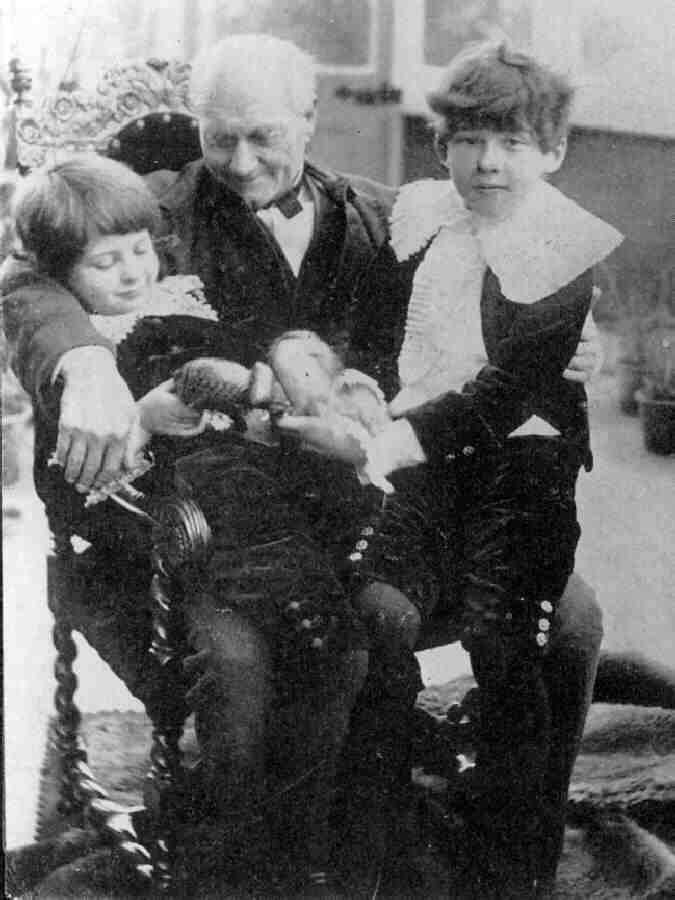
We have some idea as to how they wre dressed from available portraits. They seem to have been dressed very fashionably, apparrently in matching outfits. Usually mothers selected the clothes of younger children. We are not sure to what extent their father was involved in choosing their clothing. We know that he was interested in fashion and known to weak velvet suits with knickers fir his lectures. We note satin cavalier outfits, Little Lord Fauntleroy suits, sailor suits, and other outfits. Here they can be seen wearing their velvet Little Lord Fauntleroy suits (figure 1). Noitice that both the suits and collars are cut differently. We do not know if the boys were dressed in identical outfits, but they were clearly dressed ins imilar outfits. While their father apparently liked velvet suits, the boys were much less enamored of them. They much preferred their sailor suits. The boys also wore berets and blouses with large collars.
Theeir father's legal problems shattered the boys' family life (1895). Their mother decided that the boys could no longer stay at their school. They had no idea what had happened, but they would have been subjected to terrible taunts from the other boys. She decide to send them to Switzerland with a French governess. Te boys stayed there 3 years. It was in in Switzerland with their mother and her brother, Otho Lloyd, instructed the boys that they had to forget their name Wilde and they would now be called Holland. This was the name of their mother's relations. Vyvyan was told that his name was now Vivian and the Oscar Beresford dropped. The boys were not told what had happened, but they were told in no uncertain terms that there would be serious repercussions if their old identity slipped out. Vivian recalls that even 2 years after their father's digrace that he still did not know just what his father had done. Cyril found out but did not tell his little brother. Constance Wilde's family wanted to eradicate all memory of his father and insisted that he was dead and that literary work was not important. Vivian recalls that he was so miserable that he once layed down in the snow wanting to die.
Contsance's actions may seem harsh. What she did was not out of hatred for her disgraced husband. She must have known about Oscar before the public scandal occurred. She wrote to Vivian shortly before her death, "Try not to feel harshly about your father; remember that he is your father and that he loves you. All his troubles arose from the hatred of a son for his father, and whatever he has done he has suffered bitterly for".
The boys were enrolled in a preparatory school, but I do not yet have detailed informaion on which school it was. They were immediately removed from the school when news about their rather broke. The boys were sent off to an English-language boarding school in Heildeberg, Germany--Neuenheim Collage (1896). It was then across the river from Heidelberg.
There the boys found some cricket flannels packed in their trunks still had the Wylde name tags. They rembemer being horrified to find evidence of their former names on their clothes. They had no idea what had occurred, but they that they felt like little criminals and had to desperately assume a new identity. Vyvyan later wrote, "The thought that at any moment an indiscreet remark or a chance encounter ... might betray us was a sword of Damocles constantly hanging over our heads."
Vyvyan apparently did not like the school in Germany. One report says that he was very miserable at the school. We are not sure why he so disliked the school. Perhaps because he was not as good at sports as his brother.
It was subsequently decided to separate the boys as an added security mesure.
Cyril stayed at the school in Germany. Vyvyan was sent to a Catholic (Jesuit) school in Monaco.
It was while on holiday he met people who attended Jesuit boarding schools or at any rate were catholics. They made a good impression on him.
January 1897 transferred to Collegia della Visitazione. The Jesuit college in Monaco. The priest in charge of pastoral care informs him about the death of his mother following an operation to her spine (1898) .
I think he liked Monaco school better, but have few details. He was not there long. It is difficult to fully comprehend what this meant. The boys had been permanently separated from their father and living far away from their mother in a foreign country. They were still very young and had no idea what had transpired. They had grown up together and had always been very close. Now they were separated from each other. The situation for the boys worsened when their mother experienced a serious accident 3 years after they had been sent to the Continent. They were left in the charge of their mother's family whose sole concern was the family disgrace. The boys were seen as an embarrassment, a continuing reminder of their father and the didgrace. The family did not tell them when their father died (1899).
Even before their father died, the boys were struck with another disaster. Constance injured her back in a fall down the stairs in the London family home. Afterwards she experienced severe pain. Surgeons in Genoa operated on her spinal cord to relieve the pain. She died in hospital shortly afterwards (1898). This left the boys orphans.
The boys eventually returned to England after their mother's death. Vivian was brough back from Monaco by a priest. He was taken in by his mother's aunt. Cyril who was nearly 2 years older, 13 at the time. was allowed to leave his school at Heidelberg and come home on his own. The family decided to keep the boys split apart and chose two different schools for them. I think that this was primarily a security matter. Vivian was sent to Stonyhurst College, Lancashire. Cyril was sent to Radley School. With this separation they no longer spent much time together, but kept in touch by writing.
Vyvyan attended Stonyhurst College in 1898.
Stonyhurst was a Jesuit public School. It has had some notable old boys. Remember the Winslow Afair at the Osbourne Navy College and the 5 bob postal order. There was a big legal battle to clear the boys name. H e was a pupil at the school. Conan Doyle went there too. He modeled Baskerville Hall on the school.
Vivian was 12-years old when he entered the school. He was enrolled as Vyvyan Holland. It was a few years after the trial. How it came about was that he met students from Stonyhurst while on holiday. He thought the school sounded a good place to be. He liked what they told him. He must have expressed a wish to go to such a school. Vyvyan was transferred to a Jesuit School in Monaco. The family decided to bring the boys back to Englnd. Vyvyan is found a place at Stonyhurst College, Lancashire. It was another Jesuit school. He started there around September 20, 1898. He was in Hodder. The school records say he was a gifted scholar. When he was 14 his father died and school again had to inform Vyvyan of this tragic occurance (1900). The Rector of Stonyhurst summoned Vivian and told him. Vivian remembers saying, "But I thought he died long ago." and began crying. Vivian while still at school at age 16 read Robert Sherard's Oscar Wilde: The Story of an Unhappy Friendship (1902) and finally learned what had happened. He remembers being so "depressed" that he determined to read no further books about his father. As it was the thing to do, he went into mourning. His schoolmates asked why, he came up with a cover story. He told him that his father's body washed up on a South Sea island after he had long been lost at sea. The coloful story made him "something of a hero" for a time. He finished at stonyhurst in 1904.
Cyril attended Radley College, a public school. Unlike his brother, he did not go on to university.
His mother's family continued to regard the boys with considerable disdain. They were constantly criticised for drinking or other such behavior.
Vivian entered Trinity College at age 19 to study law (1905). They could not attend Odford, their father's university. When Vyvyan was sent off the Cambridge with the Holland name, his guardians sent the authorities a note warning that he was "idle, drank to excess and frequented bad company". Here he began to read his father's works and was greatly impressed. He decided not to persue a law career and left Trinity (1907).
Cyril decided to make a career in the Army. After leaving Radley, he enrolled as a Gentleman Cadet at the Royal Military College, Woolwich. He was commissioned a 2nd Lieutenant (1905). He joined the Royal Field Artillery (1906).
World War I broke out (1914). Vivian with no military background entered service as a second lieutenant. His qualification was basically coming from a wealthy family. With his linguistic talents he was assigned to the Interpreters Corps, but learned that no more interpreters were needed. He transferred to the Royal Field Artillery where his brother was serving. Looking back, Vivian wrote, "He was not popular with his brother officers, who considered him pompous and intolerant. He would not join the small talk of the mess, mostly scandal or about sport. And they could not understand anyone who spent his ordinary leave in travelling about Europe and visiting art galleries instead of hunting, shooting, yachting, or fishing". Cyril was killed during the second battle for Neuve Chapelle (1915). This is an occurance that we too often have to report in British, French, and German biographies. A sniper shot and killed Cyril. Vivian who was only a few miles away was shattered. He wrote, "The last link with Tite Street and the spacious days had snapped". While still in France, Vivian learned that his wife, Violet, had been terribly burned in a fire. She died before he gt home (1918). Vivian had been wounded and mentioned in several dispatches for his bravery under fire. He was awarded the Order of the British Empire and discharged (1919).
After returning to England, Vivian began a career as a translator, author, and editor. He edited a series French romances written in the 18th century (1925-28). He worked on a wide variety of books in several languages. He translated novels by the French author Julian Green. An important work was a biography of Stalin by Henri Barbusse. He translated and edited several of his father's works into other languages. Vivian went on the write a book Son of Oscar Wilde. Vyvyan's son Merlin is also a writer and the family has kept the name Holland, never reverting to Wilde.
Vivian at the onset World WarII was offered a position as a translator and editor for the BBC. Here he spent the war. He married Thelma Besant, an Australian spending the War in Britain (1943). They had a child--Merlin (1945).
Merlin became a writer and the family has kept the name Holland, never reverting to Wilde. He also became a dealer in glass and ceramics.
The Hollands traveled to Australia and New Zealand after the War/ She had been invited to give lectures on fashionable 19th-century Australia dress. Vivian's book Son of Oscar Wilde was published abd received considerable critical aclaim (1954). He received many appreciative letters from friends and admirers of his father. Merlin in the "Foreword" to a 1988 reissue wrote that his father had, "as it were, laid to rest the bitter memory of those early years by the cathartic effect of recording them for posterity."
Holland, Merlin. A Wilde Album.
Holland, Vyvyan. Son of Oscar Wilde (1954)
Holland, Vyvyan. Time Remembered: After P�re Lachaise (1966).
"A Life of Concealment," Time Magazine (September 27, 1954).

Navigate the Boys' Historical Clothing Web Site:
[Return to the Main Oscar Wilde page]
[Return to the Main biographies page]
[Introduction]
[Activities]
[Biographies]
[Chronology]
[Cloth and textiles]
[Clothing styles]
[Countries]
[Topics]
[Bibliographies]
[Contributions]
[FAQs]
[Glossaries]
[Images]
[Links]
[Registration]
[Tools]
[Boys' Clothing Home]