|
The Dynasty 18 pharaohs or Tuthmosides not only freed Egypt from foreign rule, but created one of the largest empires in Egyptian history. The dynasty was noted for both its military prowess, despite the inclusion and organizational ability. Thebian Prince Ahmose I founded Dynasty XVIII about 1580 BC. His reign is considered the beginning of the New Kingdom. It was the first of the Diospolite dynasties, named after Diopolis (the city of god). Under Pharaohs Menhotep and Thutmose Egypt became an imperial power, controlling territry streaching from Nubia in the south east to Euphrates River. There were collosal archetectural achievements, most notably the temple at Deir el-Bahri near Thebes. Cities were constructed at Luxor and Karnack, two of the great Egyptian cities of antiquity. It was during this period that Amenhotep/Amenophis IV changed his name to Akhenaten, supressed the traditional religon and attempted to replace it with a kind of solar monotheism. Some Egyptologistd believe he advoacted a kind of universal brotherhood of man under a single god. [Aldred, p. 67.] The resistance at Thebes to the new religion caused Akhenaten to move his court to Akhet-Aten. Akhenaten also advocated a realistic depiction in art. The depictions of him and his Queen Nefertriti which survive are some of the most realistic in Egyptian art. Even more interesting, the depictions of his family of six daughters provide a rare realisic glimse ino the life of an Egyptian royal family. [Aldred, pp. 67-68.] Akhenaten tendency toward pacifism greatly weakened Egypt's international position and control over the aclient states of Syria and Palestine. The old priesthood reexerted heir influence and were able to restore the old religion after the brief reign of Amenhotep's successor, the boy king Tutankhamun. (It was his unspoiled tomb that was discovered by Harold Carter in the Valley of the Kings during 1922, perhaps the most famous discovery in all of archeology.) Tutankhamun became pharaoh when he was a boy of about 9 years of age. He is believed to be Akhenaten's younger half brother. He married his older half sister Ankhes-en-Amun. Normally little is known about minor pharaohs like Tutankhamun, but the fact that his tomb wss never disturbed makes him one of the best known pharaohs. Many of Egypt's imperial possessions were lost as a result of the disorders associated with the reign of Amenhotep IV and Tutankhamun.
Ahmose was Thebian prince related to 17th Dynasty pharaohs, They organized a rebellion against the Hyksos which drove them back to their capital at Avaris which was location on one of the eastern branches of the Nile in the Nile Delta of Lower Egypt. Ahmose laid siege to the city. Ahmose was forced to leave the siege of Avaris in the hands of his military commanders while he rushed south to supress a rebellion in Thebes. When he returned he found that negotiations were under way. The Hyksos were permitted to leave Egypt in exchange for surrendering the city (1532 BC). When his older brother Kamose died (perhaps in battle), Ahmose then became head of the Theban royal party.
Historians believe that Ahomose was very young when he inherited the throne, perhaps as young as 10 years old. His mother, Ahhotep, became co-regent. He became parhoah in his own right when he reached age 16 years.
Ahmose I suceeded in freeing Egypt from foreign domination. This is seen as the foundation of the 18th Century--the beginning of the New Kingdom. It was the first of the Diospolite dynasties, named after Diopolis (the city of god).
Under Pharaohs Menhotep and Thutmose Egypt became an imperial power again, controlling territory streaching from Nubia in the south east to Euphrates River. There were also collosal archetectural projects, most notably the temple at Deir el-Bahri near Thebes. Cities were constructed at Luxor and Karnack, two of the great Egyptian cities of antiquity. Memphis was the chief administrative center. Thebes was the cult center of the god Amun-Re and home of the royal family and remained important as a religious and cultural center.
Thutmose I was the third Pharaoh of the 18th dynasty of Egypt, perhaps the best known. At the time the great pyramids were over a milenium old. He obtained the throne after the death of Amenhotep I. It is widely believed that Thutmose's father was Amenhotep I, but his mother was Senseneb who was of non-royal parentage, perhaps even a concubine. Thus Thutmose's sucession was not assured. His military campaign began in the south. He also conducted campaigns east well beyond of the Nile Valley, deep into the Levant. This expanded the borders of Egypt beyond those of any previous pharoes. He was a great builder. The Karnack temple complex is largely the work of the 18th dynasty pharoes as Thebes became the capital of the unified Ancient Egypt. Thutmose I as one of the great builder pharoes played a major role in initiating a major building effort at Karnack. His greatest building projects were at the Temple of Karnak under the supervision of the architect Inen. He erected a massive enclosure wall connecting the Fourth and Fifth pylons. This is the earliest part of the temple still standing in situ.
Almost every pharaoh of the 18th Dynasty added something to the Karnak temple site expanding on what Thutmose left.
Thutmose built many temples in Egypt and built a tomb for himself in the Valley of the Kings, arguably the first.
Thutmose I was succeeded by his son Thutmose II. He maintain Egypt�s control over Nubia and at the same time moved into Palestine ans Syria. Thutmose II apparently suffered from heart disease which led to a relatively early death. There are differences as to the dating of his death (1491-1479 BC). His juvenile son, Thutmose III, was appointed heir. His reign is somewhat complicated by the fact that his sister/wife--Queen Hatshepsut (the stepmother of Thutmose III). Thutmose married his half-sister Hatshepsut. Thutmose II had a son, Thutmose III, by a minor wife. When Thutmose II died his son, Thutmose III became pharaoh, but as he wa a child, his step-mother ruled as regent. She seems to have attempted to make herself pharoh. It is difficult to know during Thutmose II's reign to what extebnt he actually ruled or Hatshepsut dominated because he was sick.
Hatshepsut's father was Tuthmosis I, a powerful pharaoh. Her mother was Ahmes, a sister of Amenophris I--another powerful pharaoh. Thus her bloodlines were the bluest of the blue, very importanhtbin Pharonic Egyot. After the death of her father, her half-brother (Tuthmose II) succeeded to the throne. Some sources describe Tuthmose II and Hatshepsut as co-regents. This is difficult to assess because Tuthmosis III would later destroy so many of the records. As it was the tradition in Egyptian royal families, the oldest daughter of the pharaoh would marry a brother to avoid non-royal marriages. This kept the keep the royal blood intact. The future European expedient of marrying foreign royals was not practiced in Egypt. Tuthmose II was the son of Mutnofret, one of her father�s lesser wives. Tuthmose II seems to have died of a hear-attack or other illness. Thus his reign was relatively short, about 14 years. Thutmose II was succeeded by his sister Hatshepsut. It appears that she emerged as a force even before he died because he was sick. Almost all Egyptian rulers were men. There were, however, a few women pharoahs. Hatshepsut was the most important of the female pharoahs. Her importance emerged because not only was Thutmose II apparently sick, but his bloodlines were not as strong as his half-sister. Hatshepsut and Tuthmose II did not produce a male heir, but a daughter whom they named Neferure.
Neferure may have married her half-brother, the future Thutmose III. Hatshepsut was the chief wife or queen of Thutmose II, but apparently not the mother of Thutmose III. [Aldred, p. 39.] Tuthmose III was the son of Tuthmose II and probably with a royal concubines named Isis. Tuthmose III was thus a stepson to Hatshepsut whose bloodlines were not as pure as her's were, but as a male was in line to inherit the throne. Tuthmose III was, however, still very young when his father died. Hatshepsut who may have been ruling as a co-regent while her husband was stiil alive, became a co-regent and ruled with her stepson. After a few years of the co-gengency, Hatshepsut appears to have proclaimed herself pharoah in her own right. She did not harm her step-son, but did move him out of the way. Her dynastic name was Maatkare. Matt in Egyptian is the ka of Ra. She was also known as the Khnemet-Amun-Hatshepsut--She who embraces Amun, the foremost of women. After this proclamation, Tuthmosis III would have no longer reigned as co-regent with Hatshepsut, but he was still very young. Hatshepsut in an effort to mase her proclamation more in line with Egyptian traditions, she justfied it as a co-regency with her father Tuthmosis I. Texts and representations decorating her unique mortuary temple at Deir el-Bahri in western Thebes atest to this. Hatshepsut also took on male adornments to substabntiate her authority while she ruled Egypt. Hatshepsut had many achievements. She moved to rebuild the trade networks that had been disrupted during the Hyksos occupation (Second Intermediate Period). This was a major factor in building the wealth of the 18th dynasty. She also inituiate many building projects. Hatshepsut died as she was approaching middle age. As she left only a daughter. her step-son suceeded her as pharoah. Thutmose III became one of the most important pharaohs in Egyptian history. Apparently he came to dislike the idea that his father's wife ruled as pharaoh. About 20 years after her death, Thutmose III ordered that her name and image be obliterated on temples and public places throughout Egypt.
Thutmose III was the greatest in a series of warrior kings who established a new Egyptian empire. The priests of Amen played a major role in Thutmose III's seccesion to the throne, even though he was not one of his father's children by his chief wife Hatshepsut. [Aldred, p. 39.] This is a striking indication of the power of the priestly class. Thutmose III was the son of Thutmose II, but not by his chief wife Hatshepsut. As Hatshepsut ruled as a pharoh, Thutmose would have to seize power from hios step-mother. He then tried to wipe out all evidence of her reign. This has created a prioblem for historians. Some historians refer to Thutmose III as the Napoleon of the New Kingdom and the dynasty itself is often called the Tuthmososides, largely in his honor. He greatly expanded Egypt's influence in western Asia, including the Levant (Palestine and Syria) up to the borders of the Hittite empire. He led Egyptian armies into Mesopotamia, crossing the Euphrates, defeating all before him. [Stewart, p. 82.] Egypt also restablished dominance to the south in Nubia to the fourth cataract. As a result of these military campaigns, trade, diplomacy, and tribute, Egypt attained a level of wealth and power unknown since the heighth of the Old Kingdom. Thutmose constructed the great temples at Karnak. The wealth helped generate the third great flowering of Egyptian culture. Egypt began a series of monumental constructions unknown since the Great Pyramids of the Old Kingdom. It was not just monumental art that florish, but many types of non-royal art, including sculpture, relief work, painting, and various other minor crafts.
Amenhotep II while the son of Thutmose III had no great military achievements to report.
Thutmose IV was the son of Amenhotep II. We know that he was not the eldest son and therefore heir to the throne. A stela known as the "Dream Stela" recounts the story of how Thutmose as a young prince was promised the throne of Egypt if he would uncover the Sphinx (already an ancient treasure) from the desert sand that had buried it. Of course if Thutmose was the eldest son, the throne would have been his birthright and such a divine intervention would have been unnecessary. We have an interesting look at Thutmose III's reign from the tomb of Sebekhotep in Thebes, Egypt. Sebekhotep (or Sobekhotep) was an important treasury official in the reign of Thutmose IV (c. 1400-1390 BC). He had the title "overseer of the seal", in effect the minister of finance. The fragment of painting, almost certainly, shows Sebekhotep receiving a group of strangers from Asia bringing tributes to the Pharaoh.
Amenhotep III, son of Thutmose IV, came to the throne at a very early age, although precisely what age is unknown as is who served as regent for the young pharaoh. Yuya, father of Amenhotep III's chief wife and an important military leader seems, to have played an important role in the young pharaoh's court. Amenhotep III is one of the longest ruling pharaohs of ancient Egypt. He is believed to have ruled for nearly 40 years during one of the greatest and most prosperous times in Egyptian history. There were only limited military actions under Amenhotep III. We are not sure why Egyptian expansion stalled under his reign. Perhaps it was in part because his grandfather Thutmose III had so greatly expanded the Egyptian empire. He did extend Egypt's control over Nubia to the fifth cataract. While there were few military schievements, the cultural and artistic achievements were extrodinary. He had a harem of both family members and foreigners obtained through diplomatic contacts. His oldest son Thutmose apperas to have died leaving the succession to Amenhotep IV/Akhenaten one of the most enigmatic pahraohs in Egyptian history.
Amenhotep/Amenophis IV changed his name to Akhenaten, supressed the traditional religon and attempted to replace it with a kind of solar monotheism. Amenhotep overturned oiver a milenia of tradition when he renounced the numerous gods worshipped by the Egyptians and abolished the priesthood of Amun. He established a new order based on the worship the sun god Aten and changed his name to Akhenaten, meaning "servant of the Aten." Some Egyptologistd believe he advoacted a kind of universal brotherhood of man under a single god. [Aldred, p. 67.] The main temples of Amun were located at Thebes modern Luxor). The resistance there to the new religion caused Akhenaten to move his court to Akhet-Aten, whivch meant, "Horizon of the Aten." It was located some distance north of Thebes. Akhenaten also advocated a realistic depiction in art. The depictions of him and his Queen Nefertriti which survive are some of the most realistic in Egyptian art. Even more interesting, the depictions of his family of six daughters provide a rare realisic glimse ino the life of an Egyptian royal family. [Aldred, pp. 67-68.] Akhenaten tendency toward pacifism greatly weakened Egypt's international position and control over the various client states in what is now Syria and Palestine.
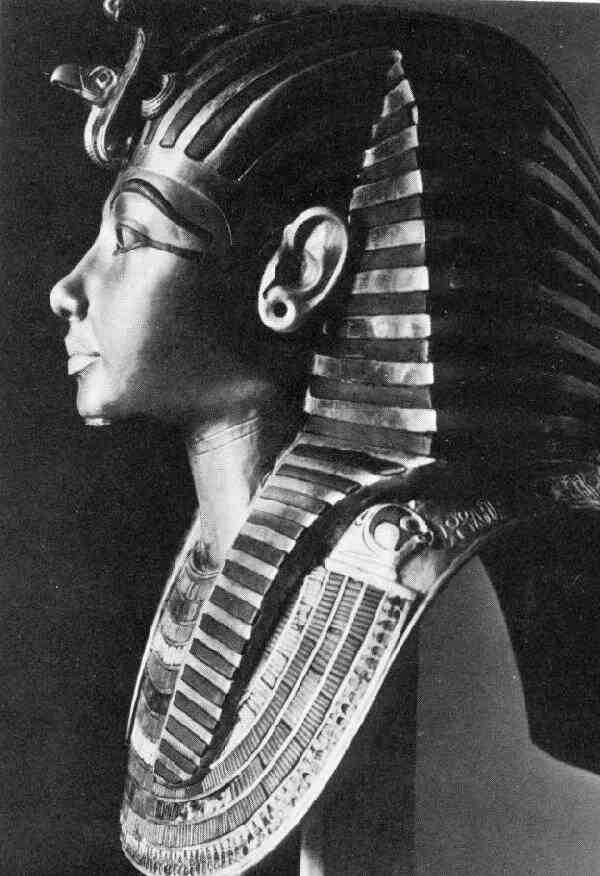
The old priesthood exerted their influence and were able to restore the old religion after the brief reign of Amenhotep's successor, the boy king Tutankhamun. (It was his unspoiled tomb that was discovered by Harold Carter in the Valley of the Kings during 1922, perhaps the most famous discovery in all of archeology.) Tutankhamun became pharaoh when he was a boy of about 9 years of age. He is believed to be Akhenaten's younger half brother. He married his older half sister Ankhes-en-Amun. Normally little is known about minor pharaohs like Tutankhamun, but the fact that his tomb wss never disturbed makes him one of the best known pharaohs. Many of Egypt's imperial possessions were lost as a result of the disorders associated with the reign of Amenhotep IV and Tutankhamun.
The identity of Ay is a subject of great debate among Egyptoligists. He was an important military official and priest in Ankhenaten's court. That importance may have been based on more than military and religiou offices. Many Egyptologists believe that there were blood ties with the royal family. [Aldred, p. 88-89.] In adiition, Ay is often described as the husband of Nefertiti's nurse. Many believe, however, that he was actually Nefertiti's father. [Aldred, p. 90.] This may explain Ay's increasing importance on the death of Ankhenaten's death. He was apparently one of the great survivors in history, rather like an ancient Tallyrand. Even after the death of Nefertiti, he again survived as he had become Tutenkhamen's principal advisor. As the pharoh was so young, Ay became the virtual ruler of Europe, a Vizier. It was during the reign of Tutankhamun, despite Ay's connections with Ankhenaten, Ay appears to have organized the return to the old Atum cult. This was undoubtedly a factor in his survival. As part of the return to orthodoxy, Ay returned the pharaoh's court to Thebes. Ay was an aging man by the time of Tutenkhamun's death. Even so he married Ankhesenamun, probably his granddaughter, and became pharaoh. This marriage further confirms the suposition that Ay was related to the royal family. This marriage is not accepted by all scholars, but seems the only way Ay could have obtained the throne byond overt usurptation. [Aldred, pp. 95-96.] The care he took with Tutankhamun's funerl suggests that it was a legitimate transition. This is the last we here of Ankhesenamun. [Aldred, p. 68.] Ay reigned for 4 years. A general Nakht-min may have been a son of Ay, but died before his father. [Aldred, p. 92.]
Horemheb sometimes spelled Haremhab rose to great prominance during the reign of Tutankhamun who appointed him Deputy Pharaoh. With control of the army and support of the Atum priesthood, he seized power on the death of Ay and was crowned in Thebes. [Aldred, p. 86.] He married Mut-nodjme, pehaps a sister of Nefertiti. [Aldred, p. 92.] Horemmheb began a massive campaign to destroy any evidence of the reigns of Akhenaten, Tutankhamun, and Ay. This suggests not only a rejection of the Aten cult, but the fact that he was not related to the royal family. Horemheb promoted a restoration of the temples to the old gods. [Aldred, p. 86.] His name was substituted for their names when possible on monuments throughout Egypt. In that regard he would have had the strong support of the Amun cult priesthood which despised Akhenaten and the two subsequent pharaohs related to him and Neferiti. Horemheb despite his military background devoted great attention to public administration. Haremhab's campaign against the Aten cult is known as the Vengence of Haremhab. The demolition of Akhet-Atn destroyed temples with their carvings and paintings, stellas, and official buildings as well as references to the Aten cult and his predecessors has severely resticted our knowledge of Akhenaten and his religious heresy. He criticised state officials for abuse of the public trust and set about to cend these abuses. [Aldred, p. 86.] It is difficult to assess his charges as to whether they actually occurred or were made to justify his reign. One aspect may have been local and regional officials retaining more of the tax revenue which weakened the pharaoh's national finances. Horemheb's administrative reforms undoubtedly addressed this problem. He ruled for at least 27 years.
Aldred, Cyril. Akhenaten: Pharaoh of Egypt--A New Study (McGraw-Hill: New York, 1968), 272p.
Stewart, Doug. "Eternal Egypt," Smithsonian, date missing, pp. 74-84.

Navigate the Historic Boys' Clothing Web Site:
[Return to the Main Egyptian New Kingdom dynastic page]
[Introduction]
[Activities]
[Art chronologies]
[Biographies]
[Countries]
[Photography]
[Style Index]
[Bibliographies]
[Contributions]
[FAQs]
[Glossaries]
[Images]
[Links]
[Registration]
[Tools]
[Boys' Clothing Home]