
|
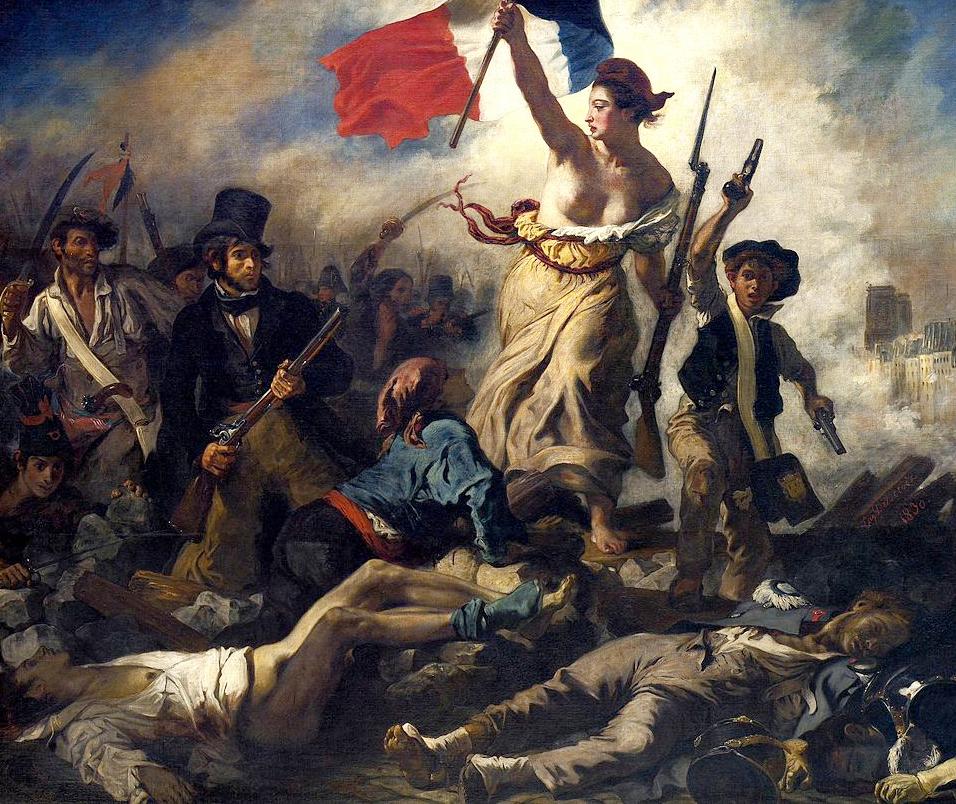
The story of freedom is arguably the key epic of humanity. Here we are not talking about a history of freedom because freedom has so many ramifications beyond just history. There are profound consequences impacting architecture, artistic expression (art, dance, drama, literature, and music), economics, education, ethics, medicine, politics, science, and much more -- in sum total the entire universe of human accomplishment. Karl Marx argued that economics has been the driving force of human history. We argue that it is freedom that has been the driving force for the great advances in human history. This does not mean that important advances can not be made in the absence of freedom. Important accomplishments occurred under Egyptian pharaohs and Chinese emperors. Modern mathematics came from India. But it is in the tiny Greek states that the concept of freedom and Western civilization was born--ironic because slavery was an important part of pat of classical civilization in both Greece and Rome, but the great arc of Western civilization has been toward freedom. And through many trials and tribulations, reverses and advances has been an advancement of freedom. And as a result Western civilization has forged modernity. Religion is a factor that needs to be considered. Religions have impeded freedom. And some have over time both impeded and promoted freedom. This is true of Christianity whose role in the the development of the concept of freedom and the achievement of free societies is poorly understood. Despite the fact that China was for much of history the richest and most technologically productive society in the world, China did not create modernity. Democracy capitalism, the industrial revolution, effective medicine, and science are all creations of Western civilization. It has been responsible not only for political democracy, but the economics of free market capitalism. Freedom of course is not the only current that flows in Western Civilization, but the great Totalitarian Powers, using Marx's terns were thrown on the 'ash can of history' by the force of freedom mustered by the liberal democracies in the form of political democracy and economic free market capitalism, including the Soviet Union which his ideology helped create. It is no accident that the most prosperous countries of the world are liberal democracies with vibrant private economic sectors. As a result, migrants by the millions from societies which lack freedom, taking their lives in their hands to reach the countries who have institutionalized freedom. In the 21st century new question has arisen in the saga of freedom, China is by using free market capitalism to develop a prosperous society, but with totalitarian controls. The outcome of this new approach will in large part dominate the history of the 21st century as will the competition between liberal democracy and Islamic fundamentalism, a reiteration of the medieval mind in a modern totalitarian guise.
Americans and Europeans as part of modern Western Civilization have come to believe that the average person have an innate desire for freedom and thus freedom is a universal value and the driving force in history. This is of course absurd. Even the most basic study of history shows that rather than freedom, the driving force of history is the struggle for power. And this has been the primary motivating factor throughout history. [Fears] This explains why historically there have been so few democracies. In fact, until the 20th century, democracies were actually absent for millennia. There was a brief flickering in the classical era. And even in the 19th century, America stood virtually alone as a democratic republic. History spans millennia, and you can name on one hand the number of democracies before the 20th century. If freedom was universal value this would nit be. And while many democracies appeared in the 20th century. The great totalitarian systems also appeared pursuing Communism and Fascism, both forms of socialism--the most important being the Soviet Union and NAZI Germany along with other variants like Italian Fascism and Japanese militarism. Even in the 21st century the number of real democracies is still a minority in the United Nations. Developments in China are notable. China for some time after introducing market reforms (1970s) claimed that they were a democracy. In recent years this has changed. They now claim that democracy is dangerous and inefficient. What has taken place is that Chairman Xi Jinping after winning a power struggle has established a powerful dictatorship and ignoring the price China paid for the Mao dictatorship has proceeded to suppress any semblance of basic freedom. Xi has introduced 'citizenship' scores in which every Chinese citizen is ranked as to how closely he coincides with the demands of the state. They receive numerous scores. And there are real consequences for those falling below a basic minimum.
Any assessment of the saga of freedom requires at the onset an attempt to define freedom. This is more difficult than it may seem. During the culture wars of the 1960s both the right and the left organized their messages around this concept, freedom. Of course, their ideas were quite at variance with each other. The dictionary definition is fairly straight forward. It is the ability and right of the individual to act, speak, or think as one wants without restraint or the fear of communal, religious or despotic governmental reprisal. A second definition is more of a communal concept, the absence of subjection to foreign domination. The idea of freedom became a matter of considerable discussion during the Enlightenment as concept of natural rights became widely accepted. Natural rights were often defined as life and liberty--liberty meaning essentially freedom. But here the issue becomes more complicated. Important Enlightenment thinkers, most notably John Locke added 'estate' meaning property--'life, liberty, and estate'. The thought being that life and liberty were impossible to enjoy without the right to acquire and enjoy property. Interestingly, Thomas Jefferson in the Declaration of Independence, a document in the spirit of the Enlightenment, phrased it somewhat differently--'life, liberty, and the pursuit of happiness'. Jefferson and the other Founding Fathers were familiar with Locke. Why he chose 'the pursuit of happiness' and what he meant by it is not known with any surety. It is commonly thought that Jefferson was just plagiarizing Locke and rephrasing his concept. This may be case, but Jefferson was also an Epicure and he may have meant more than just property, but considering Jefferson's life style and his dependence on slaves to support it, property must have been part of what he meant by the 'pursuit of happiness'. The complication comes in our modern discussions in that the right insists on the Lockean addition of property or the variously phrased Jeffersonian version. The left reflecting Marxist thought, however, insists that only the propertied class has real freedom. And those without property have no real freedom. It is important to note that Jefferson did not say happiness, but the 'pursuit' of happiness. Thus it is not acquired property that was an important, but a society in which individuals were free to pursue prosperity.
Our assessment of the history of freedom is primarily a saga that plays out chronologically. There are, however, some overarching threads that are at play throughout the history of the West, these are religion, the Judeo-Christian tradition, and the development of law. We thus intend to create separate sections specifically on these important threads in which readers can follow development over time. The Judaeo-Christian tradition is the primary religious movement in the West. It is no accident that democracy is a Western creation. The Jewish convent with God was the beginning of the idea of a contract or constitution between rulers and the ruled. An idea fostered by law, an important concept with both Jews and Romans. Both Judaism and the classical tradition recognized the importance of life and the value of th individual. But unlike Judaism, Christianity spread, first to Latin America and then to Sub-Saharan Africa as well as other areas of the world, especially Oceania. Law is another major thread. Of course law is not unique to the West. The Judeo-Christian tradition has an extremely strong law component, stronger than in any other religion. Law that promotes democracy and free market capitalism, essentially modernity, is a rare phenomenon. This is largely a unique development in the West and those countries that have developed democracies and successful economies (like the Asian Tigers) have developed Western legal systems. Another creation of the West was science. Secular critics stress Catholic resistance to science, but rarely that science was invented in the Christian West. Many societies (China, India, the Caliphate) made important technological achievements--but all failed to invent science. Slavery is another topic that needs to be considered in any history of freedom.
There are many different types of freedom. And over time freedom has not been a unitary experience. Each of these different types of freedom have had their own often discrete and fascinating history. While each has a discrete history, they are not entirely separate and they often overlap. Various authors have described a range of the most commonly discussed types of freedom and liberty. The concept of freedom has varied over time and in different societies. Here we have a basic list that covers most of the various concept. Actually there is no way to create a discrete list of freedoms. There is a substantial overlap between the various forms of freedom, no matter how the list is constructed. The Greeks had a high degree of political freedom, but very restricted national freedom. The Romans had little political freedom, but a high greed of national freedom. And concepts of freedom have varies. The Soviets and Chinese had and th Cubans today have no political freedom, but they claim that they have freedom because most people were economically relatively equal meaning poor. While in America, freedom meant the ability to work and acquire property and wealth (the pursuit of happiness). In such a system, differences in wealth within limits are not only inevitable, but beneficial. The primary freedom is political freedom, because without political freedom and a bill or guarantee of rights, there is no guarantee of any other rights. But even political freedom is no guarantee of other freedoms. The Greeks has political and a high degree of economic freedom, but with it slavery and no religious freedom. And many Muslims today while advocating political freedom and democracy do so with the idea that they can deny political and religious freedom to minorities.
Another way at looking at the saga of freedom in human history is a chronological approach. Early man of course had freedom, but because of the constraints of primitive technology and the desperate need to survive was make only slow advances. Civilization was born, but certainly not freedom. As civilization advanced, authoritarian political and religious systems developed which constrained freedom. Civilization advanced over time, but freedom for the individual was very limited. Nobles controlled resources and for the most part an individual's lot in life was that of his father and his father before him. The ancient civilizations in the great river valleys were very static societies. That is not to say that there was no change, but change occurred at only a glacial pace unless outside forces intervened like invasion or natural events. The Neolithic or agricultural revolution changed this (about 10,000 BC), The pace of change increased, but was still at a glacial pace. There world freedom did not yet exist. And this did nor change until the the historical age. Suddenly on th bloody plains of Marathon, freedom was born (490 BC), It was the creation of the tiny Greek city states, especially Athens and a Golden Age followed. It was the most creative outburst of human creativity in history which tells us something about the importance of freedom. The subsequent history of freedom is not a straight line. We see harrowing reversal and tragic suffering, but the overreaching arc of history, t lest in the est has been toward freedom. An most of the advances in human culture and well being had been with those societies which have embraced freedom. That is not to say that tyrannical societies have not been able to generate power or important achievements, especially monumental architecture. It is to say that virtually all the lasting advances in human society have been with those societies embracing freedom. Here we do not mean the modern robust freedom of 21st century liberal democracy, but societies that offered at least a degree of freedom. And remarkably this has occurred since the Medieval era in the West. Today a simple calculation dramatically shows the impact of freedom. The rich societies in the world are those that have embraced freedom, both political democracy and free market capitalism. The greater the embrace, the more affluent the country. The poorest countries in the world are those that have most severely restricted freedom. This includes totalitarian Communist countries (Cuba, North Korea, and Vietnam)or failed societies where crime and violence rule (Haiti and Somalia). Here the few exceptions are those countries which sit on vast pools of oil and other natural resources.
A common topic discussed about the Olympics is the economic value of hosting the games. A much more important topic rarely discussed is the impact of the economy on Olympic performance. We recently noted a study that linked success at the Olympics to both economic freedom and individual freedom (human rights). It in short boils down to how effectively and justly a nation uses its human capital. To an extent this was always the case since the modern Olympics were begun (1896). The games were dominated by the richer countries, capitalist in Europe and the United States. Just as in Britain and America earlier began to found modern sports (19th century). This was because the wealth generated by industrialization gave ordinary people the time and leisure to participate in and enjoy sports. And for that reason Europe (mostly Western Europe) and America dominated the medal awards at the Olympics. To be a world class athlete you need to train and practice and devote time to it. Thus countries (at the time colonies) where most people lived at or near the subsistence level were it as healthy or had the free time to train and practice. This situation is still notable when studying Olympic Medal counts. One study found that "... that per capita income levels are strongly associated with medal attainment. In particular, we found that increasing GDP per capita by one standard deviation tends to be associated with two to five medals more per Olympics." [Ursua] And with the economic progress made by countries embracing capitalist market reforms, we now see Third world countries making some progress in the Olympics. This basic tend was obscured as the world moved toward World War II. The reason for it was NAZI Germany. Hitler as part of his desire to display a peaceful, prosperous Germany on the world stage wanted to make a major show at the Berlin Olympics which had been awarded to Berlin before he seized power. It was the perfect stage for his new Germany. Other issues were involved such as personal health and Aryan superiority. So the NAZIs essentially turned German athletes into professionals. Athletes could quit their jobs or more commonly keeps their pay checks and just not show up for work. They could train full time and facilities for training were made available free of charge. Thus the German athletes competing against amateur athletes from other countries dominated the games. There were spectacular exceptions such as Jessie Ownes and the other black athletes and the Washington rowing team, but the largest medal count went to Germany. The same was true of the Soviet Union during the Cold War. The Soviets did wonderfully despite the poor performance of the Soviet economy. The reason for this was like the NAZIS, the Soviets and their Eastern European satellites (colonies) after World War II turned their athletes into professionals cultivated and supported by the state. And if this was not enough they even began doping their athletes. This was something the NAZIs did not so, but that the Russians still do. In short economic failure forces countries to violate basic rules to be able to win medals. It is important to note that doping not only violates Olympic rules, but is a human rights violation. Generally doping yields the greatest on younger athletes which means primarily girls. Some of the female Olympians are quite young, even in their early teens. Doping these girls has significant long term health consequences. A different human rights issue is Islam, especially affecting Arab countries which do very poorly at the Olympics. The Muslim population in the world is some 1.6 billion people or nearly a quarter of the world population. Despite this, Muslims win very few medals and the Arabs virtually none. It is just one illustration of how poorly Muslim countries use their human capital. There are many other indicators of this such as Nobel Prize awards, again virtually no awards to Muslims.
Berman, Joshua. Created Equal: How the Bible Broke with Ancient Political Thought.
Diamond, Jared. Guns, Germs, and Steel: The Fates of Human Societies (W.W. Norton & Co.: 1997). Also published with the title "Guns, germs and steel: A short history of everybody for the last 13,000 years".
Fears, J. Rufus. 'A history of freedom,' The Great Courses (2001).
Shachtman, Tom. Gentlemen Scientists and Revolutionaries: The Founding Fathers in an Age of Enlightenment (2004), 288p.
Stark, Rodney. The Victory of Reason: How Christianity Led to Freedom, Capitalism, and Western Success (2006).
Ursua, José (Economist, Goldman Sachs) and Toni Johnson (interviewer). "The Economy of the Olympics" (August 10, 2012) Council on Foreign Relations.

Navigate the Children in History Website:
[Return to the Main topics page]
[Introduction]
[Biographies]
[Chronology]
[Climatology]
[Clothing]
[Disease and Health]
[Economics]
[]
[Geography]
[History]
[Human Nature]
[Law]
[Nationalism]
[Presidents]
[Religion]
[Royalty]
[Science]
[Social Class]
[Bibliographies]
[Contributions]
[FAQs]
[Glossaries]
[Images]
[Links]
[Registration]
[Tools]
[Children in History Home]