
Color in Fashion: Country Trends
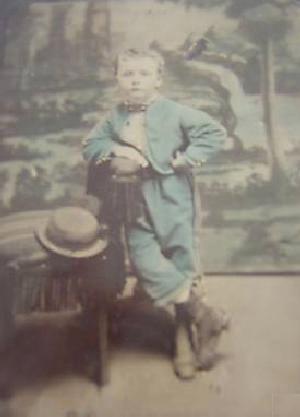
Figure 1.--One of the problems we have in assessing color trends is the black-and-white photography of the 19th and early 20th centuries. There were tinted images, but the accuracy of the colors depicted is unclear. We are unsure, for example, about the accuracy of the light-blue colored suit depicted here in this American tintype. Click on the image for a fuller discussiin of this. We are unsure how to date this portrait, but would guess the 1870s.
|
|
This is a vey complicated topic. Color has been used differently in various countries. This has of course varied over time. And there have been different uses of colors by various groups within countries. Here we have only begun to assess the topic of variation in the use of color in fashion among countries. Often there was considerable continuity in the use of color over national borders within regions.
Our information on color in American boys is incomplete at this time. The popularity of some colors have notably changed over time, bit some baic colors includuing brown, blue, and grey seem pronounced over time--at least since the 19tyh century. Of course, information on 19th century colors are limited by the blasck sand white phpotography of the day. Fauntleroy suits were often black, but the black and white photography of the day effectively hide deep blue, burgandy, dark brown, and forrest green suits. Blue appears to have been a particularly popular color, both navy blue and other shades. There are a great range of blue shades. We know boys commonly wore dark blues, but we are less sure about light blues. Of course sailor suits were commonly navy blue. Blue suits and especially navy blue blazers beocme standard in the 20th century. We note many other colors in the 19th century. The suits sold in the late-19th and early-20th century included a lot of green and brown shades. We also note black and grey suits in the 20th century. The modern color conventions of blue for boys and pink for boys does not seem to have been firmly established at the turn of the 20th century. We do not see it universally accepted until after World War I (1914-18). Preppy fashions of the 1950s help popularize pastel shirts and khaki pants. And of course by the 1970s we see both color adverising and color photography that provide us detailed information about color and fashion.
We do not have much information on clothing color yet. We hope to pursue this topic at greater length as HBC expands. At this point we can only comment on the few color images we have archived and can not yet assess trends. Early hotography of course was black and white. There were some colorized images. While colorized images are not the same as color photographs. We believe that colorized images usully tried to get the color if not the precise shade correctly. One early albumen portrait shows a girl wearing a rather drab grey dress with black trim (figure 1). The boy wears a brown tunic with matching knee pants. Both children wear white stockings. White and black cangenerally be determine in the black and white photography. We note a lot of children wearing what looks like black school smocks in the early-20th century. It could be a very dark blue, we are not sure.
Another interesting fashion topic is color. Unfortunately we still know very little about color in Canadian fashions. Not only is our Canadian photographic archive limited, but we have very little information on Cannadia art. And period paintings is an important part of color information, especially before the advent of photography. Of course early photography was black and white, but colorized images are useful if not the same as actual color photography. We suspct that Canadian color trends are very similar to American color trends, but this need to be confirmed. English color trends may also be important. We think it is American trends that is probably the most important and fortunately that is the country we know the most about. Basically we see boys in America and Canada generally preferring more sunsued colors than hirls, but adding touches of bright colors in bows and ties. This all is, however, impossible to address in any detail without a substantial Canadian archive which we do not yet have. Our preliminary assesment is that Canadian color trends are very similar to those in the United States. This is, however, a topic that requires a great deal of additional work and building our archive.
Children's clothing, especially boys clothing, was for much of the 20th century rather drab. Colored garments were not unknown in the early 20th century, especially for younger children. For the most part, however, we see rather drab colors being worn. The only colour at school was ties, sock tops - and blazer/cap badges - for posher schools blazers would be coloured. A British writer in the 1960s remembers mostly grey school clothes. He writes, "Most of my school clothes were grey, although I had a blue blazer. A friend attending a R.C. state primary had a fancy blue and gold blazer and they had trimming on the jumper too. His primary school and mine were considered the best R.C. and C. of E. respectively primaries in the district so there may have been a bit of religious rivalry about who had the best uniform. Mostly we wore grey items." Outside of school there was more colour - bright t-shirts and so on but even then our cords were always grey, blue,green and brown and never a bright shade and the cotton shorts that my brother preferred were similar colours. Socks were always grey or khaki. Even plastic macs were always grey. Colored garments seemed to come in later, the late 60s/early 70s.
Color is a difficult topic because of the black and white photograph used during the 19th and much of the 20th century. And our site uses the photographic record as a major source of information. Black and white photography does show black and white clothing as well as if the coloes were light or dark. But while you can colorize movies, grey scales require some guesses. We are collecting svailable information about color. A major source is of course French art. We notice George Feydeau as a 8-year old boy wearing a black velvet suit with color provided by a light blue bow (1870). A generation later the Faydouu children are dressed in a dark blue velvet Fauntleroy suit and a satin silver dress (1898). Renoir provides us many wonderful color images, although we are less sure about the color accuracy. In general, however, we believe the artistic depictions are a fairly accurate, dependable depiction of color. Another useful source of information is colorized photographs. Many studios offered to colorize the black and white portaits. Some of these colorized images are journey-men's work and very quickly and poorly done. Other are beautifully done. We believe that usually the colorist tried to replicate the colors actually worn, commonly noted by the photographer at the time the portrait was taken, but colors come in mny hues and unlike the artist, the colorist could not capture the specific hues. There were also some issues. Trying to colorize clothes with patterns could be very tedious, in some cases impossible. And we have never seen detailed instructions addressing patterns. France had a very large commercial postcard industry. They produced large numbers of cards with children and many were colorized. In this case the colorists commonly paid no attention to actual colors. They seem more interested iun a colorful card than acurately de[octing color. Color information is also available in catalogs and advertisements. A French reader tells us, "In my time during the 1940s-50s, black color was never used for our garments, but dark navy, brown, grey were popular as well as white and also sky blue."
One interesting question is the use of color in clothing. We are begiining to address this question, but it is a question HBC cannot easily answer because we rely so heavily on photography. And until the 1970s, color photography was very limited. There are some useful sources of information. There are a few color photographs. Another highly reliable source of information is vintage clothing. There are colorized photographs, although they are ot as reliable as actual color photographs. Catalog provide some useful information. Drawings, paintings, and magazine illustrations also provide some color informations. Postcard were very popular in the early-20th century and mahy were colored, but they are not reliable sources of color information. Each of these sources of information provide useful information, but readers need to be aware of the limitations and reliability of each. We do not at this time know much about the use of color in German children's clothing. Our information at this times comes largely from colorized photographs. We have found some colorized photigraphs which provide some information. We are unsure as to the accuracy of the color depictions. Some of the best examples we have noted of early tinted photographs are German..
(The) Netherlands
Russia
We have some early color information on Russia because a Russian photographer, Sergei Mikhailovich Prokudin-Gorskii, developed an early color photography system.
HBC

Navigate the Boys' Historical Clothing Web Site:
[Return to the Main color page]
[Introduction]
[Activities]
[Art]
[Biographies]
[Chronology]
[Clothing styles]
[Countries]
[Photography]
[Bibliographies]
[Contributions]
[FAQs]
[Glossary]
[Images]
[Links]
[Registration]
[Tools]
[Boys' Clothing Home]
Created: 10:40 PM 6/17/2005
Last updated: 7:23 AM 1/4/2018