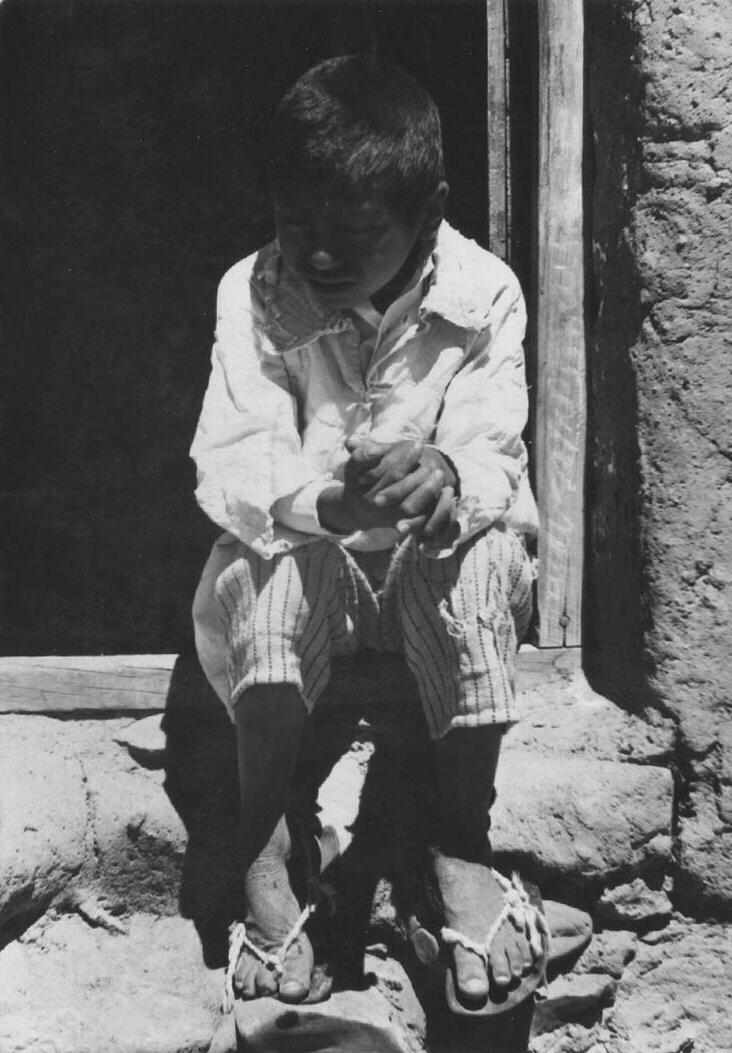
Figure 1.--This post card was taken mailed in 1949. It was a commercial post card mailed in 1949 to Buenos Aires from La Paz, presumably by a French tourist. The boys wear typical campesino clothing that was worn with minor differences throughout Latin America. Notice the sandals with rope tops.
Bolivia is besides Brazil the largest country in South America. It is also the poorest country. The economy is based in exploiting natural resources. It is an extrenely ethically diverse country with Latin America's highest percentage of Native american people. Political and economic power was dominated by the Spanish colonial elite. This contintinued with the Criollos after independemce. President Juan Evo Morales Ayma is Bolivia's first democratically elected president from the indigenous population, in his case the Aymara people. His focus is on reducing Bolivia's endemic poverty, but his pasionate devotion to Socialism does not auger well for Bolivia's economic future. HBC at this time has developed some information on Bolivian history. The Bolivian economy during pre-Colombian times was primarily based on agrculture. Thi continued in the Spanish colonial era, but the discovery of silver (16th century) made mining a major industry. The Spanish were after gols, but found silver, huge quantities of it. The immense amount of silver helped finance the economic expansion of Europe. Spanish mining involved the brutal exploitation of Native American workers. We have, however, very little information on Bolivian boys' clothes. A HBC reader reports, "I lived over 10 years in Bolivia where boys as young as 10 wore long trousers but usually short ones, also in varying lengths. Some were as short as the Japanese, normally though longer shorts, but well above the knee were most common up to the age of about 13. They also wore dark blue or black suits with short jackets so they wouldn't overlap the shorts. I worked for a while in a textile store where customers could buy remnants at discounted prices. I remember a couple buying one piece for the jacket and another for the short when the father said, `The jacket will be longer than the pants.' And sometimes so they were." Bolivian school children wear white smocks.
Nota
Nuestro sitio web esta muy interesante de recibir informacion desde bolivianos sobre la ropa de niños en su pais. Nuestro sitio Ropa Historico de Niño (HBC) es un sitio en ingles, pero nosotros estamos dispuestos de recibir contribuciones en español. Tales contribuciones seran puestos en nuesto sitio en ambos lenguas.
Geography
Bolivia is one of the larger countries in South America, not considering Brazil of course which totals half the area of the continent. In American terms it is three times the size of Montana, one of the larger American states. Bolivia borders on Argentina, Brazil, Chile, Paraguay, and Peru. During Spanish colonial times it was known a Upper Peru. It is today a land locked country, but lost its coastline as a result of the War of the Pacific (1879-84). The climate varies considerably, primarily as a result of elevation. It ranges from humid and tropical to cold and semiarid. The Andes Mountains runs through westrn Boliviacreating a highland plateau (Altiplano). In the pre-Colombian era, the Bolivian alti-plano and southrn Peru around Lake Titicaca was tdeveloped as the most productive high aladitude arae in the world. Much of th mortheast is lowland plains draining into the Amazon Basin. Bolivia shares control of Lake Titicaca, the world's highest navigable body of water (3,805 m), with Peru. Much of the mortheast is lowland plains draining into the Amazon Basin which was undeveloped until modern times. .
Western Bolivia was inhabited by the Aymara people. They dominated the area around Lake Titicaca. The war-like Inca conquered them and added them to their emense empire. The Spanish at first focused on the Inca centers in Peru because they were close to the coast and the Inca treasures could be more easily ceased and transported. The Spanish gradually moved into Bolivia which they called Alto Peru (Upper Peru). The Spanish reduced the Native Americans to a form of serfdom little different than slavery. The remoteness of the high Andes helped limit the numbers of Spanish reaching Alto Peru. This had the affect of protecting the Native Americans from the European diseases that so ravaged populations in other areas of the Americas. An extremely stratified society with an elite Spanish land-owning class developed, the continuing impact of which still affects modern Bolivia. The Spanish discovered a famulosly rich silver vein near Potosi (1544). Potosi became the largest Spanish settlement in South America. The country's independent life was marked by an extended period of domestic power struggles and instability. The country was ruled by a series of dictators called cauldillos. Geography and internal divisions made it difficult for Bolivia to defend the poorly defined borders of Alto Peru. Continued instability in the 20th century, conservative military rule, socialist economic reforms, and the absence of the rule of law have left Bolivia the poorest country in South America.
Boliviais today is anomg the poorest of the Larin Americn countries. This has not always been the case. The Pre-Colomnian economy
primarily based on agrculture and animal husbundry. The Altiplano was developed with irrigated agriculture and supported a relatively dense population despite the relatively adverse growing condutions. This was a situation that developed over time by kingdoms of the Aymara-speaking Amer-Indian competing wuth Quechua-speaking tribes aling with a rnge of coastal civilization. At the time of the Spanish conquest, the Quechua-speaking Inca had created the lrgest Amneri-Indian empire, uniring coastal and Andean aeas frim central Chile north to Ecuador. The population of the Empire were the most propsperous peoole of the Americas. The Inca Empire was in many ways, the only successful Communist economy.
As a result of the Spanish conquest and the introduction of European disseses the Amer-Indian pooulatoin collaped. And those that survived were reduced to medieval serfdom under the Encomieda system. Living standards for Amer-Indians fell below that of Inca Empire. For the Spanish there was a huge bonanza. A huge silver desposit was discivered at Potosí -- essentially a silver mountain (16th century). Bolivia at th time was knowen as Upper Peru. The silver mines made the region one of the wealthiest and most heavily populated in the Spanish Empire. Bolivia had the largest population in Latin America, exceeeded by only Brazil (1800). Great fortunes were made, but the Aner-Induan population did not benefit. Spanish mining involved the brutal exploitation of Native American workers. The Amerr-Indians were forced into basically brutal slave labor in the mines. Upper Peru was more important and more heavily populated than the southern come countruies (Argentina, Uruguay and Chile) or the rest of the Andean colonies. The Spanish were after gold, but found silver--huge quantities if it. The American silver from Upper Peru and Mexico had a huge impact on the European economy. The immense amount of silver helped finance the economic expansion of Europe. The silver was transported llama and mule train to the Pacific coast. From there it was shipped north to Panama City, taken by mule train across the isthmus of Panama to Nombre de Dios or Portobelo and then to Spain on the Spanish treasure galleons organized into fleets. The heavily laden Spanish treasure ships were primary targets of the English Sea Dogs. Silver was also shipped West to the Philippines and then on to China--the Manila Galleon trade. otably while the European economy benefitted, neither the Spanish or Bolivian/Mexican economies did not benefit in the long term. While the siover created a mining industry, when the silver ran out, so did the econony of Bolivia and Mexico. Bolivia in particular became a Latin American backwater and the economy nprimarily subsistence agriculture on over worked land. Ohere mining operations develped after indepemdence: antimony, iron, lead, gold, silver, tin, tungsten, and zinc, Other resources include: natural gas, petroleum, and timber. Exploiting these natural resources are the mainstay of the Bolivian economy. The country faces a range of eniromental issues, including clearing of land for agricultural (especially slash-and-burn agriculture) purposes and logging tropical timber, both leading to deforestation and soil erosion. Overgrazing and poor cultivation methods are also factors.
Bolivia's principal ethnic groups are the indigenous people dominated by the Quechua and Aymara Native American people. There are a small number of European-descended whites and a much larger, diverse group of mestizo people. The Bolivian population is notable for its ethnic diversity. Nore than 50 different ethnic groups of varying sizes make up the population of Bolivia. Over 60 percent of Bolivians identified themselves as indigenous. [2001 Census] The percentge would be much higher if the origins of mestizos is considered. The two larget groups are Quechua (30 percent) and Aymara (25 percent). Smaller indigenous groups include Guarani (1.5 percent), Chiquitano (2.2 percent), Mojeno (0.9 percent), and smaller mostly Amazonian tribes (2 percent). Bolivia has the population with the largest proportion of indigenous people in Latin America. This compates with Guatemala (50 percent), Peru (40 percent), and Ecuador (35 percent). The Quechua and Aymara are concentrated inthe northern parts of the Andean Altiplano. They are also important in the higher valleys and basins of the Andes. The Chiquitanos and Guarani-speaking peoples in the eastern lowlands are the third and fourth most important ethnic groups. There is a large number of relativly small tribes in the Amazonian lowland departments of Santa Cruz, the Beni and Pando. Bolivia has a small population of African ancestry. They are mostly found in the Nor and Sur Yungas regions in the department of La Paz near the silver mines. These people are descended from enslaved Africans, brought to Bolivia as slave labor to wirk the silver mines One report claims that the Spanish soon decided, that they were 'unsuitable' to work in the horific conditions prevailing in the mines. That does not sound quite right. The high alditude may have been a factor, but we suspect that African slaves who had to be transported long distances were more expensive than Native American labor. In addiion to the Spanish colonial population, other Europeans migrated to Bolivia, most immediately before and during World War II. Some Jews found refuge in Bolivia. There was also a German community. The opening up of Santa Cruz and the Amazonian lowlands attracted Europeans, particularly from Eastern Europe and the former Yugoslavia. There are also colonies of Japanese and Mennonite farmers in northern Santa Cruz. After the indegenous groups, the largest part of the population is mestizos, mixed European (mostly Spanish) and indigenous people. Theu make up much of the urbn population. The term 'cholo' is also used. This has different meanings in Latin America, but in Bolivia commonly tkes on the meaning of an indigenous individual attempting upward mobility by adopting the cultural norms and speaking Spanish, essentially necoming a cultural mestizo. Ethnicity has a powerful afect on language and other cultural matters bcause so many Bolivians are Native Americans. The large Native American population has meant that many Bolivians have preserved their indigenous languages and cultures. Spanish and European culture tends to predominate in urban areas, more than half of Bolivians speak an indigenous language as their first language. Community festivals play an important cultural role, especially in rural areas. Political and economic power was dominated by the Spanish colonial elite. This contintinued with the Criollos after independemce. President Juan Evo Morales Ayma is Bolivia's first democratically elected president from the indigenous population, in his case the Aymara people. His focus is on reducing Bolivia's endemic poverty, but his pasionate devotion to Socialism does not auger well for Bolivia's economic future.
Clothing
HBC at this time has very little information on Bolivian boys' clothes. A HBC reader reports in the 1950s that boys as young
as 10 wore long trousers but usually short ones, also in varying lengths. Blue and black suits with long and short trousrs were noted. Many Bolivian school children currently wear white school smocks.
Bolivia is one of the Latin American countries where school children
wear smocks. As in Argentina and Uruguay, the children wear white smocks. I'm not sure why these three countries have selected white smocks. Nor do I know about the situation in neighboring Paraguay. The girls wear back buttoning smocks with small Peter Pan collars. The boys
wear front buttoning lab-type styles. I have very limited information on Bolivia and do not know how extensively the smock is worn country wide.
Suits
A HBC reader reports, "I lived over 10 years in Bolivia where boys as young
as 10 wore long trousers but usually short ones, also in varying lengths. Some were as short as the Japanese, normally though longer shorts, but well above the knee were most common up to the age of about 13. They also wore dark blue or black suits with short jackets so they wouldn't overlap the shorts. I worked for a while in a textile store where customers could buy remnants at discounted prices. I remember a couple buying one piece for the jacket and another for the short when the father said, `The jacket will be longer than the pants.' And sometimes so they were." Bolivian school children wear white smocks.
Religion
Bolivia is as a result of the Spanish colonial era is a largely Catholic country. The Native American people before the Spanish had a rich religious tradition which has not entirely disappeared. Bolivian traditions, holidays and festivals are heavily influenced by religion. They are largely Catholic in character, bit often incluenced by Native American traditions. There are 30-40 indigenous cultures in Bolivia, each has their own set of beliefs and customs, but were wsentially animist in character. Many of these still worship or pay homage to their ancestral deities. The Inca traditions are the best known historically, but the Inca were only one of the Native American traditions. The principal religion is Catholicism implanted by the Spanish after the Conquista (15th century). Mumbers of Franciscan, Dominican and Jesuit priests traveled to South America to convert Ntive Americans.
As in other Spanish colonies, conversion was forced upon the Native Americans and as the the Spanosh colonists mixed with them, the country's Mestizo culture became strongly Catholic. The Inquisition prevented Protestantism from being established as it did in Spain itself. The Church dominted majny aspects of Bolivian cultural life, including education. After the War of independence, liberals struggled with conservatives over establishing a more secular society (19th century). Some 80 percent of Bolvians still identify as being Catholic. Especially after World War II, various Protestant denominations as well as other religions have begun to establish themselves in Bolivia. The Mormons are especially active. The Bahai also have an active community as part of the Diaspora resulting from Islamic persecution in Pakistan. Bolivia also has Jehova�s Witnesses, Baptists, Lutherans, and other evangelical congregations and missions. The Mennonites have a substantial community in the Eastern Lowlands with several colonies around Santa Cruz. The Bolivian Constitution guarantees all people the freedom to adopt and practice any religion and belief system they may choose. Bolivia�s socialist government led by President Evo Morales has given some indication that he would like to abolishing religion. He is espcially hostile to the Catholic Church. He has said that he wants to keep religion separate from the government. His true goal is presumably to reduce the role of religion which he does not control in national life and to increase the authority of the state which he controls.
Personal Experiences
HBC currently has only one report on Bolivian boys clothing. It is from a foreigner living in Bolivia. Hopefully Bolivians will also provide us some information on fasions in their country.
My family emigrated to Bolivia from Germany in the 1940s. I lived in La Paz, Bolivia in the 1940's and early 1950's. I made short visits to Cochabamba, Oruro, Potosi and Santa Cruz, but stayed most of the time in La Paz, especially during my school years. This is what
I remember,