
French Canadians
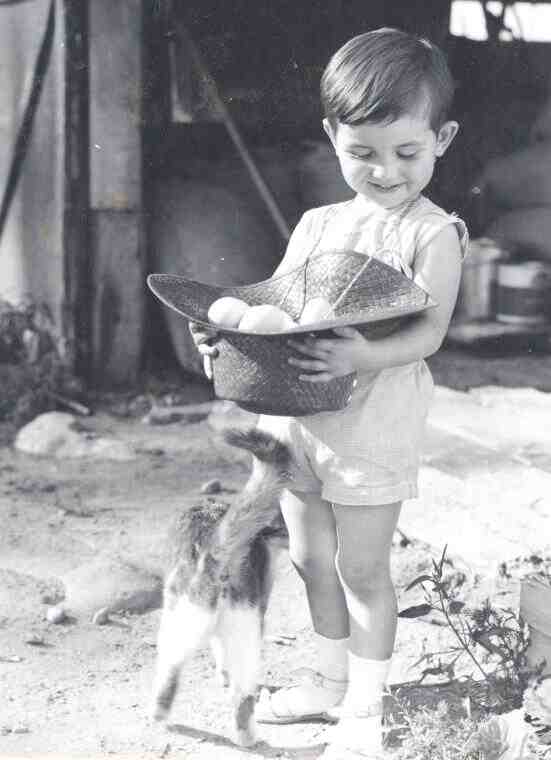
Figure 1.--This is Laurence Gobeil collecting eggs on the family farm as his mother requested. This charming photograoh was taken by Omer Baudoin in 1949 as part of a project with the Quebec Film Board. La petite Laurence, fille de M. et Mme Jos Gobeil, fait la levée des oeurf pour sa maman à Chicoutimi. .
|
|
Canada was of course founded as a French colony in the 16th century. From an early stage the English and French struggled for control of North America. The original French colony was centered on the fur trade. The English were also interested and founded the Hudson Bay Colony. The French established the same feudal and absolutist structure as existed in France. The major English colonization activity was to the south in the colonies along the eastern seaboard. Agriculture became the major econimic ctivity. As aesult, the English population far exceeded the French population. This became a major factor in the 18th centurstruggl for control over of North America. Not only did the French lose, but French Canadians came to be a minority in Canada as it developed over time and immigration increased from Europe. Fe French people showed an interest in emigration and settling in Canada. The French population remained centered in Quebec. The Catholic share of the population, however, was not diluted as significantly as the French population because of the large number of Irish immigrants. This meant that there is a portion of the population that was not Protestant and not favorably disposed toward the English. Despite the Irish resentment toward England, the Irish were strongly indluenced by English culture in many ways. The Irish largely, for example, adopted English fashion trends.
The leadership in Canada, however, continued to be dominated by English, Protestant Canadians. The French in Canada were thus relegated a second-class role and until after World War II were generally descriminated against, in large measure explaining current Quebec demands for independence. The French in Quebec maintained their cultural and linguistic identity, but the mid-20th century there were realtively limited contacts with France. Here General DeGualle's endorsement of a 'free Quebec' was an example of growing ties with France. And over time interest in secssion from Canada increased.
Historical Background
Canada was of course founded as a French colony in the 16th century. From an early stage the English and French struggled for control of North America. The original French colony was centered on the fur trade. The English were also interested and founded the Hudson Bay Colony. The French established the same feudal and absolutist structure as existed in France. The major English colonization activity was to the south in the colonies along the eastern seaboard. Agriculture became the major econimic ctivity. As aesult, the English population far exceeded the French population. This became a major factor in the 18th centurstruggl for control over of North America. Not only did the French lose, but French Canadians came to be a minority in Canada as it developed over time and immigration increased from Europe. Fe French people showed an interest in emigration and settling in Canada. The French population remained centered in Quebec and over time interest in secssion from Canada increased.
France following the voyges of expolorations attempted to found permanent colonies. Early attempts failed. The Fur Craze rekindled interest in the colonization effort. The experiece of Wuropean fishermen on the Grand Banls alerted the French Criwn to the availability of valuavle furs in North merica. The French Crown attmted to interest French nobels in founding a colony by offering a fur monopoly. A young geographer named Samuel de Champlain became the founder if New France. His first experiebce was at Port Royal on Nova Scotia, but he went on to found Quebec which became the French stronghold. From an early stage control of North America became an issue in the on-going competition between England and France. The colonization effort developed along very different lines in the English and French colonies. The English colonists pursued agriculture and developed along democratic lines. New France was centered on the fur trde and copied the feudal and absolutist model of France. The major outcome was that the French population in North america was very small while the English population reached substantial numbers in the colonies along the eastern seaboard. French ijnterest in NewFrance waslimited and the supression of the Hugenots limited that interest. The French also recreated the French political system in New France. Unlike the English colonies there was no separtion from France at an early point. The English Civil War cut off the colonies and a trditoin of colonial parliaments developed ith little or no royal supervision. Nothing like a democratic system developed in New France. The King appointed a governor, the senior colonial figure and representative of the King. Like the French monarch, he had virtual absolute power. He was responsible only to the monarchy, not the people of New France that he governed. King Louis XIV created a new post with the appointment of an intendant (1665). His duties were finance and the judicial system. This change in the colonial administration did not work well. There was considerable overlap between the responsibilities of the governor and intendant. This generated friction and complicated cooperation as only the king could resolve disputes. The English and French alo pursued different policies toward the Native Americans. The French perhaps because of their small population znd limited lznd usage developed amicble relztions with the native Americans. They also lzunched a mjor missionry activity. There was a major problemn with the Iriquois.
The Seven Years Wars has been called the first world war. It was aart of the epic struggle betweem Britain and France that spanned the clobe. The major battles were fought in Europe, but important struggles were fought in Indiam Nort America and other countries. The War broke out in the Ohio Valley and the American phase of the War is known as the French and Indian War. Early encounters in the interior favored the French. The British and the Royal Navy controlled the coast. And here the British expelled the French settlers in the Maritimes--the Acadians (1755). Under Pitt the British eventually marsheled the forces to prevail in the unterior as well. The French loss of Quebec sealed the future of Canada and in fact that of North America as an English-speaking cultural area.
Contact with France
After the English victory, French Canadians appear to have lost contact with France. The English Government presumably persued this as a matter of policy, but here we have few details. I believe that after the English victory, significant French migration to Canada ceased. Some French Canadians migrated to America, the origins of Louisiana Cajuns and French culture in New Orleans. Of course in an era without modern communications and with the Royal Navy's control of the seas, isolating French Canadians was more feasible than in our modern world.
The American Revolution
Canadians during the American Revolution remained loyal to the British. I am not sure precisely why this was. The American colonists attempted to entice the Canadians to join the Revolution and there were two failed American invasions of Canada. The most serious was led by Bendeict Arnold. Canada at the time had only recently been added to the British Empire and their had not been time for a established local government to develop. I do not believe that the French Canadian population played a significant role here.
Dilution of French Population
At the time of Confederation (1867) , there were 3.25 million people settled in the provinces that comprised Canada. Over the next three decades hundreds of thousands more arrived. Few of these immigrants came from France or learned French as their new language. Most settled in Anglo-Canada. This imigration over time significantly diluted the French propotion of Canada's population.
Much of the population of Québec was rural. Gradually the population of Québec became increasingly urban in the 20th century following trends in the rest of Canada and the United States. The rural population was very Catholic and socially very conservative. This changed significantly in the 1960s. A Canadian reader writes, "I beginning in my childhood had many experiences in rural Québec. I lived in Montreal, but weoften traveled into thecountryside to visit family and friends. My wife who lived in Beauce south of Québec grew up on a farm. After 1960, there was something like "a quiet revolution" in rural Québec which significantly changed social attitudes. Good or not? For some, living in the 1940s and 50s was a kind of dark age. After 40 years, I think what I refer to as the Americanization of Québec leads to the [?adverse prediction]. Instead of being Canadians, people became more oriented toward independance like a lot of other countries in the world. It is a big debate in Canada still now. Those who made the quiet revolution in the 1960s are not so anxious to blame Church Institutions. I think Québec became a success story without bloody wars and guerilla like in South America, But many think that we sold our soul to devil when we became part of the wider North American consumer society."
Catholic Canada
The Catholic share of the population, however, was not diluted as significantly as the French population because of the large number of Irish immigrants. This meant that there is a portion of the population that was not Protestant and not favorably disposed toward the English. Despite the Irish resentment toward England, the Irish were strongly indluenced by English culture in many ways. The Irish largely, for example, adopted English fashion trends.
English Domination
The leadership in Canada, however, continued to be dominated by English, Protestant Canadians. The French in Canada were thus relegated a second-class role and until after World War II were generally descriminated against, in large measure explaining current Quebec demands for independence. The French in Quebec maintained their cultural and linguistic identity, but the mid-20th century there were realtively limited contacts with France. Here General DeGualle's endorsement of a "free Quebec" was an example of growing ties with France.
We are just beginning to explore the impact of these cultural differences on clothing trends. One would think that the French Canadians would have been more influenced by France than English-Canadians. We note, however, relatively little reflection of French clothing styles among the admittedly limited number of French Canadian images archived by HBC. We have noted some clearly English influences in the clothes worn Canadian boys. Here there seems to a class factor. The more affluent the family, the more prominent the English influence. HBC has noted a very significant American influence in Canada. Here climate and mass market retailers like Sears and Montgomery Ward may have been influential, especially in western Canada and even rural areas of eastern Canada. We note quite a number of late 19th and early 19th century images in which the boys, both French and English Canadians, seemed to be wearing American rather than English styled fashions. The French Canadians boys photographed about 1910 are a good example of this. A Candain reader writes, "I would agree with what you are saying. British influence was more with the wealthier Canadians. American fashions have been dominant simply because of the close proximity of the United States. I noted an increasing influence of American here fashions after the 1950s."
Photography
Some noted photographers have left us some wonder images of French Canada, especially images from Québec. Omer Beaudoin created beautiful images of farm children in rural Québec. Michel Coron took fascinating photographs of chool children in Québec.
French Canadians of course speak French. They have a destinctive accent, but are easily understood in France. (Just as Americans are in Britain.) As with the English spoken in America and Britain, there are differences between the French spoken in France and Canada.
Differing Views
HBC has discussed this issue with a small number of Canadians. We note that English Canadians in general have no knowledge of differeing dress tends among French Canadians or seem to think thaere are no differences, rather like French Cadians do not exist. French Canadians, on the other hand, have mentioned some differences.
Definition
For many people, in writing French Canadian, they just think of Quebecquers. Québec is not the only part of Canada where there are French speakers, although it is true that most French speakers are located in Quebec. Acadians living in New Brunswick are also French speaking, althiugh there are significanbt cultural differenbces among Acadians and Quebecquers
French Politics
A French Canadian reader writes, "You have to realize that Québec is also something else than Canada. We were close to independance in the 1995 referendum. The real problem is the geopolitical importance of
Québec with the United States to the south. Without Québec, Canada will be vanishing. and the other province will become new American states, except Ontario and Québec. Anyway, it already beginning in British Columbia and Alberta which are already more American than
Canadian in terms of trade. Just in terms of petroleum: Alberta is the biggest seller of petroleum in the world to the United States. Albertans are
not willing to see Ottawa controlling their natural ressources. They would
prefer to keep all the money for them without any perequation with poorer
provinces like Newfoundland. "
Sources
Westley, Margaret W. Remembrance of Grandeur: Montreal's Anglo-protestant
Elite. l900-l950. Translated into French by Dominique Clift & Louis Royer with the title:
Grandeur and déclin: l'élite anglo-protestante de Montréal, 1900-1950 (Montréal: Editions Libre Expression. 1990).
HBC

Visit HBC Canadian Pages:
[Return to the Main Canadian page]
[Canadian choirs]
[Canadian families]
[Canadian long stockings]
[Canadian First Communions]
[Canadian Scouts]
Navigate the Boys' Historical Clothing Web Site:
[Return to the Main French-Canadian culture page]
[Introduction]
[Activities]
[Biographies]
[Chronology]
[Clothing styles]
[Countries]
[Bibliographies]
[Contributions]
[FAQ]
[Glossaries]
[Images]
[Links]
[Registration]
[Tools]
[Boys' Clothing Home]
Created: July 25, 2003
Last updated: 3:45 AM 11/18/2009