
English Boys' Clothes: 20th Century Families
|
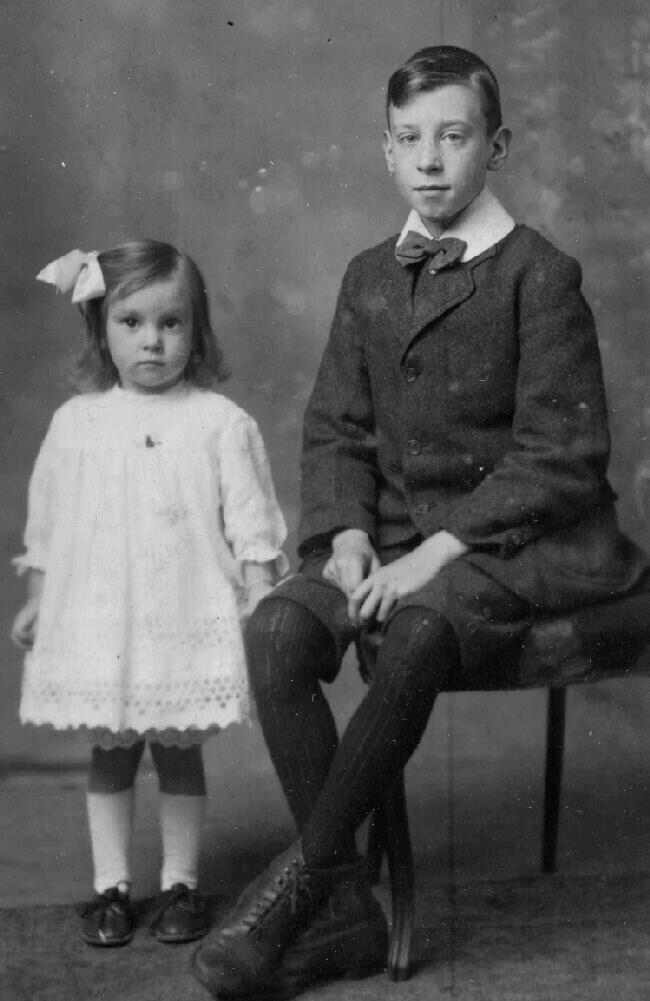
A range of 20th century family portraits show us how boys and other members of the family and in many cases thed whole family dresssed. Clothing was still quite formal in the early 20th century for both children and adults. We note in the early part of the century that boys wore a variety of outfits, including tunics, Fauntleroy suits, and sailor suits. Older boys wore knee pants and knicker suits. Norfolk suits were popular, often worn with Eton collars. Long stockings were common. Girls wore different styles of dresses. Major changes occurred after World War I (1914-18). Clothing became more informal. Boys commonly wore short pants, often with knee socks. Girls still mostly wore dresses. Clothes became even more informal after World War II (1939-45). Girls still commonly wore dresses through the 1960s. Long trousers for boys began to become more common in the 1960s.
The 1900s
Queen Victoria died soon after the turn of the 20th century (1901). The 1900s are thus called the Edwardian age after King Edward VII who amomg other things was a real clothes hound. The late-19th century victorian age was known for formality, even for the children, if the parents could afford it. We continue to see many 1890s fashions still worn in the 1900s with perhaps a glimmer of informality, at least for the children. We notice boys wearing peaked school caps, flt caps, sailot headwear, and boters. One notable change was we see fewer younger boys wering dresses and other skirted grments. This convention did not disappear, but it declined notably. Another change was Fauntleroy styles declined such as lace collars, but we still see a variety of large collars for younger boys. The gleaming white stiff Eton collar continued to be a hall mark of boys' fashions. Even very young boys wore them They were very notable at school and not just for the privlidged classes. Eton collars were worn with and without neckwear. Suits were commonly worn and there were several styles. We see a lot of sailor suits and Norfolk jackets in the 1890s. Various trousers were worn with suits, including knee pants and knickers were common, usully worn with long stockings. State education was well established by the 1900s and most children attended school until bout 13years of age. Boy commonly began wearing long pants after leaving school at about 13 years of age. Boys from better off families continued school and might wear shortened length pants a little longer.
The 1910s
Children in the early-1910s dressed much as they did in the 1900s. The convention of younger boys wearing dressess was decling, except perhps for boys from walthy families. We see some boys wearing tunics, but this was much less common than in America. We also see afew boys wearing kilts. School caps were ubiquatous. Younger boys wore sailor suits, but they were not as common as in Germany. Fauntleroy vsuits were going out of style. We see many boys wearing Eton and other stiff collars. We see mostly narrow ties. Most boys still wore suits. Norfolk suits were still very commonly. Jerseys looking rather like turtle-neck sweaters seem common for casual wear. We see more boys wearing what might be called short pants, although the shorts were still rather long. Shortened-length pants begin looking more like shorts than knee pants. Here Baden-Powell's Boy Scouts probably had an influence. Shorts seem more common, but primarily because boys were cuffing their socks below the knee. And we still see high-top shoes. We are not surejust when sandals first appeared, but we do not yet note them in the 1910s. We do not yet know a great deal about girls' dresses. Of course the disaster of World War I began during the decade (1914). By necesity we begin to see a shift from formal to more casual styles.
The 1920s
we see increasingly informal clothing trends in the 1920s. They do noy look so informal to us tody, but the comparison to make is with the more formal trends before World War I on the 1900s and 10s. School caps were becoming increasingly common, but we still see some flat caps. One notable change is that we see fewer boys wearing the classic stiff Eton collars and more and more soft collars. Short pants and knee socks become virtually universal. The shorts continue to be long. We still see some sailor suits, but not as many as before the War. Sailor suits were more common on the Continent. We no longer see long stockings, at least for boys. We see purpose-made knee socks, but rolled down long stockings. Long stockings were still common in many countries on the Continent. We see knee socks with bands. We see many boys wearing sandals. We still see high-top shoes, but sandals were becoming popular. Families continued to dress up for outings that today would call for casual wear.
The 1930s
We have archived some 1930s family portraits. Boys commonly wore school caps. We see both single and double-breasted suits. Younger boys in prosperous families might wear velvet suits. There were a range of informal play suits for pre-school boys. We note sweaters becoming a popular item, both sleveless and long sleeves. Short pants and knee socks were standard. We see the girls wearing gymslips, a common school unifirm item. Sandals and strap shoes were common for children. Pre school children boys and older gurls wore strsp shoes. Ikder biys and girls wore sandals.
The Patey Family (late-1930s)
This is a 1930s snapshot showing a family in their London back garden. We would guss it was taken sometime before World War II, perhaps 1937 or 38. There is no sign of prparation for the War. We see a typical British family of the period. There is a father, mother, five children, about 6-14 years old. The youngest are two boys who may be twins. The parents are attempting a smiling formality, but the children are misbehaving to various degrees, most notably with the mugging boy to the right. The two older girls are wearing their school gym frocks. The boys are dressed a little differently. One wears a sleeveless sweater, the other a suit vest. This coyld have been schoolwear as well. Both wear short pants and probaby knee socks. Notice how long the shorts are. A rug hangs over a garden trellis and the back of the house seen beyond that. The boy standing directly in front of his father is Reginald (Reg) Patey who moved to Bromley, Kent).
Village family (1930s)
Here we see a family at Whatton in the Vale, a small village in Nottinghamshire. This is located in the industrial midlands. It lies in the Vale of Belvoir, with the River Smite to the west and the River Whipling to the east. The Anglican Church of St. John of Beverley dates to the 14th century. Here we see an unidentified mother and her two children crossing one of the rivers on a footbridge. The children look to be about 5-10 years old. The boy wears a white vshirt, short pants, white socks, and strap shoes. His big sister looks to be wearing her school uniform including a rounded crown hat. The portrait is undated, but looks to us like the 1930s. The photograph is done as a cabinert card. Perhaps dad took the photograph and had the print done as a white cabinet card, a photoraphic format going out of style at the time.
Clapham family (1930s)
All we know for sure about this portarit is that it wasa Clapham family. This was a district of south London. They look like a prosperou, middle-class family. We see the mother and father in their living room with their three sons about 4-13 years old. We are not entirely sure waht the younger boy with the trddy is wearing. It looks like a tunic, short pants, and strap shoes. The middle boy wears a black velvet cut-away jacket suit with a white vest. The older boy wears a double-breasted jacket suit.
Jackson Family (1930s)
We think thee name of the family here is Jackson, but we are not sure. Written on the back of the post card is 'JACKSON'S FACES'. We don't know what this means, but are guessing that the family name is Jackson. We do know that the the photograph was taken in Lowestoft which is a channel coast port in Suffolk. At the time it was a fishing port of some importance, but also had popular beaches and a pier. The post card shows a lady in a cloche hat and her children. The curious aspect of this photograph is how the children were dressed. The boy looks like he is headed to school. His sister seems more dressed for the beach. We are not sure where dad is. Perhaps he took the photograph.
The 1940s
Shillito Family(1945)
This family photograph was taken in Buckhurst Hill, a suburban of Epping Forest district of Essex. Edward Shillito (1872-1948), was a Free Church Pastor. He wrote also many poems. He married Annie Elizabeth Brown (1901). The photo was taken during a family gathering that took place in summer 1945 afer VE Day. During the War a part of the family was evacuated. Now the grandparents could meet their children, children-in-law and grandchildren. Some of the grandchildren were born in Uganda, where the son Jim taught at a missionary school in Nyakasura, near Kampala. This proably explains why the two boys are barefoot.
Working-class Family (Late-1940s)
Here we see one of the working-class families that made Blackpool so important. A huge number of inexpensiive accomodations were built for them, both hotels and bread and breakfast gues houses. The image here is a good example of how English workibg-class families spent their summer vacations. This photograph was taken in the late-40s after the War or early 50s. The boy appears to be taking a photograph of his Mum and grandparents. You will also see that adults often stayed fully clothed on the beach although Mum has kicked her shoes off! Given the temperature of the water, this is understandable. The 'sea-side' dress habits of the adults shown here is typical of the 1930s and this photo is a post-war hangover from that era. The strap on the boy's 'bathing suit' is to hold it up, but there are two straps. The other one is hanging down his back and is either broken or he has not put his arm through it. Again, this is a typical pre-war style.
Middle-class family (Late-1940s)
Dad presumably took this snapshot of the children in the family. The photograph is not dated, but looks like the late-1940s. The early-50s is also possible. There are four children, three boys and a girl. The children look to be about 6-15 years old. The two younger boys wear short-sleeved shirts, the youngest boy with sleeveless sweater. They both wear short pants, ankle socks and sandals. This suggests that the photograph was taken during the summer vacation. Their sister wears a light-colored dress. Their older brother wears a suit. It does not look like a school uniform, but rather a standard suit. An interesting aspect of the photograph is what it shows about British housing. Many Brits lived in terraced housing (row houses) on small plots. You can see that here. If you look at the extrene left you can see the street and the row houses across the street. And if you look closely you can see the very small bit of land between the street/sidewalk and the front of the house. Commonly these are used for small flower plots. In this case mother has planted roses. There will be more land in the back garden (yard). This type of medium denisty urban housing was a factor in World War II. The latelate-40s of course was just after World War II. London and other British cities were spread over large areas, meaning the Germans had to expend precious military assetts for mininmal impact on Britain. It was in the back gardens that the British built their Anderson shelters.
The 1950s
Donaldson family (1950)
This is a 1950 portrait of a happy middle class British family that they used to send as a Christmas greetings photograph; they are signed as 'The Donaldsons'. Father, mother, two sons and a daughter, all smartly dressed. The father looks like a professinal man. The children look to be about 4-11 years of age. The girl wears a smocked dress and the boys matching short pants suits. One boy looks to be eearing a white shirt, his younger brother a grey school shirt. The suits could have been worn for school, but at the time middle-class children might have suits in addition to school uniforms. Short pants suits were still standard for boys. A real image from mid-century suburbia. The portrait was taken by the A. Pollard Studio in Bexleyheath, Kent.
Cavendish Family (1952)
Here we see Peregrine Andrew Morny Cavendish, Marquess of Hartington with his sister Lady Emma Tennant (n�e Cavendish) in 1952. They are about 8-10 years old. They are pictured on the family estate with the manor house in the background. Peregrine and Emma are wearing matching white sailor suits with the traditional blue trim. That was not so common in the 1950s as traditiuonal sailor outfits were no longer commonly worn by children. Of coirse artistocratic children growing up on an estate were not as affected by popular fashion. This was probably just before Peregrine was sent off to his prep school. Earlier wealthy aristocratic children were titored at home, but by the 20th century, especially after World War II, most attendded private boarding schools.
Post Card Image (1950s)
We note what appears to be a postcard image. Postcards used to be used rather like greeting cards or note paper. By the 1950s they had become more of a vacation greeting, but earlier they were more widely used. One popular type of postcard were ones with children. This had become less common by the 190s, but had not yet disappeard. The card here is undated, but we would guess was taken in the 1950s. It is clearly a staged photograph, but the family probably posed in their actual clothing.
Roberts Family (mid-1950s)
Here we see the Roberts family in the 1950s. They look to a a family of modest, but comfortable means. There are three children. I think the names are Alan, Wendy, and Ken. They look to be about 6-15 yeard old. The family image here appears to have been talen in the mid-1950s. All we know about them is that the family seems to have liked seaside vacations. This was before the cheap flights to Spain. Notice all the sweaters. The two boys are wearing crewnecks which means they are probably not school sweaters.
Summer Back Garden Family (mid-1950s)
Here we see an unidentified English family. The snapshot is undated, but we we think in was tal=kern in the mid-1950s. They seemn to be a comfortable middle-class family. It looks to be family get together, apparently in grandmother's back garden. Basck garden is the English term for back yard, yard being offensive in England. We see four children looking to be about 6-14 year olds. The boys look to be brothers. The girl may be a cousin. The boys are all dressed alike in casual summer outfits, sleeveless sweaers, short-sleeved shirts, casual short pants, ankle socks, and closed-toe sandals. The sweaters may seem a bit unusual for summer, but there can be copol days even un the summer. Trainers (sneakers) were not yet very common, what the Britiuh call school sandals were very common summer footwear. Sneakers at the time were called plimsols, but were more for school gym than leisure wear, at least among middle-class families. They may have lost grandfather, unless he took the photoograph.
Visiting Grandmother (late-1950s?)
This snapshot looks to show two boys about 8-11 years old who we believe may be visiting grandmother and her kitty. The room does not look like a room in a family house. And the boys have clearly been spruced up for a visit. Mom or dad probably took the snap. It looks like she may be in an old folks home--perhaps a sign of the time. There is no information associated with the photograph. All we are left is to guess about the image. The dealer involved is British, but we note that he also handles a lot of German images. We think in this case that English is most likely. The boys have close-cropped hair and wear collared shirts, V-front swearers, probably grey short pants, light-colored knee socks, and dark leather shoes. The boys could be dressed identically or wearing a school uniform, but there are minor differences with school muniforms -- especially a tie was genrerally worn with a school uniform. The snapshot is undated. Wr are guessing that it was taken in the late-1950s, but the early-60s is certainly possible.
The 1960s
Movie star family: Dawn Adams (early 1960s)
Dawn Adams was a popular British mobie and TV actress (1950-70s). She was a major Bitish star, butnvr made it big in Hollywood and is virtually unknown to American audiences. She made a brief appearance on early american TV. Here she is with her husband, Don Vittorio Emanuele Massimo, Prince of Roccasecca. Interestingly the Massimo family is ne of the oldest nobel familys in Europe. They married (1954). Their son was Prince Stefano Massimo (1955--). We are using Stefano to date the photograph. If this is not Stefano, than we would guess the photograph was taken in the late-50s. Here Adamms is with her husband. The boy may be theur son, but we are not sure. he could be a fan, but I am not sure that boys his age were all that taken with actresses. . He looks to be wearing a school uniform, but it may be just a blazer and short pants with knee socks.
Unidentified family (1962)
Here we see an unidentified English family in 1962. There are three children, two boys and a girl. They look like they are dressed for Easter, but that is only a guess. The girl wears a hat, jacket, and pleated skirt. The boys wear identical short pants suits. English boys through the 1950s commonly had suits. This became less common in the 1960s. Suits became much less common in the 1960s as boys clothing became more casual. The suits the boys wear here may be specially purchased suits, but they look like the grey suits worn at many private schools. Thee schools often had blazers. But many had grey suits rather than blazers. Some schools had both. The boys do not wear school caps or ties. The older boy on the left is 13 years old and is wearing school knee socks as well as school sandals. His younger brother wears patterened-top knee socks with shoes. These socks were not normally worn at private schools.
Movie star family: Samantha Eggar (1969)
This is a press photograph of Samantha Eggar and her two children, Nicholas (1965) and Jenna (1967) Stern. Eggar was born into a British military family in Hampstead, the year World War II began (1939). The family relocatd to rural location during the War. She was educated in a convent school, but did not get on with the nuns. She claimed she tried to kill one. She was interested in acting at an early age, but discouragd by her parents. Both good looks and ability drove resulting in an acting career. She appeared in many films and TV shows, relocating to America (1973). She moved to America when most of her carrer was conducted. She married American Tom Stern, a less succesful actor. Here we see her traveling with the children to a film shoot. The press caption read, "Samantha Eggar in London: Samanth Eggar in London: Samantha Eggr, arrived at London's Heathrow Airport on Saturday (21-6-69) from Los Angeles, on her way to Paris to star in the film 'Lady in the car'. She travelled with her mnager Guy McElwaine and nanny, Tina, and her two children Nicholas 3 1/2 and Jenna 1 1/2. She said, 'Oh it's great to be back in England, as he sipped a cup of tea. 'I'll never marry anyone ever again.' Samantha is now estraged from her husband Tom Stern." Her performances were competent and were noticed, but there were no stunning success. Eggar and Stern divorced (1971). Her acting carrer continued throughout the 1990s). Tea sipping sounds English, but we noticed she remained in America after retiring as did the children. Nicholas is a film producer. Jenna is an actress, best know for her appearance in the 'Law and Order' franchise.
The 1970s
The 1980s
1988: Martin Family
This press photo shows Alison Martin with her four children. We are not sure why the Martin family merited a press photo. But we see a family having fun during the summer. We assumed they were an American family, but we thin nk it may be British. The source looks to be the 'Daily Telegraph', although it os not clear. The caption simply read, "A time to unwind: Alison Martin with her four childrenn and cousin Roderick.' The photograph was taken August 3, 1988. The children from left to right are Alexander (9 years) Rosanna (6 years), cousin Roderick (10 years), baby Richard (20 months), Alison Martin, and Christopher (11 years).
HBC

Navigate the Boys' Historical Clothing Web Site:
[Return to the Main English family page]
[Introduction]
[Activities]
[Biographies]
[Chronology]
[Clothing styles]
[Countries]
[Essays]
[Girls]
[Bibliographies]
[Contributions]
[FAQs]
[Glossary]
[Images]
[Links]
[Registration]
[Tools]
[Boys' Clothing Home]
Created: 11:15 PM 11/4/2005
Last updated: 1:26 PM 11/23/2023