|
English researchers made some of the most important discoveries which led to modern photography. It was English scholar and resaearcher William Henry Fox Talbott that first fixed an image on paper (1834). He does not, however, seem to have told anyone. Talbot was a classical scholar and amateur scientist of independent means and saw no need or inclination to either publicize his achievement or develop a commercial application. He apparently did not even tell his mother until after Daguerre began publicizing his accomplishments (1839). She was apparently furious with him. And after Tabot began showing his images, he called them calotypes, using the Greek word 'kalos' meaning beautiful. This showed his roots as a clasical scholar and lack of interest in self promotion. The Calotype as a result is little noted. This meant of course that it is French researcher Louis Daguerre who is generally seen in the public mind sas tghe inventior of ohoitograpy. And only a few historians have ever heard of Talbot. Daguere's was a self promoter which is why the process is known as Dguerrepotype. It involved using metal plates whivch is why after a short run it proved to be a commercial dead end. The Daguerreotype was a commercial success in the 1840s. . It would be Talbot's process which used a negative that would ultimately until the digital age be the basis for modern photography. Talbot worked to improved his process in the 1840s. Frederick Scott Archer (1813-57) in England invented the photographic collodion process which preceded the modern gelatin emulsion. The initial result ambrotype which used this process. This esentially ended the commercial potential of the calotype. Professional studios quickly adopted the collodion process. Interestingly, upperclass amateurs, often from the landed gentry, continued to dable with caloptypes. Thus many of these images are scenes of the countryside, but rarely of the rising industrial cities. It would not be in either England or France, however that photograsphy took off. It would be in Americsa.
Commercial photography began with the development of the Daguerreotype in France. Louis-Jacques-Mandé Daguerre continued Nicéphore Niépce's experiments. He finally perfected a commercially viable process (1839) and without Fox Talbott's modesty, named it after himself. Daguere's process using metal plates was the first sucessful commercial photographic process. There must have been Daguerreotypists setting up all over Britain in the 1840. The process continued to be the principal photographic process in the early 50s, although competing processes appeared in the mid-50s. Strangely we have noy been able to find many examples, in sharp contrast to America. We are not sure why we have found very few English dags. Presumably it is simply that based in merica we have less opportunity to find English dags. The same is true for Europe in general. Daguere's process while commercial suucessful for two decades was a in fact a commercial dead end.
The ambrotype process is an early photographic process, a variation of the "wet collodin" process. The ambrotype is an underexposed wet-collodin negative on glass. The wet plate collodion process was invented just a few years before that by Englosh photograpic pioneer Frederick Scott Archer. James Ambrose Cutting of Boston developing a new process using the basic wet collodin process. Anvrose's innovation was to use the plate image as a positive, instead of a negative. He took out several patents relating to the process and may have coined the term "ambrotype" (1854). The anbrotype appeared in Englznd soon after, but were called collodion positives. Many people preferred the shiny Daguerrotypes, but Ambros were mucjh less expensive. (Preparing the metalic Dag plate was costly.) The fragility of the glass plate meant that like Dags they needed protective cases. This was especially important for Ambros, not only because of the fragility, but because a dark backgriuns was needed to view the image. Ambros were made during a relatively short period. Other processes such as the inexpensive tin-type appeared about the same time. And even more importantly, the CDV appeared. The first appeared in France during the late-1850s and by the early-60s was the dominant photographic format. While we have found many American Ambros, we have found relatively few British ones.
From the 1860s itinerant photographers (smudgers) were on the streets, fairgrounds and at the seaside taking instant photographs while the customer waited. At first collodion wet plate processes were used to take Ambrotype andFerrotype (Tintype) photographs using a portable darkroom to sensitize and develop the images. These photographs were produced in minutes. By the 1890s dry ferrotype materials were available and cameras were manufactured to use these new materials. From here onwards all processing operations could now be performed within the camera dispensing with the need for the portable darkroom. The camera had a tank containing a combined developer and fixer solution and about 30 seconds in this chemistry with a quick rinse in water in a mug tied to the tripod leg was all that was required. Smudgers carried a magnet on a chain to get the plate out of the camera. This rather short process with its lack of a suitable fresh water wash accounts for why so few images exist. However suitably stored ferrotypes have surprisingly survived to the present day. Early examples were on the iron base but in the 1920s a non-ferrous card material was introduced. The photographic wholesaler Jonathan Fallowfield was advertising in the 1935 British Journal Photographic Almanac their Straco ferrotype cards and JF Fasa plates, special Develofix salts and stickyback mounts. In the same publication Moore & Co of Liverpool were advertising their �New Improved Aptus Autocard Cameras. Ferrotypes continued to be taken until the late 1940s by the 1950s the process had been consigned to history. Ernest Pendrigh was an Australian who came to the U.K. before World War I to seek his fortune. He noticed the smudgers taking ferrotypes on Brighton seafront using an Aptus camera and he decided to cash in on this money making scheme and bought himself an Aptus. These cameras were known as 'choppers' because of a lever on the side of the camera used to position plate to take the photograph. Pendrigh used this camera in various seaside towns and in Trafalgar Square London during his eventful career. He provides a wealth of informtion about tin-types photogrophy in England. [Penrich] This book is now out of print but is worth a read if a copy can be obtained. Early ferrotypes were often presented in cases similar to Ambrotypes and they can at first glance look very similar. A small fridge magnet placed near a ferrotype should be attracted to the iron and provide a method of identification. Later ferrotype cards do not of course pass the magnet test but are often presented in a window type mount of a similar size to a Carte de Visite. Some of these mounts have printed designs on them with JF printed on them that I assume means these were Fallowfield mounts. I have a small number of ferrotypes in my collection that I attach. The one with a child on a donkey was in a case with and oval mount and was probably taken by the wet collodion method. All the others are card types and were taken between World War I and World War II. The one with a house in the background is believed to be taken in Lowestoft. The images are very dark but have been tweaked in photo editing software. [Godfrey]
As with many early photograohic development. The albumen oprocess originated in France. It is siometimes called the albumen silver pprocess. The basic chemistry was developed by Louis Désiré Blanquart-Evrard in France (1847). It was the first commercially viable process of creating negatives and producing a photographic print on paper. 【Newhall】 The process takes its name from using the albumen found in egg whites to bind the silver photographic chemicals to the paper. It began to replace the early provcesses by the mid-1850s, but really large number of albumen prints did not appear until the 1860s by which time it dominated photography for four decades. The two principal types of albumen prints were CDVs and cabinet cards, firmats used in studios. Stereoscopic card were also important, but these were cards made by companies to bringb images of olaces and peiole from around the world into British living rooms. The albumen process was invented in France (1850). For some reason it was not at firstvery popular. Patent law appears to have been the major impediment. The first commercial development was the CDV which for some reason did not become popular until the 1860s. Suddenly we have really large numbers of images. Mych larger than the number of Dags and Ambros. The albumen pricess involved a negarive and paper prints. his was much cheaper than a Dag or Ambto and provided for multiple print to share with family and friends. The CDV became populasr in Britain and America at about the same time, although there are vastly more American than British and other European CDVs. At the time the Americn and British populations were comparable. So the disparity in the size of the photographic record was not population. It was more patent laws weree more stringlyb enfirced in Britain. Americans began turning to the larger cabinet cards about 1866 abd CDVs declined very rapidky. This transituiin to cabinet cards for some reason was much slower in Britain. We have no udea why, but we still see substantial numbers of CDVs in Britain into the 1890s. We have no idea why.
The photographic industry exploded in America soon after Daguerre invented the Daguereotype (1839) and only grew with development of new formats like the Ambrotype and Tintype. The photographic industry in Rurope grew much slower. As a result the photographic record of the mid-19th century is much ,ore extensive in America than Europe. The reason for this was the legal morass that impeded Europeam photographers as a result of parent protections. American patent law was much less advanced, The European inventors could enforce their patents in Europe, but not America. The patent issued varied from country. In England, Fox Talbot secured a patent for calotypy (1841). This restricted the use by both professionals and amateurs to those who paid to obtain a license. The daguerreotype process was, of course, covered by Daguerre in both Britain and France. His process was too complicated and expensive for all but a few well-endowed experimenters and professionals. Talbot prosecuted some studios who began using Archer's collodion process (after 1851). His monopoly, supported by friends and colleagues, was ultimately invalidated by a court judgemeny Talbot vs. Laroche (1854). The court found Talbot was the inventor of the photographic process and therefore correct in bringing suit against Laroche. But they also for a poorly explained reason found that Laroche was not guilty. Talbot's patent expired (1855). He did not renew it. The coming success of the Albumen process was a comination of easing legal restrictions and the various attributes if the process.
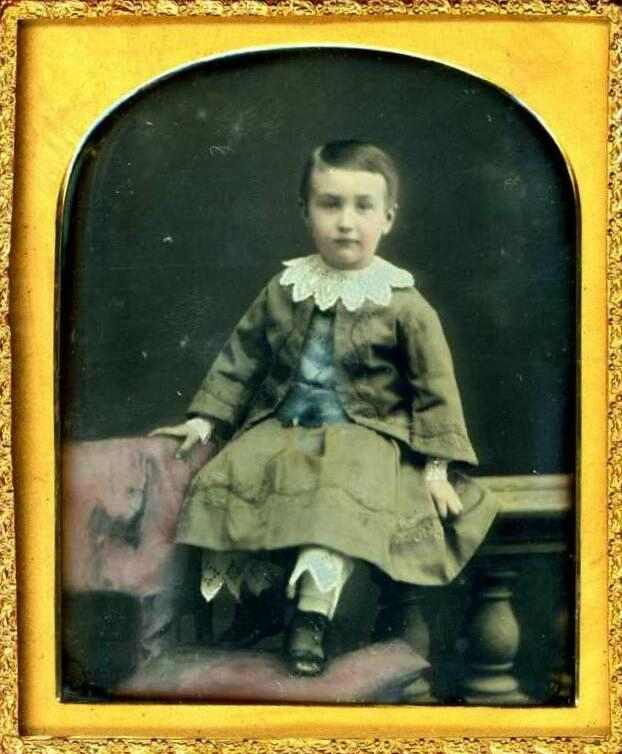
We note some images that look like tinted or even painted over photographs. Many tinted photographs
just added splashes of color. Some were more like painted over portraits. We have not found many of these fully colorized images , but we have found a few. We believe this is an option that some photographic studios offered their clients. They are destinctive in that all have the look of a photogrhaphic pprtrait. They are not very common. but we have foumd s few. They were much more expensive that a standard photographic portrait. Which is why they are so few, presumably because they were so expensive. They are useful in that they provide color information for 19th century black and white photography. You can not be sure about the acuracy of the colors represented, but we believe that most clients would have expected some semblance of accuracy as to the basic colors of the subject's clothing.
It would be Talbot's process which used a negative that would until the digital age be the basis for modern photography. Talbot worked to improved his process in the 1840s. Frederick Scott Archer (1813-57) in England invented the photographic collodion process which preceded the modern gelatin emulsion. The initial result ambrotype which used this process. This esentially ended the commercial potential of the calotype. Professional studios quickly adopted the collodion process. Interestingly, upperclass amateurs, often from the landed gentry, continued to dable with caloptypes. Thus many of these images are scenes of the countryside, but rarely of the rising industrial cities. The first commercial negative process was the albumen print. This began with the carte-de-viste (CDV) which first appeared in France during the late 1850s. The CDV was hugely popular in England by the 1860s and continued to be the principal commercial photographic portrait in the 1870s and 80s. We begin to see more cabinent cards by the 1880s which by the turn of the 20th century had become the principal portrait type. And silver-nitrate prints both for amateur snapshots and studio portraits replaced albumen ptints. While English researchers had played an important role in the development of black and white photography, the development of color photography in the 20th century was led primarily by American and Germn companies.
The magic lantern, sometimes called lanterna magica is an early type of image projector. Its origins are unknown, but may be German. Its date back to the 17th century, way before photography and electricity. It employed painted and printed pictures. Projections permitted presentations to audiences. This usually meant entertaiment (18th century). The development of brighter lighting and photography created many possibilities for magic laterns. Photography provided a wealth of interesting material that could be produced at low cost. It became an educatioinal tool accompasnying lectures on a widerange of topics. Missionaries used them to solicit donations. They used positive black and white images on glass. It was a kind of public version of the steroscope that proliferated in oeoipe's parlors withoiut the stereo aspect. We have found quite a number of these slides, mostly froim England. The magic klatern was superseded by a compact version -- the slide projector. Compact bright lights and the ability to hold large numbers of 35 mm photographic slides was a great improvement over the magic latern (mid-20th century). They could be used for home projection as well as public presentations.
English photography in the 19th century was primarily studio photography. The technology for taking photograps was well established by the 1850s. And as a result we images of the Crimean War (1850s), mostly camps scenes. We see more graphic images with the American Civil War (1860s), but still no actial fighting scenes. The photographic emulsions were too slow. But the technology was fast enough to take outdoor pictures, especially by he late-19th century. Nothing prevented orinary people from taking photographs, it is just that he process was complicated and expensive. A few avid amateurs pursued photography as a hobby and have left us an invaluable record of life outside the studio. Given the cost and complications involved, most of these anateur photographers in the 19th century were well-to-do individuals who could devote time and money to their hobby.
English photography in the 19th century was primarily studio photography. A few avid amateurs pursued photography as a hobby and have left vus an invaluable record of life outside the studio. The vast majority of English photographs during the century, however, was studio photography. We begin to note what looks like street photography about the turn of the 20th century. A good example is three unidentified brothers about 1900. We do not notice portraits like this in the 1890s, only after the turn-of-the century. [Note: Our English archive is not enormous, but large enough to say that street photography was not common in the 1890s if it existed ar all.] We are guessing this the vuidentified brothers portrait is the work of a photographer who went door-to-door offering photographic services. We can not yet substantiate this, but we think this is the most likely source of the portrait. This raises the issue of why we begin to see portraits like this at the turn-of-the 20th century. We think it has to do with the advances in photography such as the Kodak Broiwnie and roll film that radically changed the mobility of the photograopher. He no longer had to carry around bulky equipment. Note that they are usually outdoor portraits which could easily be taken by a small camera. An English reader confirms that street photographers were active after World War I in the 1920s and 30s. They not only went to door to door, but set up near parks and popular tourist locations. He also noties an interesting related phenomenon--beach resort photography. A good example is Jackson Faces. Our reader is doing a study on these photographers.
A snapshot is a casual, informal photograph which an amateur takes quickly, typically with a small handheld camera. They can be taken by ordinary people with no training or expertise, althouh a little competence helps with the results. And unlike 19th century photography, the costs were modest. The snapshot was essentially in vented in america by Kodak. It was the Kodak Brownie that changed everything. All you had to do was point and shoot. Gradually more complicated cameras appeared which permitted improved results. But baically family photograph was invented. We no longer see just studio scenes, but photographs showing the family at home and all the various activities in and around the home and the varios family events away from honme. Few of the new photographers prited their own photographs. It was done commercially. The various prints provide clues as to when the photographs were taken. Many early snapshots were done with post card backs. The size, format, borders, and edges had different time frames when they were popular, just like the CDV/cabinet card mounts. Thus they can be used to help date the many undated images we have found.
Studio portraits in the 19th and early-20th century were ione as CDVs and cabunet cards. In the 20th century, especially by he 1920s we begin to see the portraits done with paper frames or fold open portfolios.
We have just begun to collect information on important English photographers. A rare early woman photograoher was Indian-born Julia Margaret Cameron (1860s-70s).
Godfrey, Paul. E-mail message, June 6, 2012.
Newhall, Beaumont (April 1955). "60,000 Eggs A Day" Journal of Photography Vol 4, No. 4 (April 1955), pp. 25–26.
Pendrich, Ernest. The Magic Box. Pendrigh wrote his autobiography in the 1950s. It has a wealth of information on tin-types. He gives an account of how he lived and worked as a ferrotype street photographer in England.

Navigate the Boys' Historical Clothing Web Site:
[Return to the Main English page]
[Return to the Main European country photyogrphy page]
[Return to the Main country photography page]
[Introduction]
[Activities]
[Biographies]
[Chronology]
[Clothing styles]
[Countries]
[Essays]
[Bibliographies]
[Contributions]
[FAQs]
[Glossary]
[Images]
[Links]
[Registration]
[Tools]
[Boys' Clothing Home]