
French Boys Clothes: Activities--Religion
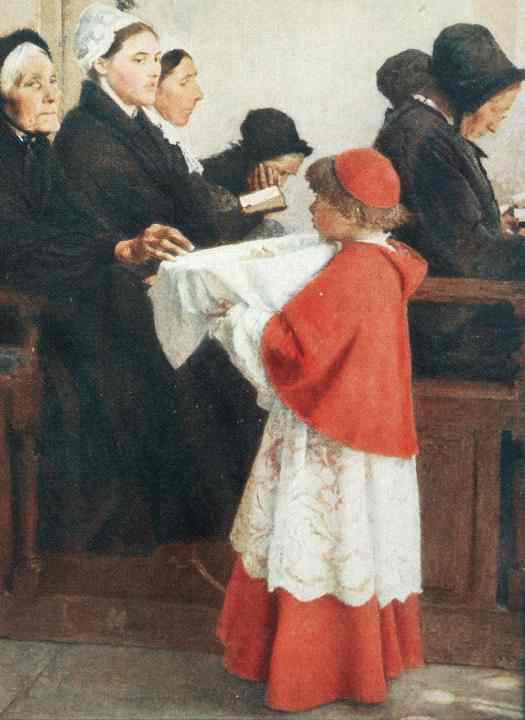
Figure 1.--Many French boys have served as altar boys. It is a considerable honor for a boy tombe chosen to assist the priests with the mass. Boys for this duty are costumed like the priests. I am not sure who the artist was. It was painted in Paris at the Luxembourg Church. I am not sure about the date, but it looks like the late 19th century. The artist portrays wonderfully the contrast between the severe looking parishners dressed in black and the innocent looking boy dressed in red and white. The altar boy here is distributing some little pieces of ordinary bred during a mass. This was very common, especialy in rural churches until the 1960s. It was a symbol of the farmer work. The boy's vêtements are very elaborate. We are notsure if this was common for altarboys at the time.
|
|
France is a largely Roman Catholic country. Protesant groups have been severely persecuted in France. Since the Revolution there has been relogious freedom. After World War II, migrants from North Africa have added Islam to France's important religious groups. Religion has palyed a major role in France's history and the lives of its people. The importance of religion and church attendance has declined significantly in France. Even so so, religion is still an important force in France, especially in the lives of children. Many French boys have served as altar boys. The Church has been the primary force behind the organization of boys choirs. The Church has also palyed a key role in French education. Most French boys have a First Communion which is a major event in their lives. Important French holiday are religious festivals, including the most important for children--Christmas.
France is a largely Roman Catholic country. As a result, the religious experiebes of mosst French boys had been Catholic. The two most imprtant experiences have been altar boys and choristers. The two experiences were joined in the early Church, bit gradually became separated, especially as the boy choir tradition declined. The French monarchy became a major support for the Roman Catholic Church in Europe. The Monarchy was noe of thecfirst in Europe to achieve control of the clergy from the papacy. The Reformation made considerable progress in France, leading to horrendous religious wars (16th-17th centuries). The St. Barthlomeu Day Masacre was a particularly grevious incident setting off the horrendous religious wars (16th-17th centuries). The Edict of Nantes established a period of toleration. Louis XIV's revocation set off a terrible round of persecution. Many Hugenots fled the country. Since the Revolution there has been religious freedom. There was an important Jewish community in France, especially in Alsace. The French Jewish community was descimated by the NAZIs in the World War II Holocaust. After World War II and the terrible war in Algeria, migrants from North Africa have added Islam to France's important religious groups. A French reader tells us today less than 80 percent are Catholic as a result of the Muslim immigration from North Africa. Our guess is that the 80 percent figure is "cultureally" Catholic. Actually practicing Catholic would be much lower. As far as I can see Europe is undergoing a de-Chritenization process. A French reader tells us, "HBC is correct. Actually it is worse, in my time the Churches were full. Today the are almost empty. Few people are praticing, but all most people are still attached and are respect our Catholic Churchs as part of our cultural heritage. It is similar in Austria and many other European countries."
Religion has palyed a major role in France's history and the lives of its people. The importance of religion and churchl attendance has declined significantly in France. Even so so, religion is still an important force in France, especially in the lives of children. There were clothing costumes and fashion styles associated with many of the roles that boys played which have varied over time. Only the garments worn by altar boys have remained relative stable. Many French boys have served as altar boys. It is a considerable honor for a boy to be chosen to assist the priests with the mass. Boys for this duty are costumed like the priests. The Church has been the primary force behind the organization of boys choirs. Many countries of Western and Central Europe have a long tradition of church boys' choirs dating back to the medevil era. One of the longest traditions is that of the French boy choirs. The Roman Catholic Church has also palyed a key role in French education. We note French children wearing uniforms at many Catholic schools, but we are not entirely sure about the chronology of this. Many French boys remember taking Communion. It was a major event in their lives. Most French boys have a First Communion which is a major event in their lives. French boys like American boys used to get dressed up in new suits or fancy outfits for their First Communion. Important French holiday are religious festivals. The two most important are Easter and Christamas. Of course the miosr important holiday for children--Christmas. Another important religious festival in France is Easter. We do not have much information about French weddings. France of course is a Catholic country and the wedding traditions ar Catholic. Even so I believe many poor people did not marry formally before the Revolution (1789). A strong anticlerical trend developed with the Revolution which was moving toward a kind secular religion.
HBC

Navigate the Boys' Historical Clothing Web Site:
[Introduction]
[Activities]
[Biographies]
[Chronology]
[Countries]
[Clothing styles]
[Bibliographies]
[Contributions]
[FAQs]
[French glossary]
[Images]
[Links]
[Registration]
[Tools]
[Boys' Clothing Home]
Navigate the Boys' Historical Clothing French pages:
[Return to the Return to the country religious page]
[Return to the Return to the French activities page]
[Return to the Main French page]
[French choirs]
[French school uniforms]
[French school smocks]
[French royalty]
[French sailor suits]
[French scout uniforms]
[Difficult French images]
[French art]
[French Movies]
[French ethnics]
Created: December 11, 2002
Last updated: 10:41 PM 2/12/2013