
World War II: Greece -- German Occupation
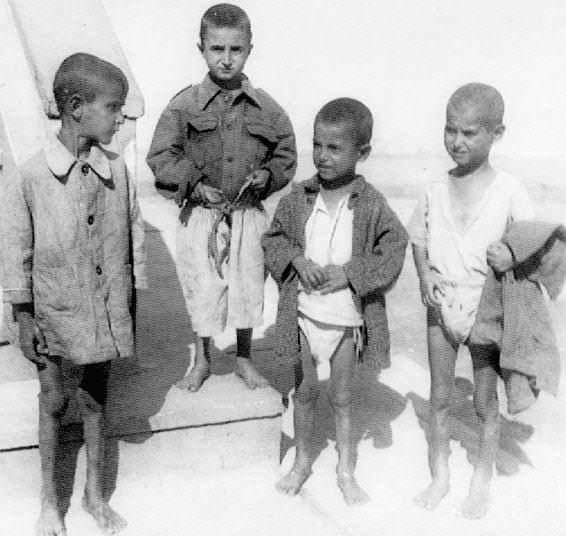
Figure 1.--The German occupation resulted in a famine in Greece. It was the children that were most affected. Here are starving children that were photographed in the streets of Athens. The photograph was taken by Kostas Paraschos. During the Axis occupation, Paraschos managed to secretly take about 1,000 pictures in the streets of Athens at the risk of his own life since the authorities were suspicious of street photography.
|
|
The Germans after defeating the Greeks and British, divided Greece into three occupation zones. The Germans zone included western Macedonia, Thessaloniki, a strip of land in eastern Thrace, the major Aegean Islands and Crete. The Bulgarians zone included eastern Macedonia and Thrace. The Italian zone included the Dodecanese Islands, the Ionian Islands, and a large section of mainland Greece including Athens. The Greek children were especially affected by the German
occupation. The Gerrman occupation of Greece differed substanially from the occupation of Yugoslavia. Greece had a relatively homogeneous population, in sharrp contrast to Yugoslavia. There was also a central government that was weak and collaborationist. Not only did Greece pose a less difficult occupation problem that Yugoslavia, but the German occupiers had a much more favorable attitude tgoward the Greek people and their culture. There was a deep respect for the culture of ancient Hellas. Germany had been a major force in archeology. It was a German archeologist who found Troy and provded that is was not just a legend. Even the NAZIs strongly sypported archelogical studies--in part believing that archeology would confirm NAZI racial ideology. The German attitude toward the Yugoslavs. The NAZIs regarded the Yugoslavs as like the Russians, barbarian Slavic untermench. The Greek economy also made it easier for the Germans to control the population. Greece was not self sufficent in food production. Before the War, the Greeks imported food. After the occupation, this was no longer possible. Food could be usedto control the population. The NAZI program of plundering the occupied countries, made the situation in Greece even more difficult for the Greek peopkle. Large quantities of food were shipped from Greece to Germany. The result was a mass famine in Greece. The famine in Greece reached Athens in the winter of 1941. The famine was a man-made event resulting from the German ability to contol distribution of food. The Germans viewed Greece and other occupied countries as a source of food and resources that could be used to support the War effort. It should be stressed that not all Germans involved in the occupation behaved crudely. German Occupation officials reported to Berlin that more food was needed for the Greek people. These requests were ignored by NAZI officials in Berlin. NAZI officials in some occupied countries were interested in remaking those societies on the basis of the National Socialist principles implemented in Germany. This seems not to have been a major factor in Greece. The German priorities in Greece were clearly food, raw material, and laborers to support the German War economy. [Mazower] The Occupation was a very difficult period for the Greek people. Actual starvation claimed the most lives. There were many executions, including resistance fighters and even more civilian hostages. Large numbers of Greeks were deported to Germany to work as slave alorers. Thousands of children starved. Asylos were set up for the thousands of displaced children. Because of German policies, however, resources were unavailable to deal with the crisis.
Occupation Zones
The Germans after defeating the Greeks and British, divided Greece into three occupation zones. The Germans zone included western Macedonia, Thessaloniki, a strip of land in eastern Thrace, the major Aegean Islands and Crete. The Bulgarians zone included eastern Macedonia and Thrace. The Italian zone included the Dodecanese Islands, the Ionian Islands, and a large section of mainland Greece including Athens. Essentially the Wehrmacht as a result of these zones turned over most of the responsibility for the occupation to the Italians in
1941. The Italians by this time had been mauled by the Britishbin East Africa and North Africa. There own invasion of Greece had been a disater. They were this not disposed towad taking aggressive measure to combat the Resistance. The limited Italian attempts at suppression were harsh, arbitrary and genrtally ineffective. This only fuled resentment on the part of the Greek people to the Axis occupation. Especially resented was the German
decission to allow their Axis partner, Bulgaria, to annex Thrace. This had been won at great sacrifice in the 1922-24 war with the Turks.
German Racial Attitudes
The German occupation of Greece differed substanially from the occupation of Yugoslavia. Greece had a relatively homogeneous population, in sharp contrast to Yugoslavia. There was also a central government that was weak and collaborationist. Not only did Greece pose a less difficult occupation problem that Yugoslavia, but the German occupiers had a much more favorable attitude toward the Greek people and their culture. There was a deep respect for the culture of ancient Hellas. Germany had been a major force in archeology. It was a German archeologist who found Troy and provded that is was not just a legend. Even the
NAZIs strongly sypported archelogical studies--in part believing that archeology would confirm NAZI racial ideology. The German attitude toward the Yugoslavs. The NAZIs regarded the Yugoslavs as like the Russians, barbarian Slavic untermench. The Greek economy also made it easier for the Germans to control the population.
The invasion of Greece was primarily a Germab operation. The occupation was a joint effort among Axis psrtners (Germany, Italy, and Bulgaria). The Germans kept a relatively small garrison in Greece. As in Yugoslavia, the Italians had a large occupation zone and provided most of the occupation force. The Italians occupied the Peloponnese, cental Greece, Thssaly, and Epirus. The Italians also occupied many Aegean islands in addition to the Decodese which they had seized from the Ottomans (1912). The Italians deployed 11 infantry divisions as part of the 11th Army under General Carlo Geloso. An additional division was present in the Dodecanese Islands. The Germans primarily were in extrene north south of modern Macedonia and eastern Thrace. There were also German garisons in Athens, Crete, and various islands. The German troops in southeastern Europe came under the overall command 12th Army headed initially by Field Marshal Wilhelm List and later by General Alexander Löhr. The German commands in Greece were separated: the Salonica-Aegean Military Command at Thessalonica and the Southern Greece Military Command at Athens. Luftwaffe General Helmuth Felmy held sway in Athens. Crete was organised separately and designated a fortress ("Festung Kreta"). The Germns garrisoned it with the Fortress Division "Kreta" and after August by the powerful 22nd Air Landing Division.
The Bulgarians occupied much of Thrace and eastern Macedonia withan Army corps. Brutal anti-partisan campaigns drove large numbers of Greek villagers into the German zone of Thrace (1941). Allied disinformation efforts convinced OKW that after the loss of North Africa (May 1943) that an invasion might come through Greece. The Allied target was Sicily. Any look at the map would suggest Sicily as the next Allied target. The Allies wanted to confuse the Germans so they would not concentrate their forces in Sicily. The Germans moved the 1st Panzer Division and the 1st Mountain Division into Greece (mid-1943). It is not altogether clear to what extent the disinformation worked or tge Germans were preoaring for an Italian surrendr to the Allies. Italy surrendered to the Allies (Septenver 1943). As in Italy, the Germans had anticipated the surrender of their Axis ally. This represented, however, a drain on the increasingly hard-pressed Germans after major defeats in the East. The German occupation of the Italian zone was accompanied by some violence against the Italian garrisons. The Germans viweed the Italians as traitors. The Grermans also escalsated the anti-partisan campaign. The British attempted to take advantage of the Italian surrender by entering the Aegean in the Dodecanese Campaign. Without Anmerican help, the German garrison was strong enoughh to defeat the British.
Occupation Policies
Germans policy was to force the Greeks to pay for their own occupation. A similar policy was emoloyed in France. The payment was exacted through the requisition of food
and other supplies. The Germans exploited the Greek economy to the fullest extent. The civilian population was left at a minimal subsistence level. Many in fact were reduced below the subsistance level. Relief agencies of neutral powers had to be called upon to prevent widespread starvation. It became obvioys to most Greeks that there would be no relief from the NAZI plundering as long as the Germans remained in Greece. This not only generated increased support for the Resistancem but placed the Germans in a position that they could only mainatin their hold on the country with the increased application of force, especially after the Italians withdrew from the War in 1943 and German forces became increasingly streached.
Greece was not self sufficent in food production. Before the War, the Greeks imported food. After the occupation, this was no longer possible. Food could be usedto control the population. The NAZI program of plundering the occupied countries, made the situation in Greece even more difficult for the Greek people. Large quantities of food were shipped from Greece to Germany. The result was a mass famine in Greece. The famine in Greece reached Athens in the winter of 1941. The famine was a man-made event resulting from the German ability to contol distribution of food. The Germans viewed Greece and other occupied
countries as a source of food and resources that could be used to support the War effort. It should be stressed that not all Germans involved in the occupation behaved crudely. German Occupation officials reported to Berlin that more food was needed for the Greek people. These requests were ignored by NAZI officials in Berlin. NAZI officials in some occupied countries were interested in remaking those societies on the basis of the National Socialist principles implemented in Germany. This seems not to have been a major factor in Greece. The German priorities in Greece were clearly food, raw material, and laborers to support the
German War economy. [Mazower] The Occupation was a very difficult period for the Greek people. Actual starvation claimed the most lives.
Large numbers of Greeks were deported to Germany to work as slave laborers. The Germans had a desperate need to labor to keep their war industry running. Most able bodied German workers were concscripted for military service. The NAZIs refused to use married women in factories as was done in America, Britain, and Europe. As a result, they began conscrioting potential workers in the occupied countrues. Usually these were younger adults without children. I do not yet have details on the deportations to Germany of Greek slave laborers.
The Greek children were especially affected by the German occupation. No other group of Greeks, except the Jews, were more affected by the occupation and the resulting famine than the children. There were many executions, including resistance fighters and even more civilian hostages. Large numbers of Greeks were deported to Germany to work as slave alorers. Thousands of children starved. Asylos were set up for the thousands of displaced children. Because of German policies, however, resources were unavailable to deal with the
crisis. Asylo or asylums were established to care for the children. We know very little about institutions at this time. One image shows emacuated boys at one of these asylos wearing smocks.
Inflation
While the terrible famine ended in 1942, it was not the end of the food crisis in Greece. As the gurill war intensified (1943), Greece again began expeiencing food shortages. This time it was the countryside rather than the cities that suffered most. The countryside became a war zone. The resistance struck at the Axis occupation forces. The Axis forces launched deadly reprisal actions. The Axis forces burned villages and shot people in areas auspected of harboring the guerrilas. The Germans and Bulgarians were especually brutal. Terrible actions occurred in Epirus and Thessaly. [Hionidou, pp, 17 and 30.] The rural population in these areas began streaming into the cities or up into the mountains to escape the reprisals. This meant that large areas of the countryside lost a substantial part of the agricultural labor force. As a result, famine reappeared during the winter of 1943-44. Conditions were especially severe in Aetolia and some of the islands. [Laiou-Thomadakis, p. 2.] The problem was made worse by the fact that Red Cross food aid did not reach the country side. Tey helpe keep the cities supplie, but relief workers were unable to get food to the countryside. Here it is not entireky known why. It may havce been the countryside was a war zone. Som believe that the Germans were retaliating against people in areof high guerrilla activity or tokeeo food away from the guerillas themselves. The National Liberation Front (EAM) was able to distribute some food and clothing to the regions it controlled. [Laiou-Thomadakis, p. 3.] The Germans begin withdrawing from Greece indanger of being cut off as the Red Army drives into the Balkans (August 1944). Because of Crete and the smaller islands, the German evacuation of Greece was complicated. The last German soldiers loweered their swastika down from the Acropolis and begin to driving through the city towards the road north. They passed through crowds of Athenians joyously waving their blue and white Greek flags. adding to the hunger was inflation btought about by financial mismanagement. Inflation was so bad that reports describe a loaf of bread cost 2 million drachma. People were trading their belonings for basics like flour and olive oil. The countryside was in a trrible state and food productuin had declined substantiually. Greek and British troops entered thge capital (October 12, 1944). This opened the way for the delivery of food supplies to the hungary Greek.
Sources
Hionidou
Laiou-Thomadakis, Angeliki. "The Politics of Hunger: Economic Aid to Greece, 1943–1945". Journal of the Hellenic Diaspora Vol. 07 (2006)
Mazower, Mark. Inside Hitler's Greece: The Experience of Occupation, 1941-1944 (Yale University Press, 1993), 437p.
CIH -- WW II

Navigate the CIH World War II Section Site:
[Return to the Main World War II NAZI Hunger Plan page]
[Biographies]
[Campaigns]
[Children]
[Countries]
[Deciding factors]
[Diplomacy]
[Geo-political crisis]
[Economics]
[Home front]
[Intelligence]
[Resistance]
[Race]
[Refugees]
[Technology]
[Bibliographies]
[Contributions]
[FAQs]
[Images]
[Links]
[Registration]
[Tools]
[Return to Main World War II page]
[Return to Main war essay page]
Navigate the Boys' Historical Clothing Belgin pages:
[Return to the Main Greek World War II page]
[Return to the Main Greek 20th century chronology page]
[Greek choirs]
[Greek folk costumes]
[Greek movies]
[Greek royals]
[Greek schools]
[Greek youth groups]
Created: March 17, 2003
Last updated: 4:53 AM 4/19/2015