|
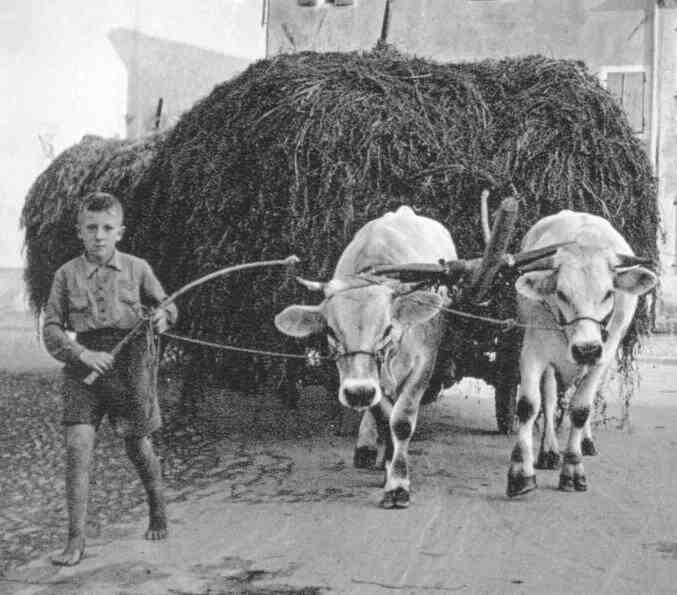
The pervasive idea currently is that the industrial revolution and capitalism were responsible fior child labor Actually the opposite is true. Only with the industrial revolution and the generation of wealth it brought were Western societies able to reduce and finlly end child labor. Italy is a ase in point. Italy until after World War II, was the poorest of the major European countries. Children commonly worked in Italy until after World War I. The poverty and child labor was especially severe in southern Italy which well into the 20th century was almost feudal with large agricultural estates. It was less common in the industrialized north. Given the poverty, especially in southern Italy, many Italian boys had to leave school at an early age and work. Italy was not as heavily industrialized as many countries to the north. Thus boys were often involved in low paying agricultural labor. The poverty in Italy was the major reason that large numbers of Italians emmigrated to America in the late-19th and early-20th century. We note Italian boys involved in agricultural work well into the 20th century, even after World war II. While the largest numbers of boys were involved in agricultural labor, Italian boys were also employed in mines, mills, and factories, although Italian law began to restrict this in the late-19th century. Our information on Italian law is still very limited. ite limited.
Italy until after World War II, was the poorest of the major European countries. The poverty was especially severe in southern Italy which well into the 20th century was almost feudal with large agricultural estates. Given the poverty, especially in southern Italy, many Italian boys had to leave school at an early age and work. Italy was not as heavily industrialized as many countries to the north. The poverty in Italy was the major reason that large numbers of Italians emmigrated to Amrica in the late-19th and early-20th century.
We note Italian children, mostly boys, commonly involved in both agriculture and many industrial areas. This is not to say that girls did not work, but they were more likely to work as domestics in private homes. We note a wide range of economic activities in which children were involved. They were similar to other European countries, although agriculture was more important than in the other major European countries. We do not seem to see as many children involved in industrial work, even in heavily industrialized norther Italy. We are not sure why this was, government restyructions and labor union opposition could have been factors. There also seem to be regional variations. Large numbers of children were involved in agricultural work and street hawking. This may have been associated with family activities. The children of fishermen, fior example may have helped sell the fish their father caught. The same may have been the case for the children of small-scale farmers.
The first Italian child labor laws were specifically directed at the mining industry where working conditions were particularly hard. The Kingdom of Sardinia forbade children under 10 nyears old from working in mines (January 20, 1859). This became the first Italian child labor law when the Kingdom of Italy was proclaimed (1861). Victor Emanuel II, King of Sardinia, became the first King of Italy. The Italian Parliament examined some outlines of child labor legislation, but failed to pass laws (1869, 1872, and 1876). The legislation was opposed by the poweful industrialist lobby. Some laws was passed (1886 and 1902). These laws prohibited children younger than 9 years old from working and limited children younger than 12 years old from working more than 8 hours per day. Parliam toughened the child labor leguslation by prohibiting children from working before the age of 12 years (1907). The Fascist Government increased the legal limit to 14 years (1934). After World War II the age limit was raised to 15 years (1961). The age limit was raised again to 16 years (2007). Passing the laws was only part of the struggle to address the problem of child labor. The laws, especially in the 19th and early 20th centuries were largely disregarded. Poverty forced many children to work and legal actions agsinst employers was lacking. Labor unions which opposed child labor were also weak. Public education was also weak. Schools were not availavle in some areas and compulsory attendance slow to be passed or enforced. Until well after World War II, in many villages and rural areas the school stopped with the 5 grade and the children ended the school at 11 or 12. Major efforts to improve rural education began (1963). 【Gurrado】
Child labor laws are not an accurate indicator of child labor trends in Italt. The laws were passed befor the Italian Government was able tio enforce them and perhaps more importantly before many Italian families could make do without sending the children out to work. The laws did probably prevent industrial child labor. Agricultural labor was another matter. Children continued to work on estates and on family farms. Children also helped their fathers who were fishermen. Also many children worked in family shops. Other sold items on the streets. Much of this was very difficult to control. An Italian reader tells us, "... even in the 1950s, many Sicilian children as well as children in southern Italy quit school very early. .... Although the Constitution (1948) stated that "school attendance is compulsory at least during 8 years", only in 1963 did this become a reality. At the time the school was compulsory only till 5th grade (today till 10th grade). Moreover many children of poorer families attended only the early grades. Child labor was still a severe social problem till early 1990s in some poorer regions. Then the Government increasingly enforced school attendance and child labor laws. And the increasing of affluence of Italian families changed the situation with fewer families needing the children to work."
We suspct that what w now call apprenticeships were common ancient socities including Rome. although we no little about thec sysrem. This had to be the case without modern public school system. Of course in the ancient world, most socities were agricultural with reltively small urban populations were the opportunities for appreticeships old exist. We know much more about the the medieval era. And here Italy is where the European economy first began to quicken after the collapse following the fall of Rome. As urban society began to develop again the medieval system of appreticeships developed. Most available records are from the high middle ages, but the system began to develop earlier. The system evolved first in the Italian city stes, but became fairly standard throughout Europe. It came to be supervised by craft guilds and town governments to protect both the bos and the interests of the mastders who acceopted them. Master craftsman were entitled to take in young people, for the most part boys. Both the boys amd masters benefitted. The boys/appretices receibed room and board as well as training in a craft. This all took place before any system of public educatiin existed. The master bernefitted from inexpensive if untrained labor. The boys common begun at about 10-15 years of age. They lived in the master's household. There were formal contaracts ivolving the master, the apprentice and, usually the boy's parents. It was a form of indenture. 【Morgan, p. 126.】 The boys sought to becaome master craftsmen upon fulfilling their contracted appreticeships, often 7 year duration. This commonly began as working as a journeyman in the masters shop. Many never rose to the level of becoming a smaster with is own workshop. This depended on his skills and business acumen. And there were differences from country to country as to status, econimic opportunity, status and legal systems. The apprentice system began to decline wityh the develoment of the modern economy, child labor laws, and public education (19th century). The system largely disappered in Rurope and America, although related ecperiences continued such as internships. Many craft Labor Unions have a system for young people to learn their ctaft and develop their skills. The apprentice system has persisted in Italy more than other country we know of and is recognized in Italian law. the system is desigsned to achueve educational qualification and/or an occupational qualification. There are differentv types of apprenticeship. They involve a combination of work-based learning and education and training. 【Article 41】
Most of what we have found about child labor in Italy is about boys. This is certainly the case with the photographic record. This is diffrent from America where we finds girls working in factories and the garment industry, at least by the late-19th century as industry was takin hold in America. There were indusry developing in northern Italy. We do know tp what extent child labor was prevalent in Italy's developing industries. Now while we have not found information on girls working in Italy like boys. That does not mean that they did not work. Generally girls worked around the home in a range of domestic duties. It shgould ve remenbered that until after World War I, donestic home making (cooking, laundry, house keeping, sewing, etc) required much more labor than is the case today. Laundey day in particular was an enormous laborious undertaking. In addition, girls also went into domestic service working in the homes of afluent families. This was not only rich peoplr who might have large staffs, but middle class families which might only hire one or two persons to help maintaian the home. Domestic service was largely for girls because of the domesric skills required and tge grater willingness of their families to intrust them to families.
Gurrado, Michele. Gurrado wrote several articles on child labor in Italian law magazines.
Morgan, Kenneth O. (2001). "The Early Middle Ages". The Oxford History of Britain (Oxford, England: Oxford University Press, 2001).
Article 41 of Legislative Decree 81/2015.

Navigate the Boys' Historical Clothing Italian pages:
[Return to the Main Italian activities page]
[Return to the Main Itlalian page]
[Italian school uniforms]
[Italian youth groups]
[Italian choirs]
[Italian movies]
[Italian royalty]
Navigate the Boys' Historical Clothing Web Site:
[Return to the Child labor country trends]
[Introduction]
[Activities]
[Biographies]
[Chronology]
[Clothing styles]
[Countries]
[Bibliographies]
[Contributions]
[FAQs]
[Glossaries]
[Images]
[Links]
[Registration]
[Tools]
[Boys' Clothing Home]