
Scottish Boys' Clothes: Chronology--19th Century
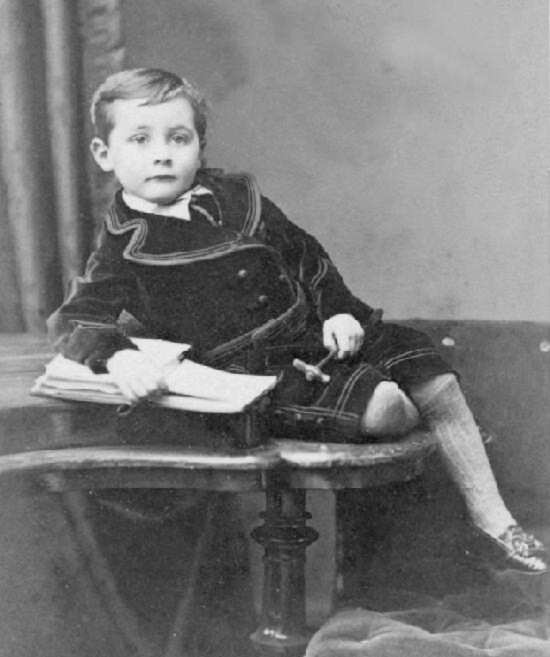
Figure 1.--This Scottish boy wears a velvet suit with detailing influenced by sailor styling. The boy is Sidney Harvey Burnett who was photographed during March 1872 in Aberdeen, Scotland. He looks to be about 4 or 5 years old. Click on the image for further details. Image courtesy of the MD collction.
|
|
British attitudes toward kilts changed significantly in the late-18th and early-19th centuries. Romantic poets and authors like Burns and Scott had a great impact on the popular imagination. The performance of kilted Higland
regiments in the Napoleonic Wars also influenced public opinion. One effect of the changing attitude toward Scotland was the renewed wearin of the kilt in Scotland. Laws prohibiting the kilt had been recended in the late 18th Century. II have few details, but I do know that Scottish boys in the early 19th Century did dress up in kilts. Paintings of the era depict boys in kilts for church and other dress occasions. I am not sure if the kilt was perceived as a boys' style at
this time. I also do not know if they were also worn for other activities such as school or play. If readers have any infornation on this subject, I'd appreciate any contributions. The major moving influence in establishing the kilt as boys' clothes for English and eventually american boys was Queen Victoria who was fascinated by Scotland. She built a royal estate at Balmoral which is still a favorite of Queen Elizabeth today. The Queen outfitted the steadily growing number of young princes in picturesque kilts. I am not sure if she just picked up on a fashion of the time or the clothes she saw when visitin Balmoral. Scottish boys were wearing the kilt in the early 19th Century, but I'm unsure
as to how commonly. Perhaps outfitting the princes was an idea she conceived herself. Hopefully some of our British observers will provide some information on this. Wheather or not Victoria conceived the idea herself, the impact of her decision is apparent. Suddenly the kilt rather than being a symbol of resistance to England was endorsed by the Queen. Royal children ever since have been outfitted in kilts. (Notably Prince William and Harry do NOT appear in kilts even when visiting Balmoral. Although they did wear kilts 'as young boys on extremely rare occasions. Their father Prince Charles, however, was often dressed in a kilt and still wears one at Balmoral. Presumably they don't like the idea of continuing the Royal tradition.) With the Queen's approval, the kilt was surely seen much more in Scotland, including on boys and at school. If some mother's had dressed boys in kilts before the mid-1800s, after Victoria's example, the kilt became a major boys' fashion for dress wear. However how extensive the kilt became as an article of boys clothes I do not know. Nor am I certain just how the kilt was worn. Was it just for formal dress occasions, or was it worn as casual wear as well. It is likely that most Scottish boys dressed much like their English cousins.
Economic Situation
Scotland made enormous economic progress in the 19th cdentury. There was substantial economic expansioj in the major cities. The economic progress was not shared throughout Scotland. Considerable poverty continued in the Highlands and Islands. Poverty of course affects the clothing purchsed for children. We have not yet, however, fully assessed the impact of these economic trends on Scottish boys' clothing.
The decade trends in Scotlands are very simolar to those we notice in England. There were differences, l;argely the result of the greater prosperity prevalent in England. There were also ethnic stles like kilts worn in Scotland. We notice, for example, more children gping brefoot in Scotlands. We think this was very common in the early-19th century. We still notice three-cornered hats and knee breeches in the early-19th century. Gradually long pants became common for boys. This transitiion was more rapid for boys than youths and adult mens. The early 19th century was dominated by long pants skeleton suits and tunics. We are not sure about kilts. We believe that they were rather rare in the Lowlland, but we are less sure about the Higlands. Many were comfortable loose fitting garments. There were major changes at mid-centurty as new styles inspirred by Queen Victoria began to tale hold like sailor suits and kilts. The tightly buttoned Eton collar replaced ruffled collars and kneepants and knickers replaced long pants. The comfortable styles of the early decade had become much more restrictive as well as more elaborate--culminating with the Fauntleroy suit of the 1880s. English boys throughout the 19th Century wore dresses as little boys. Styles were quite similr to those worn by their sisters in the early part of the century, but became more plain by the end of the century. The dresses followed the styles of the day, very long at the beginning of the century and becoming shorter as the century progressed. Shorter dresses were worn discreetly with pantalettes. Dresses were often worn with pinafores by both boys and girls, although only younger boys wore them. Pinafores became less common for younger boys by the end of the century. I am not sure how common smocks were in Scotland. We do notoice them being worn, but our archive is still very limited. The boys' style most associated with this period is the skeleton suit which dominated bous fashions in the first three decades of the century. Tunics were another popular style. We assume that trends were similar in Scotlnd to England, but we can not yet confirm this. It was in the Victorian age that many modern social values as wll as modern fashions began to appear and Queen Victoria and her family was at the center of it all. Fashionable English boys at the turn of the Century wore skeleton suits and tunics. Younger boys wore pantalettes, older boys long trousers. Major changes occurred during the Vicorian Era. The young Queen and her engaging family popularized the sailor suit and kilt which were to become major fixtures of the 19th century boys' wardrobe. After mid-century knickers and kneepants became more common. The Eton collar became the standard dress for formal occasions. Major societal changes were at work in the Victorian era. We see knee pants and knickers at mid-century, although mostly for younger boys. They gradually grew in popularity for the rest of the century. We notice Fauntleroy styles in the late-19th century. We note some boys wearing kilt outfits when dressing up in the late-19th century. We are less sure how common they were for casual wear.
Garments
The garments worn by Scottish boys in the 19th century were essentially the same as those worn by English boys. This included all tghe basic types of garments. Climate and economics did create some differerences. The basic difference was the kilt, but even here the difference was not as sharp as might be expected. As a result of Queen Victoria and literary figures, Scotland and things Scottish became popular in England. So after mid-century, we see some English boys being dressed up in kilts, incvluding Higland outfits. Some Scottish boys, especially in the Highlands may have worn kilts casuallyv which was not the case in England. r
Sailor suits
Scottish boys like English boys wore silor suits in the 19th century. We do not note any differences between the sailor suits worn in Scotland and those on in England. The sailor suit, however, does not appear to have been as popular in Scotland as it was in England.
Trousers
We are unsure about the style of trousers worn by Scottish boys in the early 19th century. We ote that many Scottih boys were wearing kneepants by the mid-19th century, especially boys from affluent families. We are less sure about working-class boys.
Kilts
British attitudes toward kilts changed significantly in the late-18th and early-19th centuries. Romantic poets and authors like Burns and Scott had a great impact on the popular imagination. The performance of kilted Higland
regiments in the Napoleonic Wars also influenced public opinion. One effect of the changing attitude toward Scotland was the renewed wearin of the kilt in Scotland. Laws prohibiting the kilt had been recended in the late 18th Century. II have few details, but I do know that some Scottish boys in the early-19th Century did dress up in kilts. Paintings of the era depict boys in kilts for church and other dress occasions. I am not sure if the kilt was perceived as a boys' style at this time. I also do not know if they were also worn for other activities such as school or play. If readers have any infornation on this subject, I'd appreciate any contributions. The major moving influence in establishing the kilt as boys' clothes for English and eventually American boys was Queen Victoria who was fascinated by Scotland. She built a royal estate at Balmoral which is still a favorite of Queen Elizabeth today. The Queen outfitted the steadily
growing number of young princes in picturesque kilts. I am not sure if she just picked up on a fashion of the time or the clothes she saw when visitin Balmoral. Scottish boys were wearing the kilt in the early 19th Century, but I'm unsure
as to how commonly. Perhaps outfitting the princes was an idea she conceived herself. Hopefully some of our British observers will provide some information on this. Wheather or not Victoria conceived the idea herself, the impact of her decision is apparent. Suddenly the kilt rather than being a symbol of resistance to England was endorsed by the Queen. Royal children ever since have been outfitted in kilts. (Notably Prince William and Harry do NOT appear in kilts even when visiting Balmoral. Although they did wear kilts 'as young boys on extremely rare occasions. Their father Prince Charles, however, was often dressed in a kilt and still wears one at Balmoral. Presumably they don't like the idea of continuing the Royal tradition.) With the Queen's approval, the kilt was surely seen much more in Scotland, including on boys and at school. If some mother's had dressed boys in kilts before the mid-1800s, after Victoria's example, the kilt became a major boys' fashion for dress wear. However how extensive the kilt became as an article of boys clothes I do not know. Nor am I certain just how the kilt was worn. Was it just for formal dress occasions, or was it worn as casual wear as well. It is likely that most Scottish boys dressed much like their English cousins.
Other garments
There appear to be little difference between the other garments worn by Scottish and English boys, but our information on 19th century Scotland is still rather limited. The clothes worn by boys from aflluent families in particular appear very similar to English styles.
HBC

Navigate the Boys' Historical Clothing Web Site:
[Return to the Main Scottish page]
[Introduction]
[Activities]
[Bibliographies]
[Biographies]
[Chronology]
[Clothing styles]
[Countries]
[Contributions]
[FAQs]
[Glossaries]
[Images]
[Links]
[Registration]
[Boys' Clothing Home]
Navigate the Boys' Historical Clothing kilt pages:
[Main kilt page]
[Kilt suits]
[Scottish kilts]
[Scottish boys clothing]
[Scottish school uniform]
[Highland dance]
[Pipeband]
[Irish kilts]
[Irish boys clothing]
[Irish step dancing]
[Greek kilts]
Created: April 22, 2002
Last updated: 5:38 AM 8/22/2011